
Star Google AI Researcher Shazeer Joins OpenAI
Serge Bulaev
Noam Shazeer, a well-known AI researcher from Google and co-author of the Transformer paper, has joined OpenAI after about twenty years at Google. His move comes during a time when several top researchers are leaving Google DeepMind, raising questions about how AI companies keep their talent. Reports suggest Shazeer will work on model architecture at OpenAI, which may help make their AI systems more efficient, but details about his project are not clear yet. This change shows that big AI labs are actively competing for experts, and it is not certain if Google's current team can make up for losing Shazeer.

Noam Shazeer, a vice president of engineering and Gemini co-lead at Google, said in June 2026 that he would leave Google to join OpenAI. His move highlights an escalating race for top-tier talent among frontier AI labs and raises questions about talent retention at Google DeepMind. The Information reports that CEO Sam Altman personally recruited Shazeer, signaling his strategic value in developing next-generation AI systems beyond GPT "Star Google AI Researcher Shazeer Joins OpenAI". Shazeer's departure illustrates how the intense competition for elite LLM architects is reshaping the landscape of leading AI organizations.
Why Shazeer's Track Record Matters
Noam Shazeer's track record is significant due to his foundational contributions to modern AI, including co-authoring the Transformer paper and developing technologies like Mixture-of-Experts. His work has directly enabled today's large language models by improving their scale, efficiency, and performance, making him a pivotal figure.
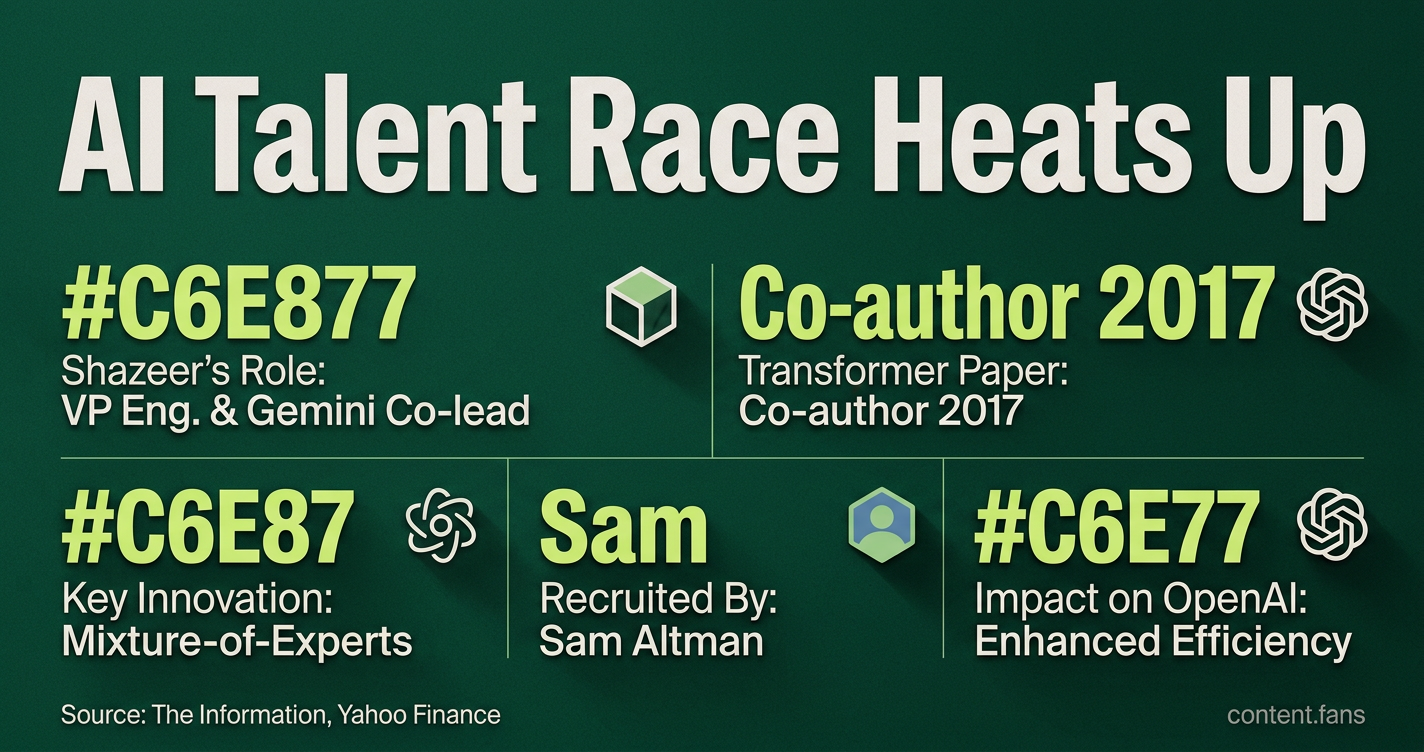
As a co-author of the pivotal 2017 Transformer paper, Shazeer's work forms the bedrock of modern large language models. His official Google Research profile documents a history of breakthrough contributions that have demonstrably lowered training costs and massively expanded model scale. Key innovations include:
- Sparsely-gated Mixture-of-Experts (MoE) layer (2016-2017): A technique later adopted by other major labs.
- Mesh TensorFlow (2018): A framework for training giant models at supercomputer scale.
- T5 Model (2019): An influential model that reframed NLP tasks as text-to-text problems.
His departure comes despite Google reportedly implementing significant retention packages, signaling that even substantial financial incentives may not be enough to retain top-tier talent.
Signals in the Cross-Lab Talent Race
Shazeer's move is part of a broader trend of high-stakes talent migration among elite AI labs. Nobel laureate John Jumper also left Google for Anthropic around the same time period. This follows earlier moves, such as Jan Leike and John Schulman's 2024 departure from OpenAI to Anthropic. Observers note this is less about one-way poaching and more of a "revolving door" between Google, OpenAI, Anthropic, and Meta.
OpenAI's strategy appears twofold: acquiring top architects like Shazeer for future models while also rehiring veteran talent like Barrett Zoph, Luke Metz, and Sam Schoenholz to preserve institutional knowledge, as reported by Yahoo Finance.
Potential Uplift for OpenAI
While Shazeer's specific project at OpenAI remains confidential, analysts suggest his expertise in sparse model architectures could dramatically enhance efficiency. According to industry reports, applying his knowledge to OpenAI's Mixture-of-Experts (MoE) systems could potentially reduce computation costs significantly. Such efficiency gains would directly benefit OpenAI's product roadmap, enabling more powerful and cost-effective versions of ChatGPT and its enterprise APIs. Furthermore, hiring seasoned researchers shortens development cycles, as they are already familiar with the company's technical stack and can rapidly integrate with safety and deployment teams.
What Google Retains
Despite this high-profile departure, Google DeepMind retains a formidable roster of talent, including original Transformer co-authors like Aidan Gomez and Jakob Uszkoreit, alongside the dedicated Gemini-Ultra team. Google leadership emphasizes that its architectural knowledge is distributed across multiple teams to ensure continuity. However, the successive losses of Shazeer and Jumper have reportedly sparked internal debate and morale concerns about Google's ability to provide rapid research-to-deployment pathways, according to reports from Chosun Ilbo.
Ultimately, the next year will reveal whether Shazeer's expertise accelerates OpenAI's model development timeline or if Google's robust Gemini roadmap can compensate for the loss. For now, the hiring patterns confirm a high-stakes competition where leading labs trade senior talent for incremental advantages measured in development time, compute efficiency, and performance benchmarks.
Who is Noam Shazeer and why is his move to OpenAI significant?
Shazeer is best known as a co-author of the 2017 paper "Attention Is All You Need", the seminal work that introduced the Transformer architecture. During his years at Google he also led development of the sparsely-gated Mixture-of-Experts layer (2016-2017), created Mesh TensorFlow (2018) for large-scale training, and contributed to T5 (2019) and LaMDA. With this track record, his arrival at OpenAI is expected to accelerate next-generation model design and post-GPT-5 architecture work.
How does this hiring fit the wider AI talent shuffle?
The move is part of a "revolving door" among elite labs:
- June 2026: Shazeer (Google → OpenAI) and John Jumper (Google DeepMind → Anthropic) announced departures around the same time
- 2024-2025: Jan Leike and John Schulman left OpenAI for Anthropic
- Recent years: Meta has attracted many senior researchers from OpenAI, Google DeepMind and Anthropic for its super-intelligence push, while OpenAI has re-hired several former leaders who had joined Mira Murati's Thinking Machines Lab
In total, sources identify a significant number of marquee researchers who have changed affiliations between Google, OpenAI, Anthropic and Meta in recent years.
What concrete impact could Shazeer have inside OpenAI?
According to reporting by GetAIBook, OpenAI has assigned Shazeer as "Lead for Architecture Research", tasking him with designing the roadmap for models beyond GPT-5. Given his prior inventions, his expertise will likely focus on:
- New scaling laws that exploit sparse expert routing
- Training efficiency gains through improved distributed-system design
- Faster iteration cycles from research insight to production-ready checkpoints
Early estimates from industry recruiters suggest this single hire could significantly compress OpenAI's next-architecture timeline.
How does Google respond when star researchers leave?
Google has implemented substantial retention efforts to bring back key talent, including significant financial packages. After recent exits, industry reports note that Google has:
- Elevated Jeff Dean to a broader oversight role
- Fast-tracked internal grant programs worth significant amounts to retain remaining leads
- Expanded equity refresh cycles for top AI staff
Despite these steps, recruiting firms report that Google's attrition rate among principal-level AI researchers has increased in recent years.
What does the hiring spree mean for OpenAI's product timeline?
OpenAI is simultaneously expanding its workforce and narrowing the gap between research and product delivery. Recent staffing moves point to three parallel tracks:
1. Architecture Research (Shazeer) for long-horizon breakthroughs
2. Post-Training & Safety (returnees from Thinking Machines and ex-Meta leads) for near-term quality gains
3. Enterprise & Sales (significant new hires) to convert models into revenue
If the roadmap stays on schedule, industry reports point to:
- GPT-4.5-style mid-generation update expected in the coming quarters
- Next-architecture flagship model anticipated for mid-2026, with early enterprise beta programs starting shortly after research completion
The message to the market is clear: OpenAI is building both the lab and the factory at the same time.