
Anthropic cuts Claude Opus 5.5 pricing to $4 per million input tokens
Serge Bulaev
Anthropic has lowered the price for Claude Opus 5.5 to $4 per million input tokens. The company provides a seven-step checklist to help teams set up and use Claude effectively, suggesting that careful preparation may improve results. The checklist includes setting clear goals, picking the right model, managing privacy, adding tool connections with approvals, creating reusable prompt skills, running tests, and monitoring early use. Guidance from experts and official documents appears to stress privacy, security, and careful rollout. Following these steps might help teams get reliable and safe outputs from Claude Opus 5.5.

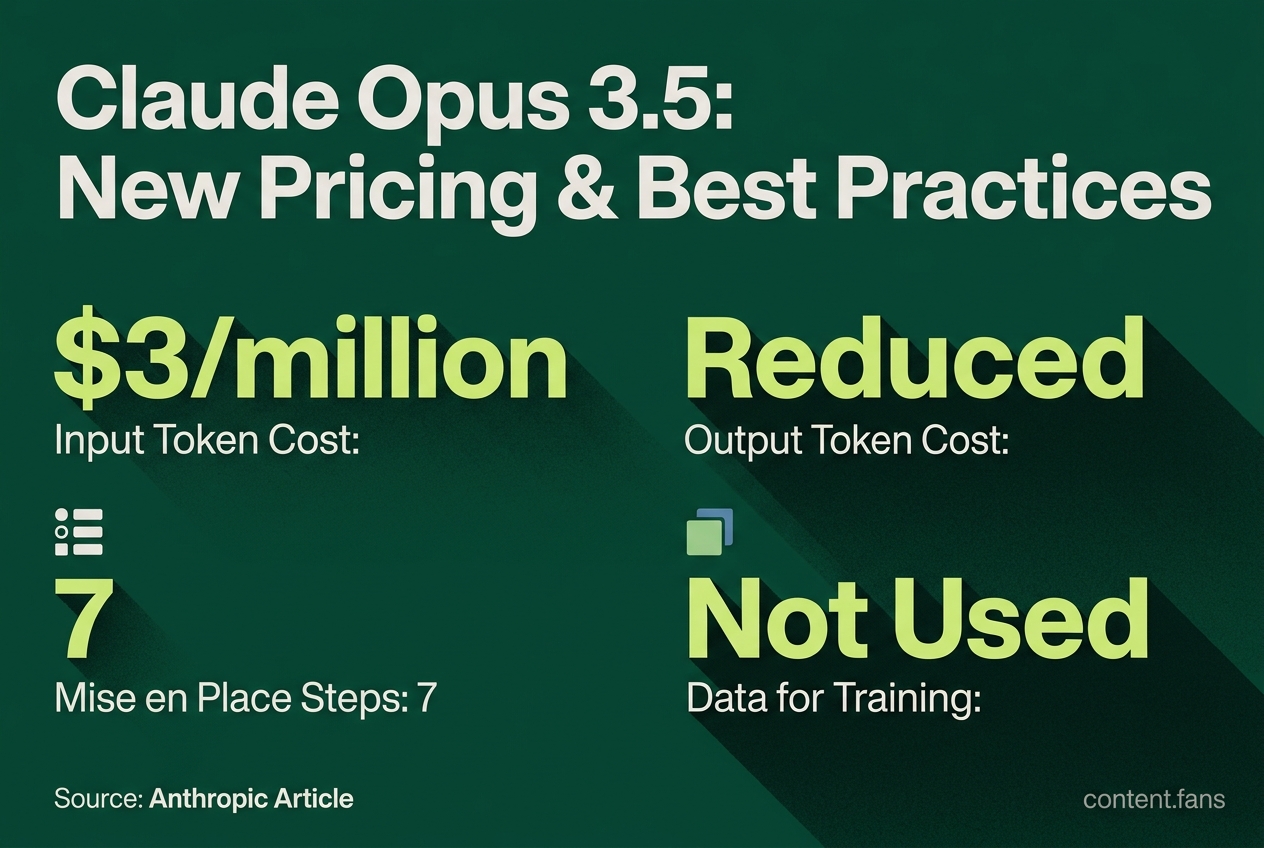
Anthropic has updated its Claude Opus 3.5 pricing, cutting costs to $3 per million input tokens. To maximize value from this change, teams can follow a seven-step 'mise en place' checklist for disciplined AI deployment. This structured framework ensures organizations achieve reliable and secure results by prioritizing governance and careful preparation.
The 'mise en place' methodology, borrowed from professional kitchens, has become a best practice for disciplined AI implementation. This step-by-step prep list keeps teams focused on foundational setup rather than chasing complex prompts. The following seven stations combine official guidance on Claude Opus 3.5 with forward-looking governance principles to help you reproduce dependable results.
Station 1: Print the ticket (context)
Begin by creating a clear system message defining the goal, audience, output format, and key constraints. While Opus 3.5 offers a large context window, clarity remains more critical than volume. The model features adaptive thinking capabilities and can generate substantial output tokens, improving coherence for long tasks. Use the large window to provide complete source documents rather than making the model infer details.
To achieve consistent and usable outputs from Claude Opus 3.5, focus on systematic preparation before generating content. This 'mise en place' approach emphasizes defining clear context, implementing security controls, and running structured tests. This disciplined setup is more effective than simply adjusting model settings for performance.
Station 2: Pick the Team plan and model
Team workspaces automatically use the latest Opus 3.5 engine. The model overview confirms the new pricing structure with reduced rates for both input and output tokens. For initial drafts, keep the per-message effort set to 'medium', as higher effort settings rarely improve quality and can increase latency and cost.
Station 3: Flip privacy and memory switches
By default, Anthropic does not use Team plan data for model training. Workspace owners can enable memory for Claude to recall previous conversations, but be aware that deletion is permanent and immediate. For security, restrict memory to channels with a documented data retention schedule. Following enterprise best practices involves encrypting prompts and logs at rest.
Station 4: Add connectors with approvals on
Before integrating Claude with tools like email, code repositories, or ticketing systems, configure every tool to require human approval for any action that writes, deletes, or posts data. While Anthropic includes a safety classifier, manual sign-off is a crucial defense against prompt injection and unintended actions. Use a dedicated service account for connectors to ensure audit logs clearly trace the origin of each command.
Station 5: Write reusable skills
Skills are standardized, reusable prompt snippets for recurring tasks like 'summarize a pull request' or 'draft a Jira comment.' Store these skills in a shared, version-controlled repository. Naming each skill and its inputs clearly simplifies future prompts and enables controlled, predictable automation.
A compact starter set:
- Summarize meeting transcript into bullet actions
- Rewrite text to plain-language grade 8
- Extract entities into JSON schema
- Generate unit tests from code patch
- Draft stakeholder update in 150 words
Station 6: Run three test orders
Dedicate at least 20 minutes to hands-on testing with three representative tasks: one easy, one average, and one complex edge case. This process helps identify potential hallucinations or performance issues early. Record key metrics like latency, token cost, and the number of revisions needed. This data serves as a baseline governance artifact, proving the model met acceptance criteria before a wider rollout.
Station 7: Open for first service
After completing the previous six preparation steps, invite a small pilot group to begin using the model. During the first week, monitor daily for performance drift, bias, or security events. Implement alerts that trigger if response lengths exceed policy or if quality scores drop below your established baseline. Once the service proves stable for a week, you can scale the deployment to the broader team using the same controls.