
SpaceX targets $1.77 trillion IPO, unveils AI data center plan
Serge Bulaev
SpaceX plans to go public with a target value of up to $1.77 trillion, which may make it the largest IPO ever. This offering could make Elon Musk the world's first trillionaire and would move SpaceX ahead of companies like Meta and Walmart by market value. Some analysts believe the IPO price may be too high and warn that share values might drop after the stock starts trading. SpaceX is also exploring turning satellites into AI data centers in space, but this idea appears early and faces big technical and economic challenges. If the IPO goes ahead, it could shift stock market indexes and affect many retirement funds, but there may be big price swings after the launch.

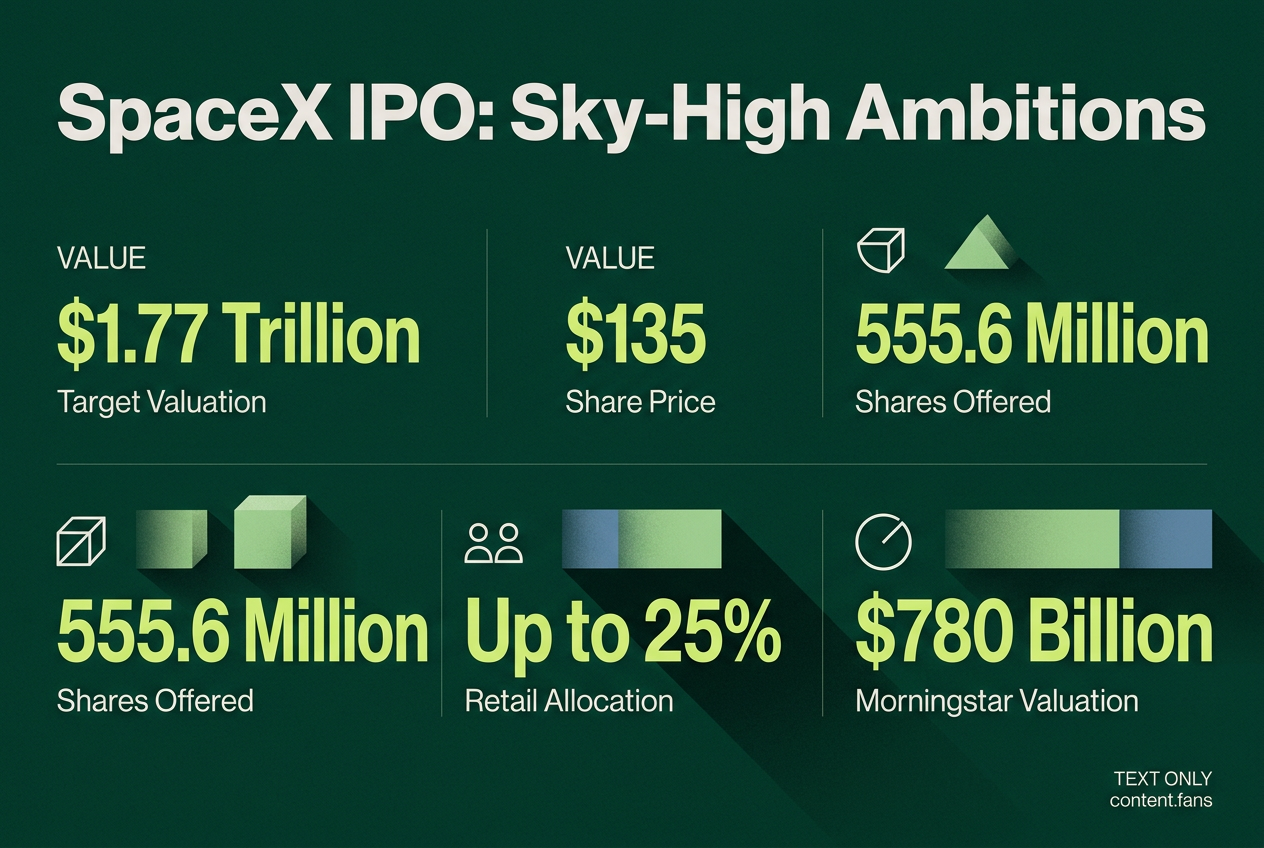
Reports suggest the upcoming SpaceX IPO is targeting a landmark $1.77 trillion valuation, an offering that could become the largest in history and make Elon Musk the world's first trillionaire. This valuation, based on a reported price of $135 per share, would position SpaceX's market capitalization ahead of giants like Meta and Walmart Guardian. While subject to market conditions, the historic transaction is poised to reshape major stock indexes and increase the average investor's exposure to the aerospace sector.
However, some analysts view this target with caution. Citing a discounted cash-flow analysis, Morningstar values SpaceX at approximately $780 billion, labeling the potential IPO price "significantly overvalued." The firm warns that the stock could face valuation compression after its public debut Morningstar. Earlier reports from Reuters noted that advisers were targeting a valuation closer to $1.5 trillion, with plans to raise up to $50 billion in primary proceeds.
IPO scale and retail allocation
SpaceX is reportedly planning to float 5% to 6% of the company in its initial offering, aiming to raise between $50 and $75 billion. A notably large portion, up to 25% of the deal, may be allocated directly to retail investors, far exceeding historical norms.
According to the Financial Times, SpaceX is considering a retail allocation of up to 25% on a potential $75 billion float, dwarfing the typical 5-10% share for retail investors in mega-IPOs. While IPO analyst Jay Ritter notes that stocks debuting at high multiples often underperform the market over a three-year period, the significant demand and limited initial float - less than 6% of total shares - could help sustain the price during the initial trading weeks.
• Key sizing numbers:
- Offer size: 50 billion to 75 billion dollars (various filings)
- Stated price: 135 dollars a share
- Shares offered: 555.6 million
- Implied valuation: 1.5 trillion to 1.78 trillion dollars
- Retail allocation: up to 25 percent of the deal
SpaceX set to IPO with $1.77 trillion target and the orbital data center pitch
A key part of the company's valuation narrative is its ambitious plan to convert low-Earth orbit into a platform for artificial intelligence computing. A January 2026 FCC filing detailed a proposed network of up to one million satellite nodes acting as distributed data centers. However, company statements cited by Reuters confirm the project is in a "nascent phase" and faces significant technical and economic challenges, including debris mitigation, radiation-hardened hardware, and uncertain commercial viability Reuters. Despite this, Elon Musk has promoted the concept, arguing that space-based advantages like continuous solar power and radiative cooling could eventually make it a cost-effective location for AI tasks.
Index and household finance ripple effects
A successful listing of this magnitude would have significant market-wide consequences. According to MSCI research, SpaceX's inclusion in major benchmarks would force passive funds to rebalance, triggering billions of dollars in automated buying. This could increase the technology and industrial sector weights in diversified retirement portfolios, concentrating risk in Musk-led enterprises. For individuals, the large retail tranche offers early access but also direct exposure to the price volatility common with high-valuation IPOs. Morningstar reinforces this, noting that pullbacks are common when IPOs debut at the upper limits of analyst models. The sheer size of the deal was likened by The Guardian to "dropping a boulder in a kiddie pool," highlighting the potential strain on market liquidity and capital.
What valuation is SpaceX reportedly targeting for its IPO, and how does it compare to today's public giants?
SpaceX is widely reported to seek a valuation of about $1.77 trillion when it lists in mid-2026. At that level, the company would immediately rank inside the global top 10 by market cap, eclipsing Meta (≈ $1.2 T) and Walmart (≈ $0.7 T). A $135 per-share price on 555.6 million shares is the structure most often cited by The Guardian and Barron's.
How might the IPO create the world's first trillionaire?
Elon Musk owns a majority of the pre-IPO equity, and if the public market awards the company the $1.77 T figure, his paper net worth would exceed $1 trillion for the first time in history. The pass-through hinges on the conversion of his privately held shares into public equity at the IPO reference price.
Is the $1.77 T figure universally accepted by analysts?
No. Morningstar's discounted-cash-flow model values the company at $780 billion, roughly half the IPO target. Analysts there describe the $1.5 T - $1.78 T range as "significantly overvalued" and warn investors to expect volatility or lower entry prices once trading begins.
What is SpaceX's long-term plan for AI infrastructure in space?
The company claims it will launch up to one million satellites as an orbital data-center constellation to power AI workloads. Key highlights:
- Filed a January 2026 FCC application for orbital compute nodes using continuous solar power
- Targets 500 - 2,000 km low-Earth orbits connected by laser links
- Admits the architecture is nascent and commercially unproven, with unresolved thermal control, radiation hardening, and debris risk
How could a 25 % retail allocation in the IPO affect everyday investors?
- Direct exposure: SpaceX has reserved up to 25 % of a $75 billion float for retail buyers, a record share for a megacap IPO.
- Indirect exposure: Once the stock enters indexes like the S&P 500, every 401(k) or index fund will automatically gain weight in SpaceX, possibly raising technology-sector tilt and triggering rebalancing costs that show up in lower net fund returns.
- Return risk: IPO expert Jay Ritter cautions that high-valuation IPOs often underperform for three years, so retail buyers risk entering near a short-term peak while retirement savers absorb the same risk passively.