
SpaceX S-1 Shows Starlink Leads Revenue, Starship Still Costly
Serge Bulaev
SpaceX's S-1 filing suggests that Starlink is the main source of company revenue, while Starship development is still expensive and not yet fully reusable. Most of SpaceX's money is going into satellites rather than rockets, and Starlink brought in about three-quarters of the company's income in 2025. Partial reuse of Starship might still help lower satellite launch costs, but there are still many uncertainties, like proving Starship can be reused reliably and quickly. SpaceX's future profits may depend on how fast Starship becomes less costly to operate and how well Starlink keeps growing.

The SpaceX S-1 filing shows Starlink leads revenue streams while Starship development remains costly and its full reusability unproven. The financial disclosures and recent test flights outline a pragmatic strategy that could deliver lower launch costs for the Starlink constellation, even if full, rapid reuse of the launch system stays elusive for now.
Where Starship stands in May 2026
According to industry reports, Starlink is SpaceX's primary revenue driver, funding much of its operations. Meanwhile, the Starship program is a significant capital expenditure, with its path to profitability dependent on achieving reusability milestones that would, in turn, reduce Starlink's own deployment costs.
Money flowing into satellites, not rockets
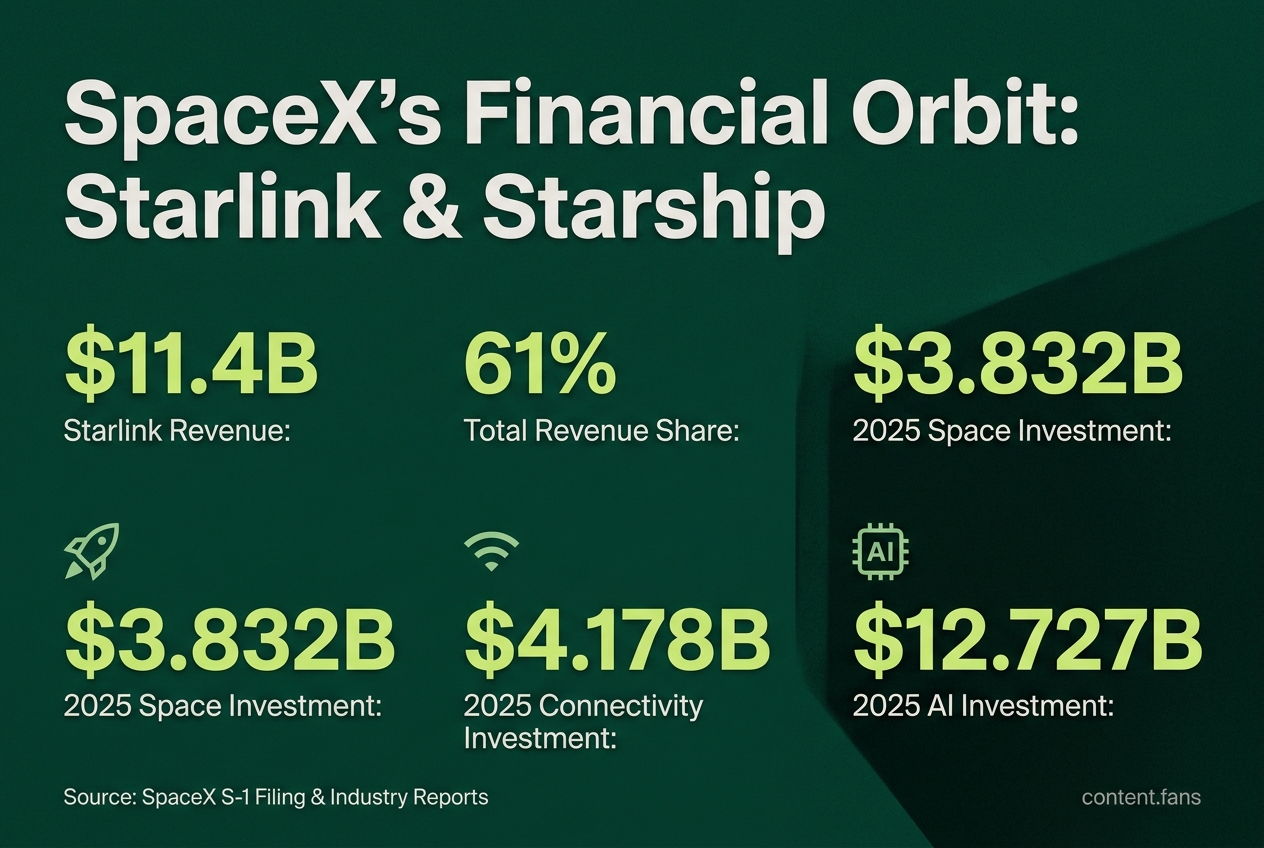
According to the S-1 excerpt, 2025 capital investments were $3.832B in Space, $4.178B in Connectivity, and $12.727B in AI. Starlink's 2025 revenue was estimated at $11.4 billion and represented about 61% of SpaceX's total revenue according to industry reports. These figures confirm that satellite connectivity, not launch services, is the primary driver of SpaceX's current valuation.
Partial reuse could still cut cost per satellite
Industry reports suggest that full reusability is not essential for economic viability, with various cost scenarios depending on which components are reused. Even partial reuse scenarios are projected to make Starlink deployment highly economical. This is because a single Starship flight can deploy a batch of V2 or V3 satellites that would require multiple Falcon 9 launches. Furthermore, regular replacement of a significant portion of the satellite constellation is crucial for maintaining service quality, a goal made more achievable with even partial cost reductions.
Business risks highlighted in the S-1
The S-1 filing transparently details several business risks that could impact the financial symbiosis of Starship and Starlink:
- Demonstrating and certifying reliable ship recovery
- Achieving turnaround times short enough to hit the low per-launch cost models
- Maintaining Starlink churn, hardware margins, and government contract share
- Financing concurrent upgrades to ground terminals and orbital hardware
Quilty Space forecasts Starlink revenue at $15.9 billion in 2026 in one reported summary, while a separate Quilty Space model page forecasts $20 billion. Delays in realizing cost savings could necessitate increased capital expenditure or decelerate satellite refresh cycles, potentially compressing EBITDA margins.
What observers watch next
Industry observers and investors are closely monitoring key operational milestones. According to industry reports, SpaceX continues developing its booster catch hardware at Starbase, with the immediate focus on making booster recovery a routine, reliable process. Achieving a consistent cadence in booster recovery, even before mastering upper-stage reuse, will be a critical indicator of how quickly Starship can transition from a major capital expense into a strategic cost-reduction asset for the Starlink program.
How much of SpaceX's revenue is now driven by Starlink?
Starlink delivered an estimated $11.4 - $11.8 billion in revenue during 2025, according to several third-party forecasts and reported disclosures. This represents a significant portion of SpaceX's overall company revenue. Industry reports indicate that Starlink's projected 2026 forecast ranges from $15.9 billion to $20 billion in revenue, underscoring its role as a primary source of profit ahead of any public offering.
Reuters
Has SpaceX achieved full reusability on Starship yet?
No. According to industry reports, SpaceX has successfully recovered the Super Heavy booster on multiple flights, but the Ship upper stage has not yet been recovered operationally. Industry reporting describes recent test flights only as "a step closer to being fully reusable", not as an achieved operational state. The distinction is important: even if recovery happens this year, rapid reuse without major refurbishment remains unproven.
Does an expendable Starship still make Starlink cheaper to deploy?
Yes - but the size of the savings depends on which parts are reused. Industry estimates indicate that even a fully expendable Starship could significantly cut launch costs, while booster reuse scenarios show even greater potential savings. For Starlink, this translates into lower cost per satellite and the ability to launch larger batches even before the upper stage is routinely recovered.
How much has SpaceX invested in Starlink versus Starship since 2023?
According to industry reports, SpaceX has made substantial investments in both the satellite business and Starship development, showing the priority and scale of the Starlink program inside SpaceX.
What happens to Starlink if Starship never reaches full reusability?
According to industry reports, full Starship reusability is "not strictly necessary" to deploy the next-generation Starlink satellites. The business can absorb modestly higher launch costs because Starlink is already profitable on an EBITDA basis today. In practice, Starlink would continue to grow, but the rate of bandwidth expansion and ultimate cost per user could plateau. Starship would still significantly reduce current launch costs, yet the radical cost reductions would remain out of reach until both stages fly again with minimal refurbishment.