
CMS extends Medicare telehealth rules through 2027, but state licenses remain
Serge Bulaev
Medicare has extended flexible telehealth rules through December 2027, making it easier for patients, especially in rural areas, to get care from home. However, doctors still need a license in the state where the patient is located, and there is no single national license. Some bills may create new federal rules, but none have passed yet. Artificial intelligence may help doctors diagnose faster, but it must be used by someone licensed in the patient's state. It is uncertain if Congress will make these changes permanent or if states will simplify their licensing rules.

While CMS extends Medicare telehealth rules through 2027, the move preserves pandemic-era flexibilities without creating a national license. Official guidance confirms that clinicians must still hold a valid license in their patient's state, creating a complex regulatory environment for providers and patients alike. This temporary extension maintains a patchwork system, giving patients continued access while providers monitor approaching deadlines.
The Telehealth Licensing Landscape
Despite federal extensions for Medicare telehealth services, medical licensing remains under state control. Providers must be licensed in the state where the patient is located. While compacts like the IMLC offer a streamlined process for multi-state licensure, no single national or federal license currently exists for telemedicine.
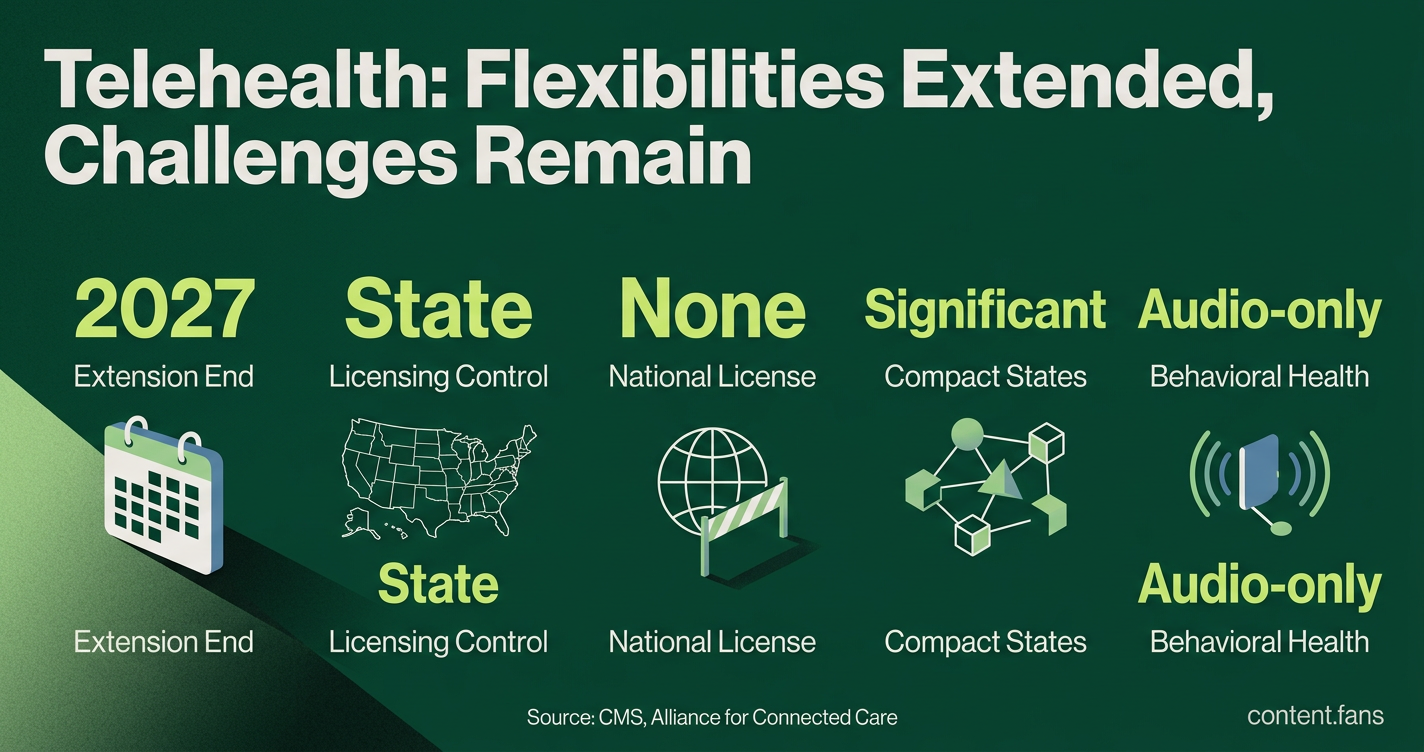
Federal law has not superseded state authority over medical licensing. To practice across state lines, clinicians must secure individual state licenses or use streamlined pathways like the Interstate Medical Licensure Compact, which is active in a significant number of states (Alliance for Connected Care). Several pending federal bills aim to simplify this process, but none have been enacted. These include:
- Advancing Access to Telehealth Act
- Protecting Rural Telehealth Access Act
- A proposed special federal telemedicine registration
As a result, state medical boards remain the primary gatekeepers for licensure. While The Centers for Medicare & Medicaid Services (CMS) has waived geographic restrictions for Medicare telehealth services until December 31, 2027 (CMS FAQ PDF), these rules may revert afterward for non-behavioral care if Congress does not pass permanent legislation.
Impact of the Extension on Rural Patient Access
The extension allows Medicare beneficiaries, particularly those in rural communities, to continue accessing specialist care from home, eliminating the pre-pandemic need to travel to a designated clinic. Coverage for audio-only behavioral health services also continues, providing a vital lifeline in areas with poor broadband. Furthermore, Rural Health Clinics and Federally Qualified Health Centers can act as distant care sites, helping to address provider shortages.
However, administrative burdens temper these benefits. Securing and maintaining multiple state licenses is costly and time-consuming. Malpractice insurance limitations can also lead hospitals to deny multi-state practice requests. One effective workaround is credentialing by proxy, which allows a rural hospital to accept a distant-site hospital's credentialing, reducing approval times from months to weeks.
AI in Diagnostics and the Licensure Challenge
As the policy debate over licensing continues, health systems are increasingly integrating artificial intelligence (AI) into clinical workflows. While AI shows promise in cancer screening and efficiency, the specific claim of 'over 90% reduction in diagnostic time for bone metastasis' cannot be verified from the provided search results (NIH PMC study).
Successfully embedding these algorithms into EHRs requires careful data mapping, identity management, and protocols for system downtime. Gaining clinician trust is also a significant hurdle, which is being addressed through the development of explainable AI (XAI) that clarifies how models arrive at their conclusions.
This technical integration intersects with regulatory uncertainty. Because an AI-generated diagnostic report must be interpreted by a clinician licensed in the patient's state, state-by-state licensing rules can disrupt automated, cross-border care workflows. While experts propose a national telemedicine registry to solve this, it remains a concept.
The extension until late 2027 provides a critical window for action. The future of telehealth access depends on whether Congress will make these Medicare flexibilities permanent and if states will harmonize licensing rules to support the growing reality of multi-state, AI-enhanced healthcare delivery.