
SpaceX Acquires Cursor for $60 Billion, Gains Colossus Supercomputer Access
Serge Bulaev
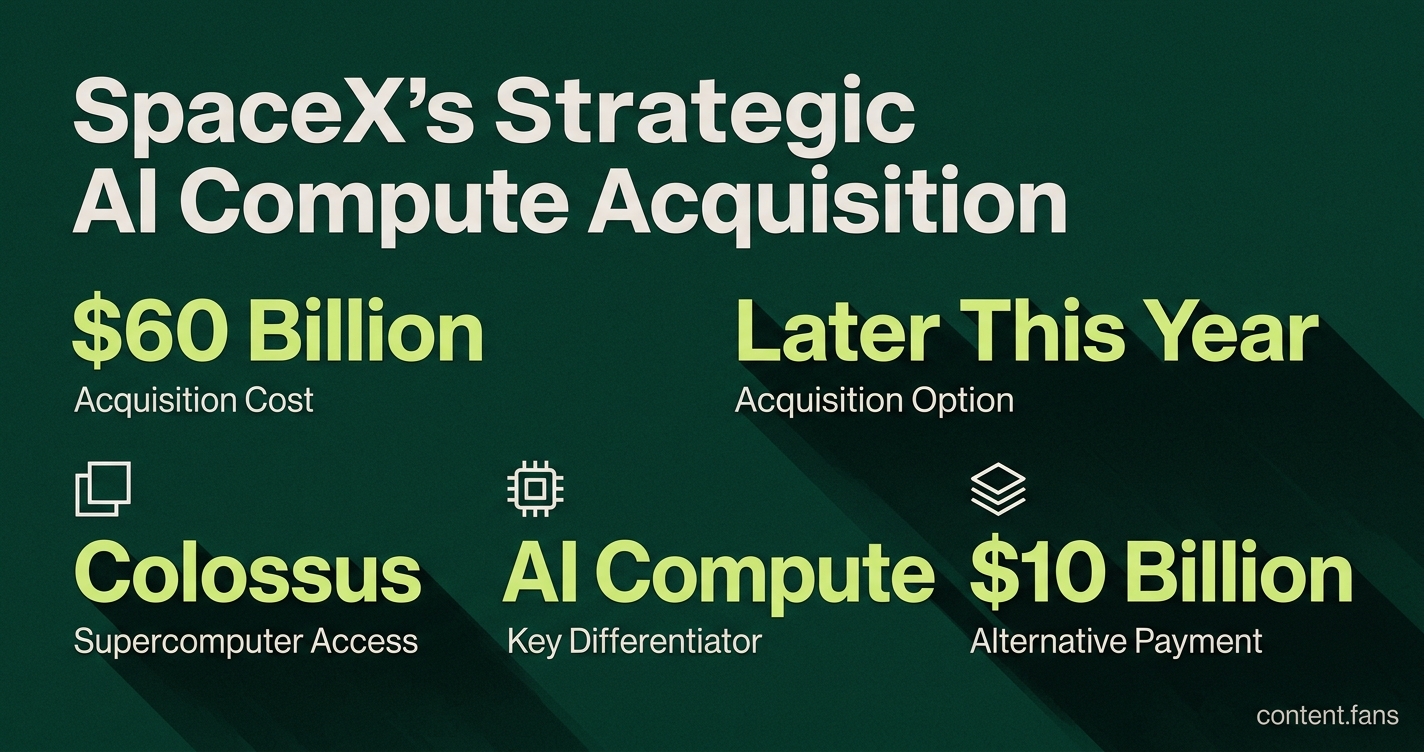
SpaceX decided in April 2026 to get an option to acquire Cursor for $60 billion, which may give it access to the Colossus supercomputer with about 200,000 Nvidia GPUs and plans for many more. This deal appears to help Cursor go past its old scaling limits and might let SpaceX improve its AI research speed and lower costs. Experts suggest that owning computing power, like Colossus, could shape a company's market share and product choices. There are still questions about the best way to balance ownership, cost, and performance, and boards are advised to check these areas carefully. The location of Colossus in Tennessee suggests companies may choose sites for cheap power and good connections, showing geography still matters.
The news that SpaceX agreed to acquire Cursor for $60 billion later this year underscores a critical shift in corporate strategy: owning AI compute infrastructure is now a key differentiator. The landmark deal gives SpaceX an option to acquire Cursor and access to the Colossus supercomputer, according to industry reports a significant GPU cluster with plans for substantial expansion (TechCrunch). For leadership teams, the message is clear: direct control over GPUs and datacenters is directly linked to research velocity, production latency, and gross margins. This framework provides a board-ready guide for assessing your own compute strategy.
Why the Board Cares About Compute Ownership
Boards now treat AI compute infrastructure as a core strategic asset, not just an IT expense. Direct ownership of GPU clusters can accelerate research and development, improve the performance of production AI models, and offer superior unit economics and gross margins compared to pay-as-you-go cloud services.
The three primary business drivers for owning compute are:
- Accelerated R&D: For Cursor, access to SpaceX's Colossus cluster removes a scaling ceiling, enabling faster model training and innovation.
- Superior Performance: Owned infrastructure allows for custom network interconnects and fine-tuning that boosts performance for latency-sensitive applications, an advantage public clouds may not offer.
- Improved Unit Economics: At high, sustained utilization, the cost of amortizing owned hardware can be significantly lower than paying for cloud instances, directly improving gross margins.
As AI infrastructure company Lambda notes, compute is "the backbone of the AI economy," meaning procurement decisions are now product decisions that define what a company can build and at what cost (Lambda homepage).
A Practical Scorecard for Build vs. Buy
To decide between building, buying, or a hybrid compute strategy, executives should evaluate options across key dimensions. A high score for ownership on the following factors suggests building a private cluster is the superior long-term choice:
- Strategic Value: Does owning the infrastructure create a lasting competitive advantage?
- Predictable Utilization: Will your workloads consistently use a high percentage of the cluster's capacity?
- Data & Sovereignty: Are there strict data residency or security requirements that a public cloud cannot meet?
- Integration Overhead: Can your team manage the complexity of integrating and operating the hardware?
- Time-to-Value: How quickly can the owned infrastructure begin delivering returns?
If ownership scores high on strategic value but low on time-to-value, a hybrid approach is often best: rent cloud capacity for immediate needs while planning a private cluster for the next budget cycle.
Geographic Footprint and Strategic Location
Datacenter geography has become a C-suite concern, balancing cost, compliance, and performance. SpaceX strategically located its Colossus cluster in Tennessee to capitalize on inexpensive power and major fiber routes. For companies in regulated sectors, a private or sovereign cloud can satisfy data residency rules, while still allowing teams to use public cloud GPUs for flexible experimentation.
Integrating Hardware and Model Development
A common pitfall is underestimating the "coordination tax" between hardware and AI model teams. The SpaceX-Cursor deal exemplifies vertical integration - placing compute, models, and applications under one roof to align incentives. For enterprises without deep MLOps expertise, a practical alternative is to outsource cluster operations to a vendor like Lambda while retaining high-level architectural control.
Controlling Costs While Fueling Ambition
Effective financial governance is crucial. Modern AI budgets require CFOs to set strict unit-economic targets, sometimes including a "kill switch" to halt projects if per-inference costs become unsustainable. True total cost of ownership (TCO) must account for hidden costs like engineering labor for maintenance and hardware refresh cycles. Only transparent lifecycle costing reveals if an owned cluster is more economical than cloud credits after depreciation.
Governance Checklist for the Board
To ensure compute strategy aligns with business goals, the board should mandate the following:
- Link Compute Spend to Product Margins: Tie all infrastructure investments directly to product OKRs and target profit margins.
- Audit Utilization and Efficiency: Require quarterly reports on cluster utilization and key efficiency metrics like energy-per-token.
- Validate Data Sovereignty Compliance: Regularly review facility locations against all sovereign data and regulatory requirements.
- De-risk Major Capex: Tie any capital expenditure above a predetermined threshold to firm customer commitments or revenue milestones.