
S&P Global warns AI talent export controls hit startups hardest
Serge Bulaev
S&P Global warns that new export controls on AI talent might affect startups the most, as they may face higher compliance costs compared to bigger companies. The report suggests that leaders need to quickly check internal risks, strengthen their technical setups, and engage with policies. Startups may have to focus on hiring locally and making early offers to important foreign staff, since larger companies can handle higher visa costs more easily. Export controls could change how products are developed and may need to be shared with investors. It appears that companies who plan for these changes now could keep running smoothly even if restrictions change.

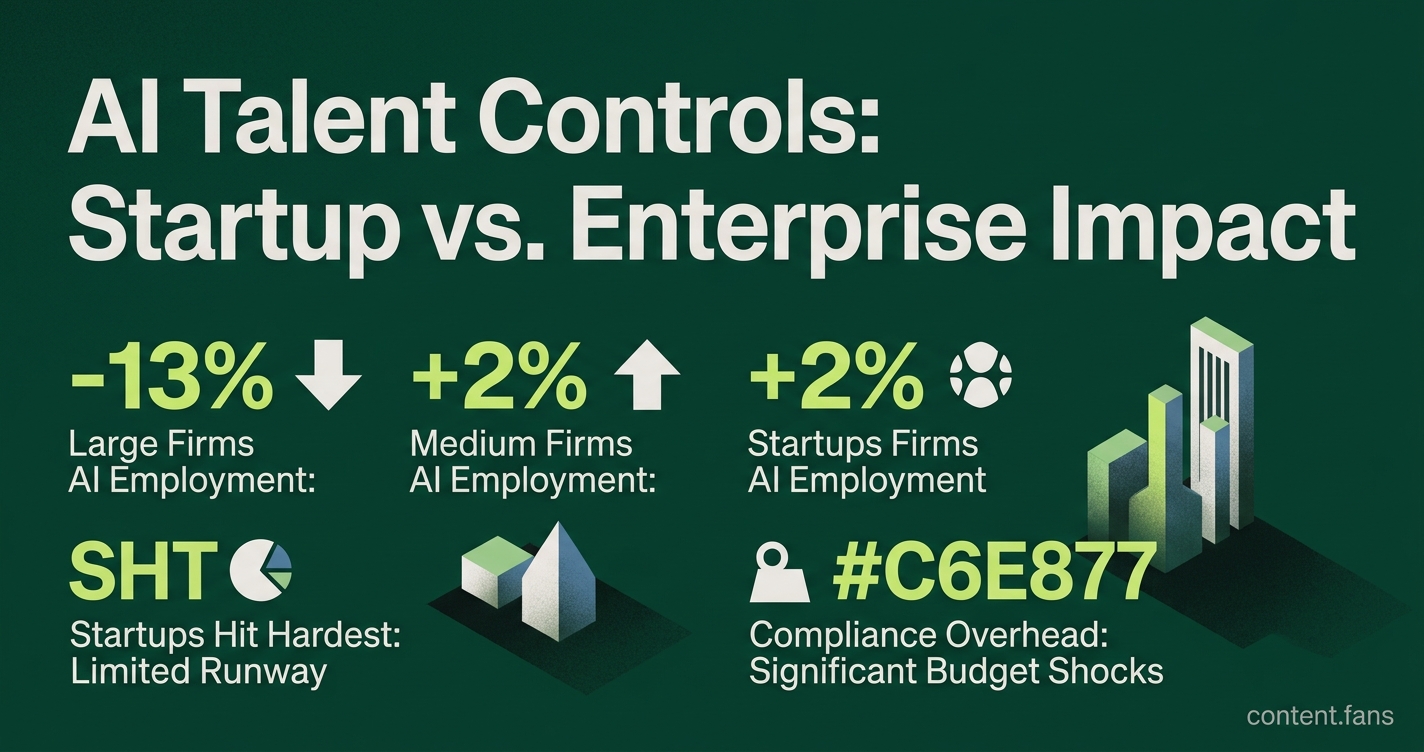
As geopolitical tensions rise, new AI talent export controls are forcing a strategic pivot for companies worldwide. Startups, in particular, face disproportionate challenges. S&P Global's 2026 report says AI's employment impact has turned modestly negative overall, with large companies forecasting a net negative employment impact of -13 percentage points and medium-sized firms a positive +2 points.
To navigate this complex landscape, executives need a comprehensive playbook focused on three critical areas: auditing internal risk, hardening technical infrastructure, and engaging with policymakers.
Near-term actions: map exposure and lock down access
AI talent export controls hit startups hardest due to their limited financial runway. Unlike large corporations that can absorb steep visa fees and compliance overhead, startups face significant budget shocks. These restrictions on accessing global talent can inflate costs, drain resources, and directly threaten their operational viability.
Begin by auditing all personnel, including contractors and service accounts, with access to frontier AI models. It is crucial to identify staff reliant on restricted cloud regions or holding temporary visas, which could become prohibitively expensive under proposed fee hikes according to industry reports (Euronews).
Technically, best practices emphasize a least-privilege access model and geofencing. Following guidance from platforms like MLflow, companies should enforce unique identities, granular role-based access control (RBAC), and immutable logs for quick access revocation. Confining model inference traffic to onshore compute via a policy gateway can also mitigate exposure without reducing staff.
Medium-term design: shore up talent and relocate compute
The S&P Global data confirms that large firms can better absorb rising visa costs, creating a strategic disadvantage for startups. To compete, smaller companies must prioritize building domestic talent pipelines, creating apprenticeships, and making early relocation offers to essential foreign employees. With competitors like China offering attractive multi-year talent visas for AI specialists, as noted by VisaHQ, retention is a significant risk for U.S.-based firms.
The physical location of hardware is equally important. Teams should relocate AI training workloads to domestic data centers that comply with data residency requirements, ensuring prompt logs and other sensitive data remain in a single jurisdiction. Some firms are already separating research and production clusters to prevent experimental model weights from crossing international borders.
Investor and government outreach
Since export controls can fundamentally alter product roadmaps, companies may need to make material disclosures to investors. It is vital to brief stakeholders on contingency plans for issues like licensing delays. For example, according to industry reports, advanced AI models may require U.S. Commerce Department licenses for access by foreign nationals.
Policy teams should coordinate with industry groups on four talking points:
- Estimated job impact across company sizes
- Compliance costs for onshoring compute
- Security gains from identity-based access controls
- Talent mobility pathways that balance security with competitiveness
Proactive engagement is key. For instance, proposed visa reforms in the United Kingdom, including a proposed concierge route for AI experts, demonstrate that governments are receptive to creating targeted talent pathways. Early advocacy can help shape regulatory carve-outs for critical roles, including those in cloud-based research.
Ultimately, the regulations governing AI models and the talent that builds them are converging. By proactively aligning their staffing, infrastructure, and policy advocacy strategies, companies can build resilience and ensure operational continuity as new restrictions emerge.