
Snowflake Unveils CoCo AI Agent Architecture for Enterprises
Serge Bulaev
Snowflake has introduced a CoCo AI agent architecture that may help enterprises build their own in-house AI agents. The design suggests a layered approach, where requests are classified, routed to the best language model, and carefully logged for security and auditing. The system appears to use multiple models, choosing different ones depending on the type and risk of each task. It also emphasizes privacy, cost control, and the need to monitor and evaluate performance. These patterns may help companies stay flexible and secure as their needs change, but success is not guaranteed.

To help enterprises build powerful in-house AI, the Snowflake CoCo AI agent architecture provides a reference design for deploying governed, cost-efficient agents. This technical guide explains how to build a similar system that can orchestrate multiple large language models (LLMs) while enforcing data governance and security. The following sections detail a reference design based on Snowflake's public disclosures and outline the essential controls and patterns for production deployment.
Technical Guide: Building an In-House AI Agent Like CoCo
The architecture is a layered system designed to intelligently manage AI tasks. It classifies requests, routes them to the optimal language model based on risk and cost, retrieves only governed data, executes actions securely, and logs every step for complete auditability and performance monitoring.
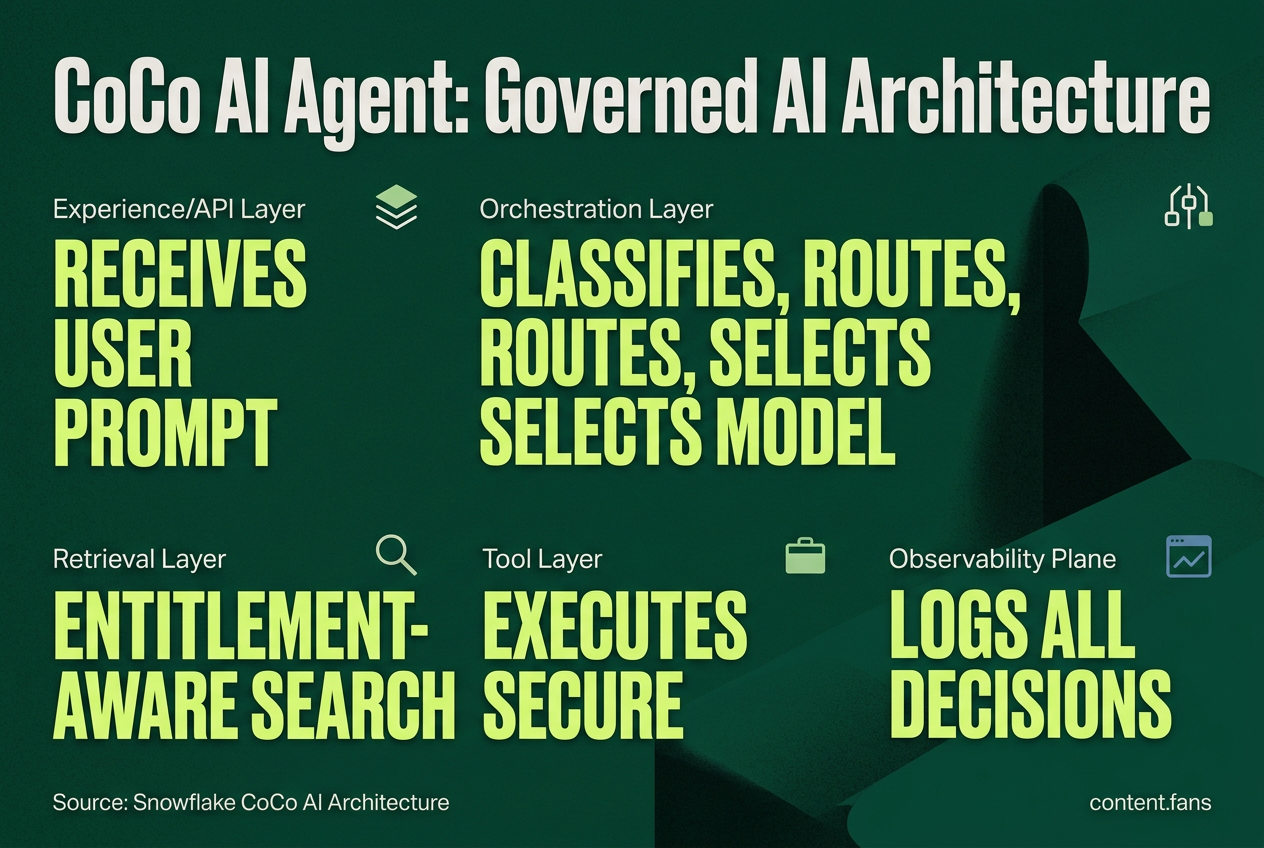
Snowflake describes CoCo as a "Snowflake-Native AI Coding Agent for Data" aware of catalog metadata, lineage, and role-based permissions. This implies a multi-layered stack:
- Experience/API Layer: Receives the initial prompt or task from a user or application.
- Orchestration Layer: Classifies the request, selects the appropriate tool, and chooses the best model.
- Retrieval Layer: Conducts entitlement-aware searches across internal documents and data tables.
- Tool Layer: Executes SQL, Python, or other actions using controlled, secure credentials.
- Observability Plane: Logs every decision and action for comprehensive auditing and replay.
The system's ability to support "multiple semantic models," as seen in Cortex Analyst, is key. This enables the control plane to select the best LLM for any given query, anchoring a multi-model routing pattern essential for balancing latency, cost, and quality.
Model Orchestration and Routing
A typical deployment begins with a simple router that evaluates request intent and risk:
- Low-risk tasks like extraction or formatting are sent to a compact, efficient model.
- Moderate-risk tasks requiring reasoning are handled by a mid-tier model.
- High-stakes or low-confidence requests escalate to a frontier model like Claude Opus 4.7.
Industry reports suggest that intelligent routing systems can significantly reduce token expenditure while preserving output quality. Actual savings will vary based on prompt complexity, cache efficiency, and escalation frequency.
Retrieval-Augmented Generation (RAG) and Privacy Guards
Snowflake's governance framework mandates that AI agents only access data permitted by user entitlements. A production-grade Retrieval-Augmented Generation (RAG) pipeline must therefore incorporate chunking, vector indexing, access control checks, and citation generation. For actions that modify data or access sensitive information, human approval gates remain essential. Enterprises should also implement row-level security, comprehensive audit logs, and pause-resume capabilities to allow for detailed post-hoc investigation of any operation.
Cost Controls and Performance Tuning
A cost-aware control plane is crucial for managing expenses and typically implements four key strategies:
- Prompt compression to eliminate redundant system text.
- Prefix or semantic caching for frequently repeated requests.
- Asynchronous batching for non-interactive jobs, such as embeddings.
- Strict output token limits enforced on every model call.
To maintain efficiency, engineers must monitor metrics like per-feature cost, latency, cache hit rate, and escalation ratio. According to industry reports, this level of visibility often uncovers significant waste from inefficient context usage alone.
Monitoring, Evaluation, and Retraining Triggers
For robust observability, every agent call should generate a detailed trace that includes the selected model, prompt hash, retrieved documents, tool usage, latency, and cost. Offline evaluation processes should continuously score outputs for factual accuracy, policy adherence, and user satisfaction. If performance degrades or costs increase unexpectedly, the control plane can automatically trigger classifier retraining, adjust model tiers, or modify routing rules.
While this reference design is not a guarantee of success, it mirrors the governed, model-agnostic architecture that Snowflake champions. By adopting similar layers for orchestration, retrieval, governance, and observability, organizations can build flexible AI systems that adapt to evolving models, data policies, and budgets.
What exactly is Snowflake's CoCo AI agent and why should enterprises care?
CoCo is a governed, model-agnostic orchestration layer that sits inside Snowflake and understands your entire data stack - metadata, lineage, RBAC, semantic views, and live data. Instead of a single LLM call, CoCo routes each task through whichever model, including Claude Opus/Sonnet 4.7 exposed through Cortex, is cheapest and best-suited for that step. The real payoff is that costs stay low while answers stay governed and traceable.
How does CoCo decide which model to use for a given task?
CoCo contains a policy-based router that scores incoming requests based on:
- Sensitivity and compliance tier
- Task complexity and required reasoning depth
- Latency vs. cost trade-offs configured by the business
For example, a simple classification step might land on a fast model, while a multi-step code-generation task escalates to a frontier model like Claude Opus only if confidence drops below a set threshold. The routing rules are exposed in Cortex governance pages so admins can tune the model mix quarterly rather than re-architecting.
Where does "internal knowledge" come from and how is it kept secure?
Internal knowledge is pulled from Snowflake-native sources, including:
- Catalog metadata and column-level lineage
- RBAC and row-/column-/cell-level access policies
- Semantic models and Cortex Search indices
Every retrieval step runs under the user's exact permissions, so the agent only sees what the user is entitled to see. All retrievals return citations for auditing and replayable traces that can be inspected in staging whenever business rules change.
How do we keep inference costs from ballooning in production?
Industry best practices suggest treating the agent stack as a cost-aware control plane with several key features:
- Prompt caching for static system and tool definitions can yield significant savings on repeated prefixes.
- Semantic caching for near-identical queries cuts duplicate calls when properly implemented.
- Strict output token caps should be set on every model call.
- Batching non-latency tasks overnight instead of on-demand.
Teams that implement both per-request cost dashboards and quarterly model-mix reviews report substantial spend reductions without quality regressions.
What does production readiness look like beyond "it works"?
Beyond basic uptime, production-ready agents must ship with:
- Human-in-the-loop gates for any action that writes to external systems.
- Rollback and pause/resume hooks surfaced through the same API that triggers jobs.
- Golden evaluation datasets and offline evaluations run nightly to catch performance drift.
- Cost, latency, and escalation rate dashboards that plug directly into on-call alerting systems.
Snowflake's Enterprise CoCo governance guide provides pre-built templates for these controls, enabling teams to adopt them in hours instead of weeks.