
Snowflake CoCo outlines in-house AI agent patterns for enterprises
Serge Bulaev
Snowflake's CoCo, formerly called Cortex Code, is an in-house AI agent that sits inside company data warehouses and follows strict security rules. CoCo appears to use the most cost-effective AI model for each task and lets teams choose from different models depending on needs. The design suggests a layered system that includes user interfaces, task routing, specialist agents, secure data access, and strong governance. CoCo may shift from simple step-by-step processes to using multiple agents at once as work gets more complex. It also seems to focus on privacy controls, monitoring, and flexible costs, while letting companies use AI safely with their private data.
As enterprises seek to deploy generative AI against governed data, the in-house AI agent patterns pioneered by Snowflake CoCo provide an authoritative blueprint. CoCo, formerly Cortex Code, operates securely within a data warehouse, respecting all RBAC rules while choosing the most cost-effective model for each task.
A robust in-house agent is not a single chatbot but a layered control plane that orchestrates large language models with existing workflows. This framework clarifies budget needs for critical components like orchestration, privacy enforcement, and ongoing performance monitoring.
Reference architecture checklist
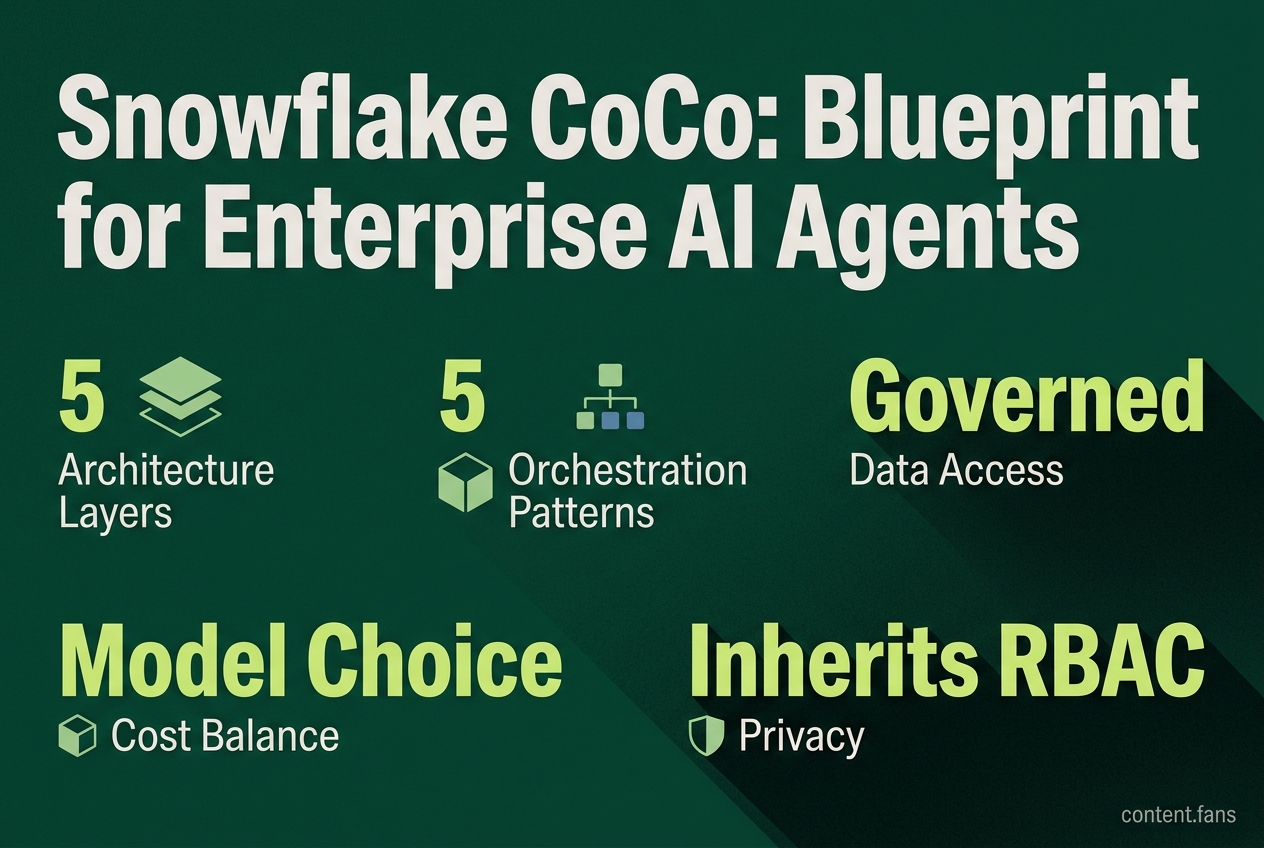
Building an enterprise AI agent involves a layered system. A reference architecture includes a user-facing experience layer, an orchestration layer for routing tasks, a capability layer of specialist agents, a secure data layer for governed access, and a governance layer for policy enforcement, auditing, and compliance.
- Experience layer for UI, APIs, and scheduled jobs.
- Orchestration layer that routes tasks, tracks lineage, and manages retries.
- Capability layer of specialist agents: planner, tool-use executor, validator.
- Data layer with governed access to warehouse tables, vector indexes, and secret stores.
- Governance layer providing policy engines, audit logs, and approval gates.
Snowflake CoCo implements this architecture by running entirely inside a customer's account, accessing governed metadata, and allowing teams to balance cost and performance by choosing between models like Claude and GPT Atlan's CoCo overview. Recent updates introduced an "Agent Teams" layer, which enables a lead planner to delegate tasks to specialized sub-agents, evolving the system from sequential chains to concurrent orchestration.
Technical Guide - Building an In-House AI Agent Like CoCo
Orchestration patterns
Effective orchestration relies on five dominant patterns described in Azure's design guidance: sequential, concurrent, group chat, handoff, and multi-agent AI agent orchestration patterns. CoCo reportedly evolved from sequential chains to concurrent sub-agents to meet latency requirements. Teams should begin with predictable sequential flows and advance to hierarchical or concurrent models for more complex tasks.
Data pipelines and retrieval grounding
With fine-tuning costs still high, retrieval-augmented generation (RAG) is the preferred approach for enterprise agents. By creating vector indexes over documentation and code within the data warehouse, agents can ground prompts in high-quality source data without extraction. Regular backfill jobs ensure embeddings stay current with schema changes.
Privacy and compliance safeguards
CoCo inherits all RBAC policies from the underlying Snowflake environment. Custom-built agents should adopt a similar security posture:
- Isolate each micro-agent with least-privilege credentials.
- Decouple prompt templates from dynamic data to streamline redaction.
- Log every agent action to create a complete audit trail for incident response.
The value of running AI in a secure perimeter is underscored by the Snowflake and Anthropic partnership, which focuses on governed enterprise AI workloads expanded partnership news.
Caching and cost optimisation
As token usage can increase exponentially with parallel agents, cost control is crucial. Effective optimization strategies include:
- Using short-lived caches for deterministic sub-tasks.
- Batching embedding jobs to run during off-peak hours.
- Routing simple tasks to smaller models and reserving premium models for complex planning.
Monitoring and retraining triggers
A baseline observability stack is essential for measuring performance and triggering adjustments. Key metrics to monitor include:
- Per-agent latency and token usage by model.
- Fallback and retry rates.
- Semantic drift alerts that signal when outputs diverge from source data.
When a drift threshold is exceeded, teams can trigger prompt updates or a new RAG indexing run, following Microsoft's guidance to instrument performance at each step.
What exactly is Snowflake CoCo and how is it architected for multi-model orchestration?
Snowflake CoCo is the re-branding of Cortex Code: a Snowflake-native coding agent that lives entirely inside your governed Snowflake environment. The agent can dynamically choose among Anthropic Claude, OpenAI GPT, and other models for every query, weighing quality, latency, and cost in real time (Snowflake CoCo product page). CoCo reads your account metadata, role-based permissions, and schema objects, then generates or refactors SQL and Python code without ever moving data outside the account. Recent updates have added Agent Teams - a control-plane layer that turns CoCo from a single-agent loop into a fleet of specialized sub-agents for research, coding, and testing, all orchestrated by a lead agent that decides which model and which agent should act next.
Which orchestration patterns should enterprises adopt when building similar agents?
The enterprise consensus is to pick one of five patterns based on task characteristics:
- Sequential - deterministic chains for multi-step workflows
- Concurrent - parallel agents for faster, redundant analysis
- Group chat - consensus-building loops with human review gates
- Handoff - dynamic delegation when the best agent is unknown at start
- Multi-agent / hierarchical - a central orchestrator that fans out work to scoped micro-agents
Each pattern is supported by an orchestration layer that handles routing, context aggregation, and retry logic (Azure Architecture Center guide). A practical reference stack includes experience, orchestration, capabilities, data, and governance layers - mirroring the same boundaries that Snowflake enforces inside CoCo (Kellton architecture guide).
How can teams control cost when running multi-model, multi-agent systems?
Cost control boils down to routing tasks by complexity rather than always invoking the largest model. Industry reports suggest that a significant portion of enterprise agent calls can be satisfied by smaller, cheaper models if the orchestrator follows simple heuristics:
- Route deterministic tasks to rules engines whenever possible
- Use small-language models for summarization and validation
- Reserve premium model tiers only for open-ended reasoning tasks
Batching and caching also deliver rapid payback: case studies show substantial cost reductions by caching common query plans and re-using validated SQL snippets across analysts (Rakesh Gohel post).
What privacy and compliance safeguards are built into Snowflake CoCo and recommended for custom agents?
CoCo inherits Snowflake's RBAC, row-level security, and end-to-end encryption out of the box. All prompts, generated code, and intermediate artifacts reside inside the customer's Snowflake account, so no data ever crosses the trust boundary. For custom agents, best practice is to:
- Isolate each micro-agent behind distinct security boundaries
- Log every tool call, prompt, and policy decision for audit trails
- Keep policy logic outside the prompt to allow governance updates without retraining
- Enforce human-in-the-loop approvals for production schema changes
These controls mirror Snowflake's own pattern and align with emerging audit requirements (Tungsten enterprise guide).
When does a hybrid build-vs-buy approach make the most sense?
A decision matrix derived from enterprise surveys shows common approaches:
| Need | Recommended approach |
|---|---|
| Standardized workflow, predictable volume | Buy platform (CoCo or equivalent) |
| Sensitive data, custom policy logic | Hybrid: vendor orchestration + custom governance layer |
| Proprietary process that yields competitive edge | Build custom agent layer; host inside your VPC |
The fastest path to ROI is often to "buy the commodity intelligence and build the control plane." Teams that adopt this hybrid stance typically deliver POC-to-production faster than full-custom builds (Aisera report).