
Snowflake CoCo Guides Enterprises on Building In-House AI Agents
Serge Bulaev
The guide explains how companies might build their own in-house AI agents like Snowflake CoCo, which helps manage and use company data safely and efficiently. It suggests that teams can follow a set of patterns, such as using a planner to pick the right tools and keeping strict controls over who can see what data. The text mentions that using hybrid models, prompt caching, and monitoring can help save costs and improve performance. There also appear to be steps for privacy and compliance, like tracking costs and having human review for risky actions. Following these guidelines may help companies create secure and reliable AI agents similar to CoCo.

This technical guide explains how enterprises can approach building in-house AI agents modeled after Snowflake CoCo, establishing a governed orchestration layer for proprietary data and tools. The CoCo pattern, native to the Snowflake Data Cloud, leverages role-based permissions to direct tasks to Cortex Analyst or Cortex Search, all while an LLM interprets user intent. This guide outlines the technical decisions required to replicate this pattern securely, managing privacy, cost, and reliability across your stack.
Core architecture layers
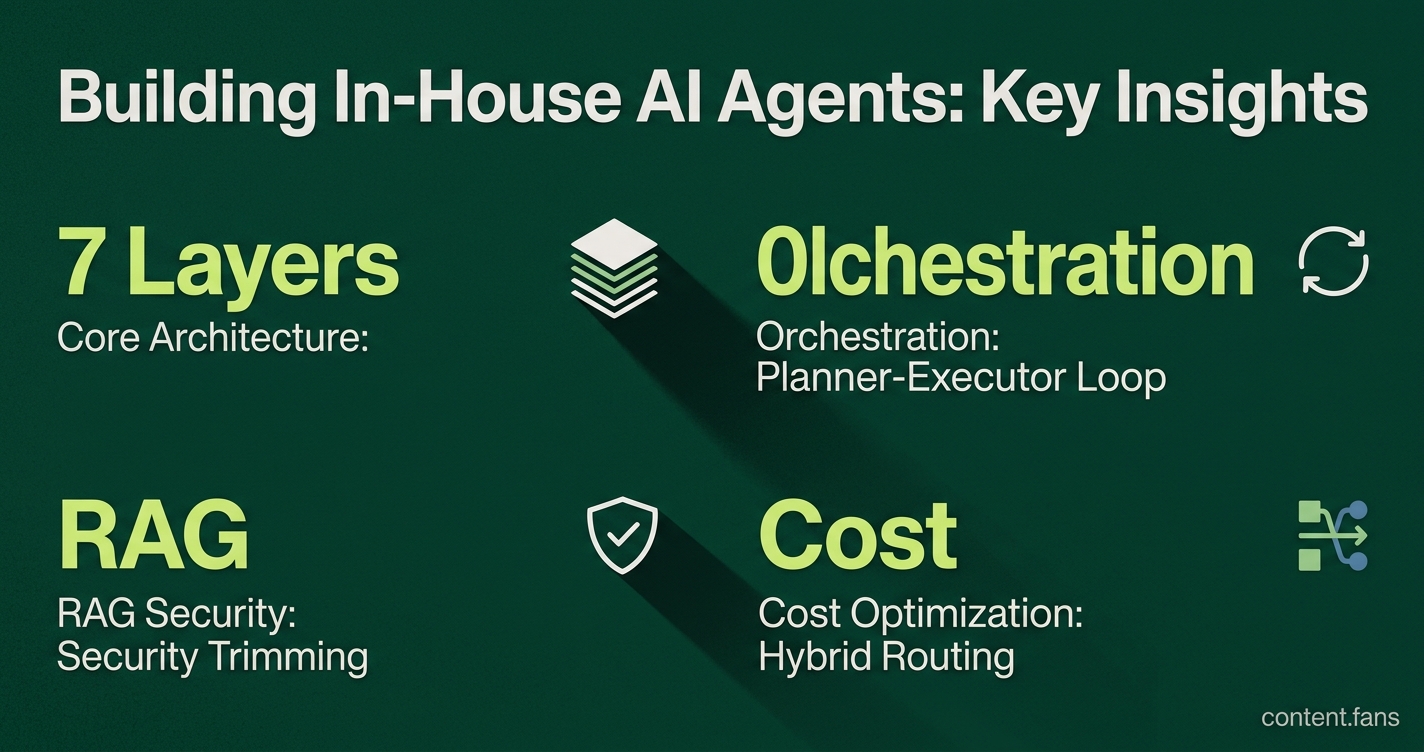
Enterprise AI architecture is commonly described in layers such as interface/application, orchestration, reasoning/agent, tool/action, data/memory, model, and governance/security, depending on the framework used.
- Interface: A chat application, API endpoint, or automated workflow trigger.
- Orchestrator: An LLM-based planner that selects tools, manages state, and handles retries. As noted in Snowflake's guide on building Cortex Agents, the planner is responsible for managing complex sequencing and error handling.
- Tool and Model Catalog: A collection of capabilities like SQL generation, vector search, and function calls, each paired with the most cost-effective model for the task.
- Governance Control Plane: Manages credit budgets, creates immutable audit logs, and enforces owner-rights execution patterns, following principles from Snowflake's CoCo governance quickstart.
- Data and Embeddings: A combination of structured tables and a vector store secured with document-level access control lists (ACLs).
Model orchestration patterns
Effective model orchestration relies on a planner-executor loop where the agent interprets a query, selects a tool, reflects on the output, and determines the next action. Best practices include using concise prompts, caching static instructions, and implementing routing logic. This allows routine tasks like summarization to use smaller, cheaper models, while reserving larger models for complex synthesis. Industry reports suggest this hybrid routing strategy can reduce token expenditure by significant percentages by optimizing batch sizes and cache hit rates.
Retrieval-augmented generation (RAG)
The quality of Retrieval-Augmented Generation (RAG) is as dependent on retrieval safeguards as it is on model capability. Industry best practices advise applying security trimming before reranking search results. This ensures the model is never exposed to documents the user is not authorized to see. Development teams also implement golden-set testing with expected citations and monitor citation precision to detect hallucinations proactively.
Privacy, compliance, and cost levers
Industry guidance highlights several recurring controls for managing privacy, compliance, and costs:
- Document-level ACLs and tenant isolation in the vector index
- Prompt caching for static system messages
- Batch tool calls to cut per-request overhead
- Per-agent cost tracking tied to credit budgets
- Human review gates for high-risk actions
Monitoring and retraining triggers
A robust monitoring framework captures every LLM call, tool invocation, and retrieved document in a trace store, logging latency, token consumption, cost, and model version. Teams should configure automated alerts for significant drops in grounding scores or spikes in cost per query. If performance drift exceeds a predefined threshold, the agent can automatically failover to a backup model or trigger a fine-tuning process with new data.
Production readiness checklist
| Concern | Minimum control |
|---|---|
| RBAC & ABAC | Enforced before retrieval |
| Audit trail | End-to-end, immutable |
| Cost KPI | Cost per resolved query |
| Evaluation | Golden set plus red-team tests |
| Failover | Secondary model route within SLA |
By implementing these architectural patterns and governance controls, teams can build a governed, multi-model AI agent that aligns with CoCo's enterprise-grade focus on security, observability, and cost-effectiveness.
What architecture does Snowflake CoCo use to orchestrate multiple LLMs and internal knowledge?
CoCo runs entirely inside Snowflake, making it aware of every schema, policy, and permission that governs your data. At runtime, it follows a four-step loop:
1. An orchestrator LLM interprets the user's intent,
2. picks the right mix of Cortex Search, Cortex Analyst, or custom tools,
3. chains the steps if the task is multi-hop, and
4. reflects on the intermediate outputs before synthesizing the final answer, a process detailed in guides for Snowflake CoCo: Snowflake-Native AI Coding Agent for Data and Best Practices for Building Cortex Agents.
Since data never leaves the governed warehouse and the SQL executes under the owner-rights model, CoCo can perform privileged operations while leaving an immutable audit trail, a key feature of Enterprise CoCo Governance on Snowflake.
How do hybrid designs help match model capability to task and control cost?
Hybrid agents strategically blend rules, symbolic logic, and multiple LLMs to ensure the lowest-cost model that reliably solves the step is chosen each time. A typical traffic pattern emerging in enterprise deployments includes:
- Rule engine for deterministic compliance checks.
- Small fine-tuned model (~8 B parameters) for routine summarization or classification.
- Frontier model such as Claude-3.7 reserved for only complex reasoning or exception handling.
Enterprises that deployed this pattern report significant reductions in token spend per resolved query while keeping hallucination rates low according to a report on Hybrid AI Agents: Benefits, Challenges & Enterprise Use. The extra orchestration overhead is offset by prompt caching and tool-call batching built into enterprise agentic platforms.
What privacy and compliance safeguards are baked into the retrieval and generation layers?
Modern enterprise AI stacks enforce privacy at retrieval time:
- Document-level ACLs are resolved in the search index before any text is sent to an LLM.
- Tenant isolation is maintained by separate vector namespaces or row-level security.
- Data minimization means only the smallest chunk that answers the question is forwarded.
- Audit logs record who accessed which file, when, and for what purpose, satisfying GDPR and HIPAA evidence requirements.
In Snowflake CoCo these controls are inherited automatically because the agent leverages Snowflake's existing role-based security and immutable audit trails as detailed in its guide to Enterprise CoCo Governance on Snowflake.
Which caching and cost-optimization techniques are proving most effective for production workloads?
The top levers that enterprises commonly cite include:
- Prompt caching of static instructions and repeated knowledge can provide significant token cost savings.
- Model routing to smaller or cached models for low-risk tasks can substantially reduce the average cost per query.
- Tool-call batching reduces round-trips to downstream APIs, which often outweighs the LLM bill itself.
In addition, context reuse across workflow steps (where intermediate results are carried in state rather than re-computed) is emerging as the next frontier, with early adopters achieving additional compute spend reductions.
How should teams monitor, retrain, and govern these agents once they are live?
A comprehensive observability stack is built around cost, latency, hallucination rate, and drift:
| Metric | Threshold | Action |
|---|---|---|
| Cost per resolved query | Significant increase over baseline | Route more traffic to cheaper models |
| Faithfulness score | Below acceptable threshold | Trigger golden-set re-evaluation and prompt tuning. |
| Model drift | Significant deviation on core classifiers | Schedule retraining or roll back to last vetted version. |
Every step, prompt, retrieval result, and tool call is logged with queryable trace IDs so security teams can reproduce any failure. Human-in-the-loop gates are commonly implemented for high-risk tasks, and immutable audit records support compliance reviews.