
Snowflake adopts AI agents to prep executives for analyst calls
Serge Bulaev
Snowflake now uses AI agents called Cortex Agents to help executives get ready for analyst calls. These agents can quickly create possible Wall Street questions and draft answers, a process that used to take weeks but now only takes minutes. Each executive has their own agent that can access important company data and documents, and a routing system decides how to answer each prompt. Reports suggest this new system saves a lot of time and matches trends in other companies, where AI helps but humans still check the final answers. Snowflake may keep expanding this use of AI, with new agents and extra safety features being tested now.

Snowflake now uses internal AI agents to prepare its executives for analyst calls, a practice that has moved from a pilot program to standard procedure within the data-cloud company. According to internal sources, staff use Cortex Agents to generate potential questions from Wall Street and draft responses in minutes, compressing a workflow that previously took weeks. Official documentation shows how these agents are built; for example, the "Getting Started with Cortex Agents" guide explains how Cortex Search accesses transcripts and Cortex Analyst queries revenue and pipeline data using SQL.
A team under Chief Data and Analytics Officer Anahita Tafvizi developed personalized agents for CEO Sridhar Ramaswamy, CFO Brian Robins, and other executives. Each agent can securely access approved materials like board decks, past earnings call transcripts, and real-time KPIs from governed Snowflake databases. A routing layer intelligently directs prompts to the right tool for either metric analysis or document retrieval, a setup that reflects the multi-tool agent pattern detailed in Snowflake's "From Zero to Agents" developer lab.
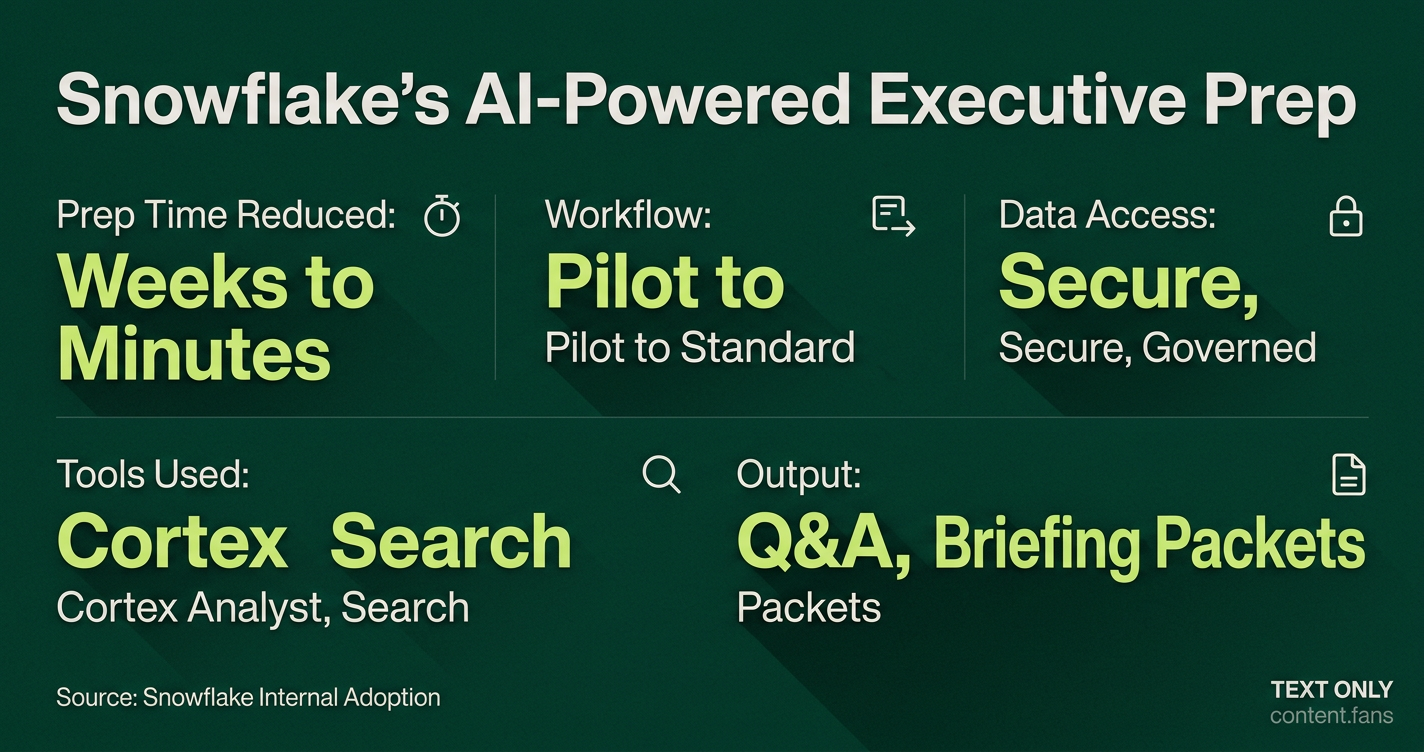
Inside Snowflake's AI-Powered Executive Prep Workflow
Snowflake's executive prep workflow uses custom AI agents to scan internal data, including financial metrics and meeting transcripts. The agents then generate likely questions from analysts and draft data-backed answers. This allows leadership to prepare for earnings calls in minutes, with all information sourced from governed, secure company databases.
The architecture, demonstrated in company quickstarts, combines structured and unstructured data sources to provide comprehensive insights:
- Data Layer: Accesses structured data such as sales tables, churn metrics, and forecast snapshots.
- Knowledge Layer: Pulls from unstructured sources like past Q&A logs, policy documents, and strategy memos.
- Core Tools: Employs Cortex Analyst for numerical queries and Cortex Search for text-based retrieval.
- User Interface: Delivers results through a Snowsight chat window protected by role-based access control (RBAC).
- Automation: Includes optional actions, such as a custom tool that emails briefing packets automatically.
Snowflake strategically uses these internal deployments as "customer zero" use cases. Anahita Tafvizi has emphasized that strong governance is a prerequisite for scaling AI, stating publicly, "there is no AI strategy without a data strategy." This philosophy ensures that trusted data foundations, semantic layers, and verified queries are in place before any agent is deployed.
The results are measured in significant time savings, with executive briefing cycles cut from weeks to minutes. This efficiency gain is part of a broader company transformation as Snowflake moves to an AI-native model, with growing usage of agent queries across its teams.
This approach reflects a wider industry trend. A 2024 Deloitte paper highlights how generative AI can enable conversational Q&A on enterprise data, reducing manual preparation for analysts while keeping humans in control of final disclosures. Snowflake's model is a prime example of this human-in-the-loop augmentation.
The company's internal AI development is ongoing. New demos showcase supervisor architectures that orchestrate specialized agents for sales, customer success, and investor relations. Before going live, every agent must pass through a strict set of guardrails, including role permissions, verified data sources, and continuous performance evaluation.