
Sierra raises $950M, hits $165M revenue amid enterprise voice AI growth
Serge Bulaev
Sierra has raised $950 million in new funding and reports revenue over $165 million, which nearly doubled since early 2025. About 40% of the Fortune 50 companies now use Sierra's voice agents in some way. Sierra may use the new funding to expand globally and improve its products, but details are not confirmed. Founder Bret Taylor suggests the voice AI market is still in an early stage, and outside analysts also say there is uncertainty about how quickly the market will grow.

Voice AI leader Sierra has secured $950 million in new funding and reached $150M ARR in early February 2026, landmark figures that underscore the rapid pace of enterprise voice AI growth. Founder Bret Taylor announced the milestones at the Cerebral Valley Voice Summit, positioning Sierra as one of the best-capitalized companies in the sector. Taylor's announcement offers a data-rich look into an enterprise voice market that many analysts still consider to be in its early stages.
Fresh capital and rising revenue
Voice AI company Sierra has raised $950 million in a new funding round and announced that it reached $150M ARR in early February 2026. The company has shown significant growth reflecting substantial enterprise adoption and positioning the company for further global expansion and product development.
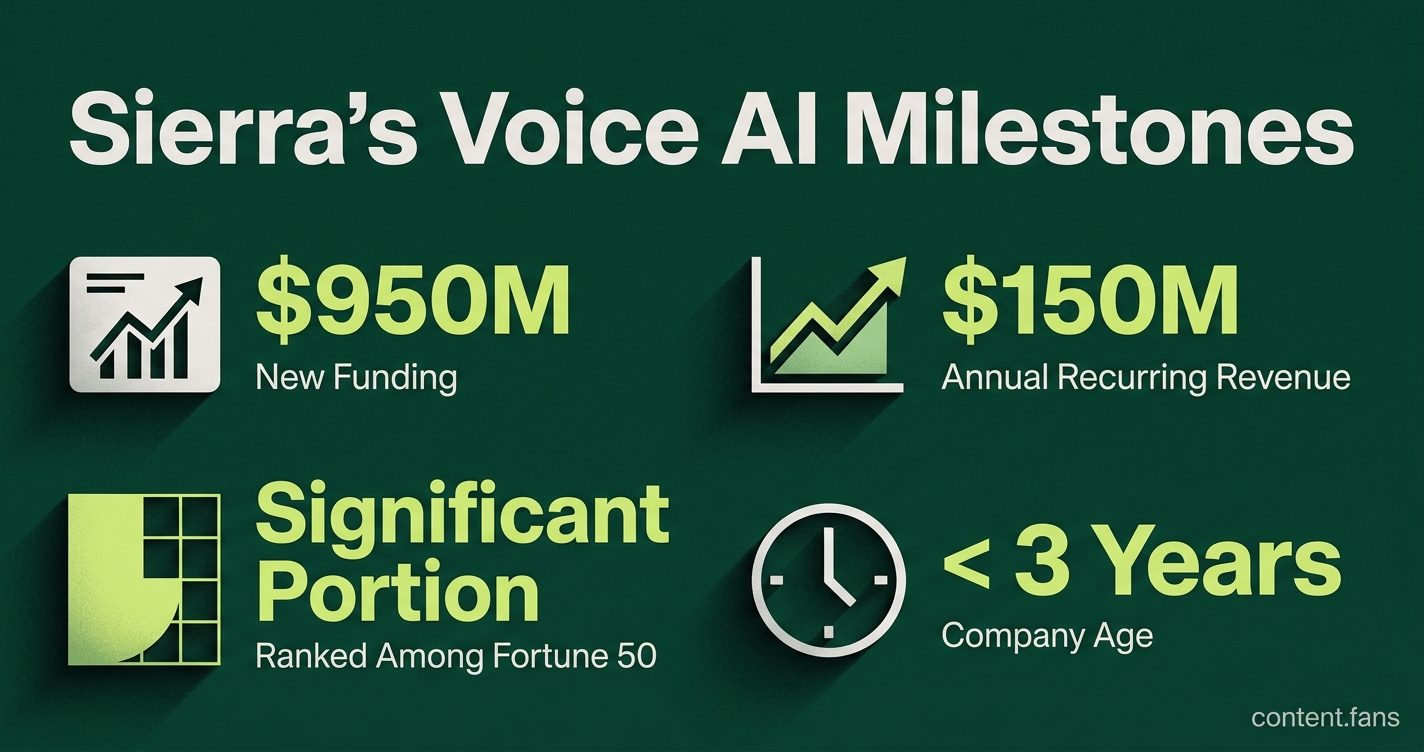
The funding was confirmed in a Newcomer.co recap of the summit. In a YouTube video of his talk, Taylor compared the current voice AI market to the internet "before broadband," emphasizing the significant potential for future growth. While the investors were not disclosed, funding of this magnitude typically fuels global expansion and intensive R&D. This capital could accelerate the localization of Sierra's multilingual voice agents, which are already used to automate customer interactions.
Penetration among Fortune 50
A key metric of Sierra's success is its adoption by major corporations: a significant portion of Fortune 50 companies now use its voice agents in at least one workflow. This rapid enterprise adoption, highlighted in the summit recap, is remarkable for a company launched less than three years ago. Sierra's growing footprint within blue-chip firms suggests that procurement barriers are falling as model accuracy improves and hosting costs decline. This trend aligns with industry reports indicating substantial growth projections for the voice AI segment.
Inside the Cerebral Valley Voice Summit
The Cerebral Valley Voice Summit, hosted by Eric Newcomer, Max Child, and James Wilsterman, is an invite-only event focused on voice as a primary computing interface. Taylor's session was moderated by Newcomer. Other notable speakers included Shiv Rao of Abridge, Anastasis Germanidis of Runway, and Justin Uberti, Head of Realtime AI. The event's tiered ticket pricing was published as:
- Founder pass: $99
- General admission: $699
- Sales or professional services: $999
- Media: free (application required)
Organizers capped attendance to foster a focused environment for founders, investors, and researchers.
Why Taylor says the market is still early
Despite Sierra's impressive traction, Taylor maintains that the voice AI market is still in its "first innings." In his interview, he drew a parallel between today's voice AI and the pre-broadband internet, pointing to existing constraints in latency, cost, and tooling. This perspective is supported by market uncertainty; while voice recognition shows strong growth, projections vary widely across different industry reports. This view aligns with Stanford HAI data, which indicates that while generative AI adoption is fast, it has not yet reached full mainstream operational integration.
How much did Sierra raise and what revenue milestone did it hit?
Sierra raised $950 million in fresh funding and reached $150M ARR in early February 2026, according to founder Bret Taylor's on-stage remarks at the Cerebral Valley Voice Summit.
How deep is Sierra's penetration among large enterprises?
A significant portion of the Fortune 50 now deploy Sierra's voice agents for customer-facing or internal workflows, a figure Taylor cited just two days after the funding round closed.
Why does Taylor say voice AI is still in "early innings"?
Taylor likened today's moment to "the pre-broadband internet", arguing that reliable, real-time voice infrastructure is only beginning to unlock new product categories and economic value.
What macro trends support his "early innings" view?
- Voice AI agents are projected to grow at a 34.8% CAGR, from $2.4B in 2024 to $47.5B by 2034
- Conversational AI overall is expected to reach $41.4B by 2030, up from $14.3B in 2025
- Enterprise-grade accuracy is now high enough that real-time usage grew 4× in 2025, signaling the shift from pilots to production
What sectors are already seeing measurable ROI?
| Sector | 2026 Impact |
|---|---|
| Healthcare | Clinicians save significant time per day; U.S. system could see substantial annual savings according to industry reports |
| Contact centers | Industry reports estimate significant savings this year alone |
| Telecom | Routine inquiry automation reaches high levels, cutting costs substantially |