
Anthropic expands Claude Code into a local AI operating system
Serge Bulaev
Anthropic has expanded Claude Code from a coding tool into a local AI operating system that runs on users' own computers. This means people may keep their projects and data private while still using powerful AI features. By 2026, new updates like Skills, Hooks, and memory features allow the tool to remember, schedule, and delegate tasks, acting like a simple operating system. Reviews suggest it makes complex work easier for both technical and non-technical users, but there might be a learning curve. Recent announcements indicate Anthropic may let users choose where tasks run, on their own hardware or in the cloud.
In a significant evolution, Anthropic expands Claude Code into a local AI operating system, transforming the command-line tool from a coding assistant into an on-device layer for work. This pivotal shift allows users to leverage Anthropic's powerful reasoning models while keeping all projects, data, and proprietary models securely on their own hardware. By mid-2026, features like Skills, Hooks, and Modular Compute Protocol servers will enable the terminal to function as a lightweight OS that remembers context, schedules jobs, and delegates tasks.
What "local OS" means in practice
In practice, Claude Code uses Skills, Hooks, and MCP servers to manage persistent context, automate workflows, and integrate external tools, but operates as an AI agent framework rather than functioning as a local OS. This architecture allows it to orchestrate tasks, connect with tools, and even run offline models, giving users full control over their data and workflows.
The system maintains four persistent layers: a CLAUDE.md file for system context, auto-firing Skills, event-based Hooks, and sub-agents that integrate with external tools. This design allows users to pair the CLI with local model servers like Ollama by setting anthropic_base_url=http://localhost:11434, as detailed in a dev.to blueprint. Such a configuration hosts both orchestration logic and model weights on a single laptop, ensuring privacy and eliminating cloud costs.
Persistence, memory, and scheduled runs
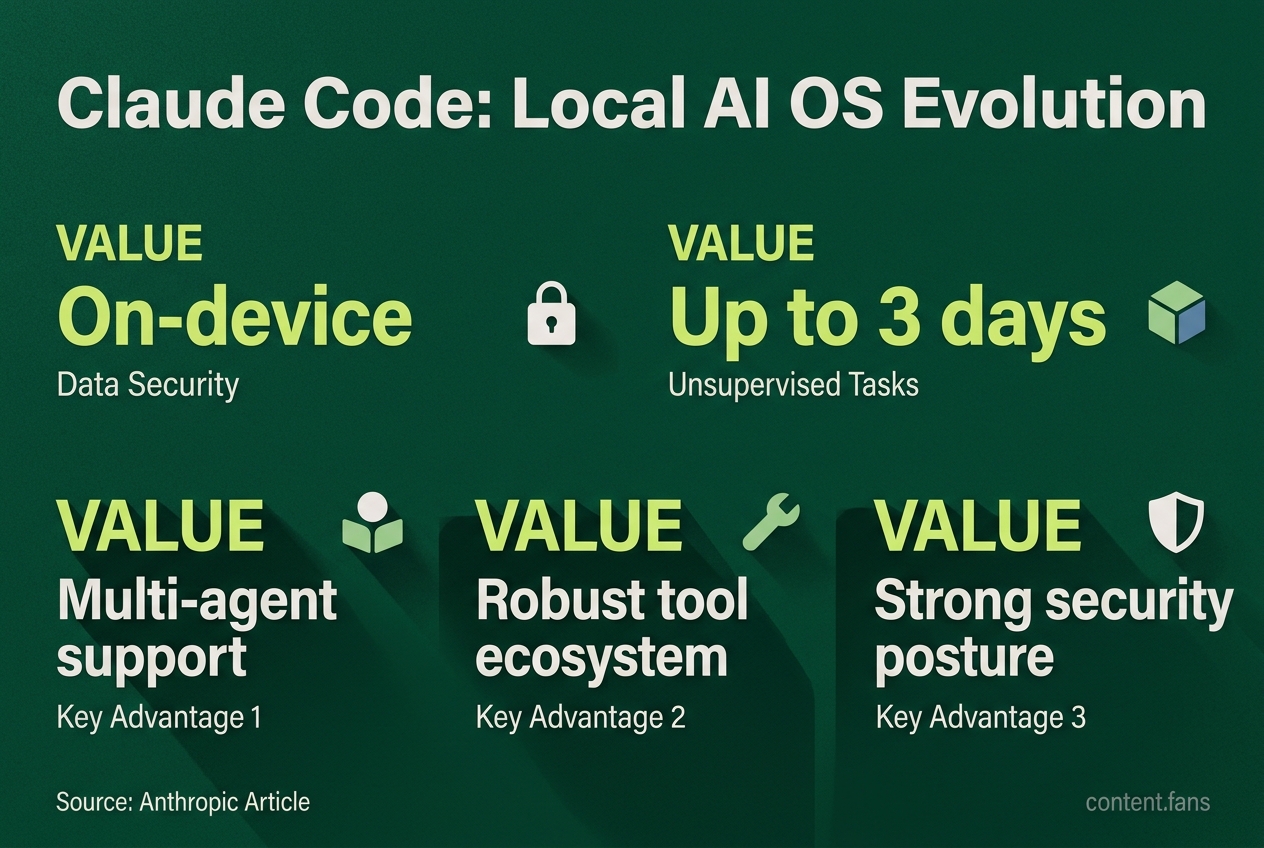
To enhance its OS-like capabilities, Anthropic introduced Auto Memory directories for storing observations at user, project, and local scopes. Long-running tasks are enabled by scheduled /loop commands, which can reportedly operate unsupervised for up to three days for data migrations or documentation updates. According to industry reports, features like Remote Control and Computer Use are being developed to enhance monitoring and desktop automation capabilities.
Where it outperforms other local agents
Claude Code demonstrates three key advantages over contemporary local agents:
- Native multi-agent support: The
/simplifycommand initiates parallel agents in isolated branches, and background tasks persist even after the terminal is closed. - Robust tool ecosystem: MCP servers provide direct read-write access to services like GitHub, Figma, and Postgres without requiring custom integration code.
- Strong security posture: All file edits are sandboxed and remain on the local machine unless explicitly pushed by a Skill.
While alternative setups like LM Studio can host local models, they lack built-in planning capabilities. Meanwhile, bots such as OpenClaw are geared toward lifestyle automation rather than code reasoning. This distinction may be why a Google engineer reportedly used Claude Code to solve a complex distributed orchestration bug in an hour that had stumped their team for months.
Everyday automations are possible
The platform's accessibility has empowered non-developers to create and share automations using packaged Skills. Common community-built tasks include:
- Identifying and archiving duplicate media files.
- Batch-enhancing screenshots for presentations.
- Downloading YouTube videos and generating text transcripts (with appropriate legal warnings).
- Extracting full-resolution images from Google Docs.
Many users report that the CLI simplifies complex processes for all user levels, though some mention a learning curve and token costs. Founders on Product Hunt emphasize that well-written test files are crucial for preventing errors during large, automated refactoring tasks.
Recent roadmap signals
According to industry reports, Anthropic is developing Routines, a feature for storing and triggering Claude Code workflows based on schedules, webhooks, or GitHub events. The company has also announced it had doubled usage limits for all paid tiers after securing new compute resources at SpaceX's Colossus 1 data center. These moves signal a strategy that blends local control with cloud-powered scalability, allowing teams to choose the optimal execution environment for each task.
Ultimately, Claude Code establishes itself at the crossroads of offline data sovereignty and scalable AI agent fleets. Its layered, OS-like architecture, persistent memory, and extensible Skill system transform a simple command line into a collaborative partner that can edit files, manage sub-agents, and intelligently automate complex workflows.