
Microsoft's 2026 Report: Workers Outpace Organizations on AI Readiness
Serge Bulaev
Microsoft's 2026 report suggests that while workers are using AI to work faster and do more, many companies are not keeping up with the right culture and leadership to support these changes. The study finds that how a company is run may matter more for AI success than an individual worker's skills. Most employees feel their companies are slow to reward or support new ways of working with AI. This gap between what workers can do and what organizations allow might grow if companies do not change their strategies and systems.

The central message of Microsoft's 2026 Work Trend Index is that workers are outpacing organizations on AI readiness. The comprehensive study, based on a survey of 20,000 AI users and trillions of Microsoft 365 data signals, reveals a critical paradox: while employees rapidly adopt AI, their companies lack the culture and leadership to turn individual productivity into enterprise-wide returns.
Where the impact comes from
Microsoft's analysis of 29 potential drivers for effective AI adoption revealed that organizational factors are overwhelmingly more impactful than individual skills. The report attributes a significant majority of the variance in AI outcomes to elements like company culture, manager support, and talent development. In contrast, individual capabilities account for a much smaller portion. A post detailing the Work Trend Index highlights that organizational influence is more than twice as significant as personal skill.
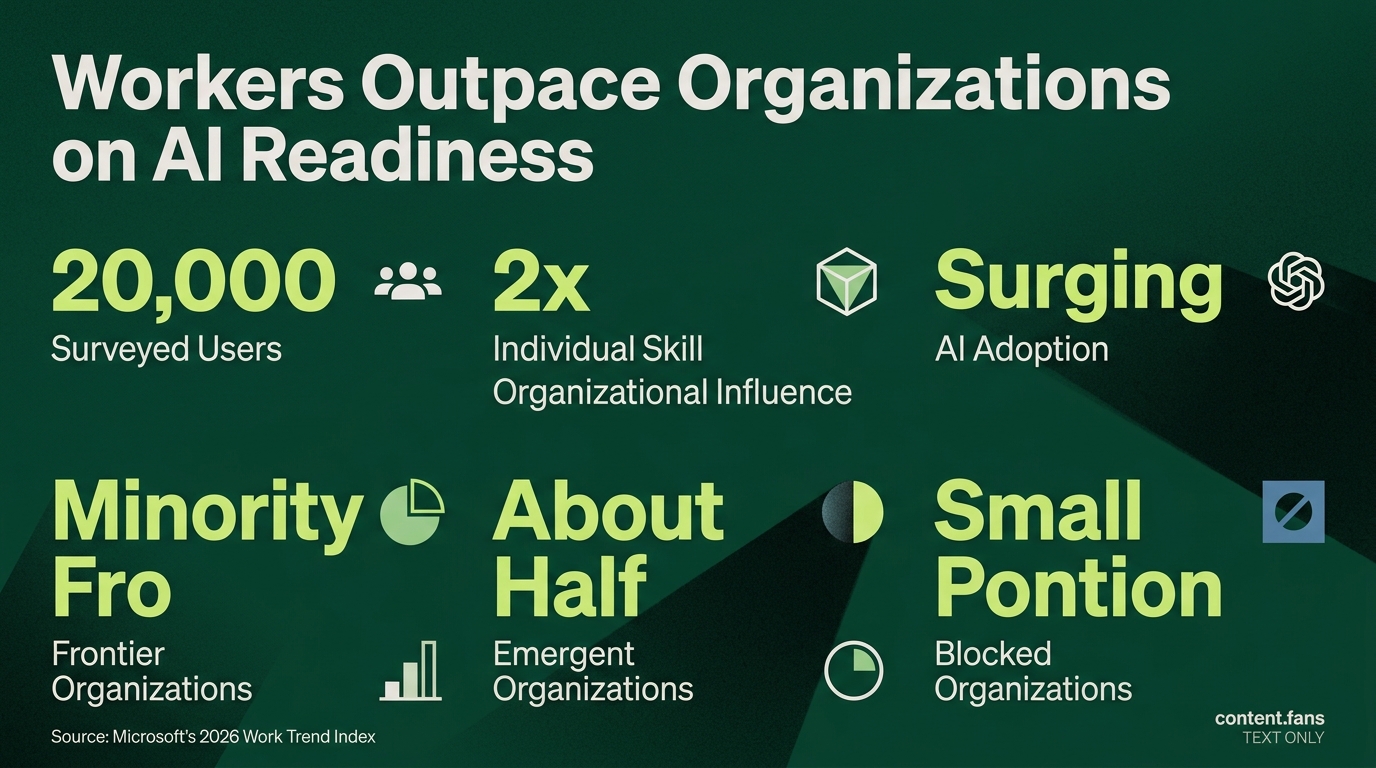
Microsoft's research indicates a significant "readiness gap," where employees are quickly leveraging AI for personal productivity gains. However, most organizations lack the aligned strategy, supportive culture, and leadership necessary to harness this momentum, meaning the full potential of AI remains largely untapped at the enterprise level.
Signs employees are moving faster than their firms
The data shows individual AI adoption is surging, even as organizational support lags:
- A significant majority of users say AI lets them spend more time on high-value work.
- Many report producing work they could not have completed a year ago.
- Microsoft 365 telemetry shows active AI agent use has grown dramatically year over year, with even more substantial growth in large enterprises.
This individual momentum starkly contrasts with organizational inertia. Industry reports reveal that only a small minority of employees see clear leadership alignment on AI strategy, and even fewer feel rewarded for AI-driven innovation.
Mapping the readiness landscape
The index categorizes organizations and their employees into three distinct AI readiness zones:
- Frontier: A minority of respondents operate where organizational readiness and personal skill are both high.
- Emergent: About half of users sit in the middle, with individual momentum but uneven organizational support.
- Blocked: A small portion of users face structural barriers that stall their progress.
Notably, 'Frontier' professionals demonstrate more deliberate AI usage. They frequently pause to assess if a task is better suited for AI or human effort and often intentionally avoid AI for certain activities to preserve their own expertise.
Culture and leadership gaps
The study identifies three primary organizational hurdles preventing companies from capitalizing on employee enthusiasm for AI:
- Lack of Leadership Modeling: Prior Microsoft polling shows that when managers visibly use AI, employee trust in the technology increases substantially.
- Low Psychological Safety: A significant portion of users feel it is safer to maintain current workflows and meet existing goals than to experiment with redesigning their work around AI.
- Insufficient Recognition: Reward systems rarely reinforce AI experimentation, with only a small fraction of employees feeling their AI initiatives are acknowledged.
Toward owned intelligence
Microsoft contends that market leaders are those who invest in creating "owned intelligence." This involves building institution-specific AI capabilities on proprietary data, governed by clear policies and integrated through continuous workflow redesign. External case studies show that firms embedding AI end-to-end achieve substantial productivity gains.
What the numbers imply
The data strongly suggests that the next wave of AI-driven productivity will come from organizational transformation, not just individual tool adoption. Without fundamental shifts in corporate strategy, incentive structures, and governance, the readiness gap between empowered employees and their lagging organizations is set to widen further.
What is the "Transformation Paradox" Microsoft describes in the 2026 Work Trend Index?
Microsoft labels the widening gap between fast individual AI gains and slow organizational readiness as the "Transformation Paradox."
- Individual factors (skills, mindset) explain a smaller portion of AI impact, while organizational factors (culture, leadership alignment, talent practices) drive the majority
- Yet only a minority of employees say their leadership is clearly aligned on AI strategy
- Active AI agents in Microsoft 365 grew dramatically in one year, but only a small portion of firms qualify as "Frontier" where individual capability and organizational systems reinforce each other
The result: employees advance, but companies leave most of the value on the table.
Which personal benefits are workers reporting today?
Users are moving beyond simple automation:
- A significant majority state AI frees them to spend more time on high-value work
- Many say they now produce deliverables they could not create a year ago; among "Frontier Professionals" this proportion is even higher
- Industry data shows a substantial portion of AI interactions already target cognitive tasks (analysis, problem-solving, creative thinking) rather than routine chores
Why does organizational culture outweigh individual talent?
Statistical modeling of 29 influence factors shows organizational AI culture is significantly stronger than any single personal attribute.
Key culture signals:
- Clear executive alignment on priorities
- Managers who actively model AI use (substantially lifts employee trust)
- Reward systems that recognize experimentation (only a small fraction of workers currently feel acknowledged for AI innovations)
Without these supports, even highly skilled employees report feeling "restricted" and many fear professional lag if they cannot scale their new capabilities.
What concrete steps close the readiness gap?
- Secure top-down alignment first - agree on three to four enterprise priorities, not dozens of scattered pilots
- Redesign workflows, don't optimize old ones - map human-AI hand-offs and embed governance checkpoints
- Appoint visible AI champions in every function and stand up a Center of Excellence to maintain standards
- Measure and incentivize outcomes - track skill acquisition, adoption velocity and business KPIs in the same dashboard
- Treat data as Owned Intelligence - invest in modular, cloud-native platforms that keep institutional context inside the firm
Where is "Owned Intelligence" already paying off?
Early adopters that embed proprietary data and context inside AI workflows are capturing disproportionate returns:
- Major retailers report substantial annual savings and environmental benefits from AI-powered supply chains
- Leading financial institutions have automated hundreds of thousands of staff hours per year in document review
- Escalation-based operating models that let AI handle the majority of tasks before human hand-off deliver significant productivity gains
These cases show that owning the data, governance and workflow integration - not just licensing models - is what converts individual enthusiasm into enterprise-wide value.