
Senate Delays Vote on Combating Organized Retail Crime Act
Serge Bulaev
The Senate has delayed voting on the Combating Organized Retail Crime Act, which may help address rising losses and violence from theft rings. Supporters say the bill would create a new federal Coordination Center to connect investigations across state lines, which retail groups believe is needed to track national patterns. Reports suggest U.S. retailers lost about $9 billion to organized crime in 2025, and survey data shows shoplifting and violent threats have increased. Some experts warn that not all losses are from organized crime, and passage of the bill is not certain. Until the Senate acts, losses related to organized theft may continue to grow, based on current estimates.
Following a strong bipartisan House vote, the Senate has yet to act on the Combating Organized Retail Crime Act, a critical bill aimed at curbing billions in retail losses and increasing violence from theft rings. Industry leaders are urging a vote, emphasizing the need for the bill's proposed federal Coordination Center to unify investigations across state lines.
Retail groups argue that a centralized federal hub is essential for tracking sophisticated, nationwide criminal patterns. Despite this, the Senate version of the bill has remained in committee with no scheduled floor vote.
Combating Organized Retail Crime Act in the Senate
The Combating Organized Retail Crime Act proposes a federal center to coordinate investigations between local, state, and federal agencies. It aims to address large-scale theft operations that currently exploit jurisdictional gaps. The bill's delay in the Senate is preventing the establishment of this much-needed national response.
Where the money goes
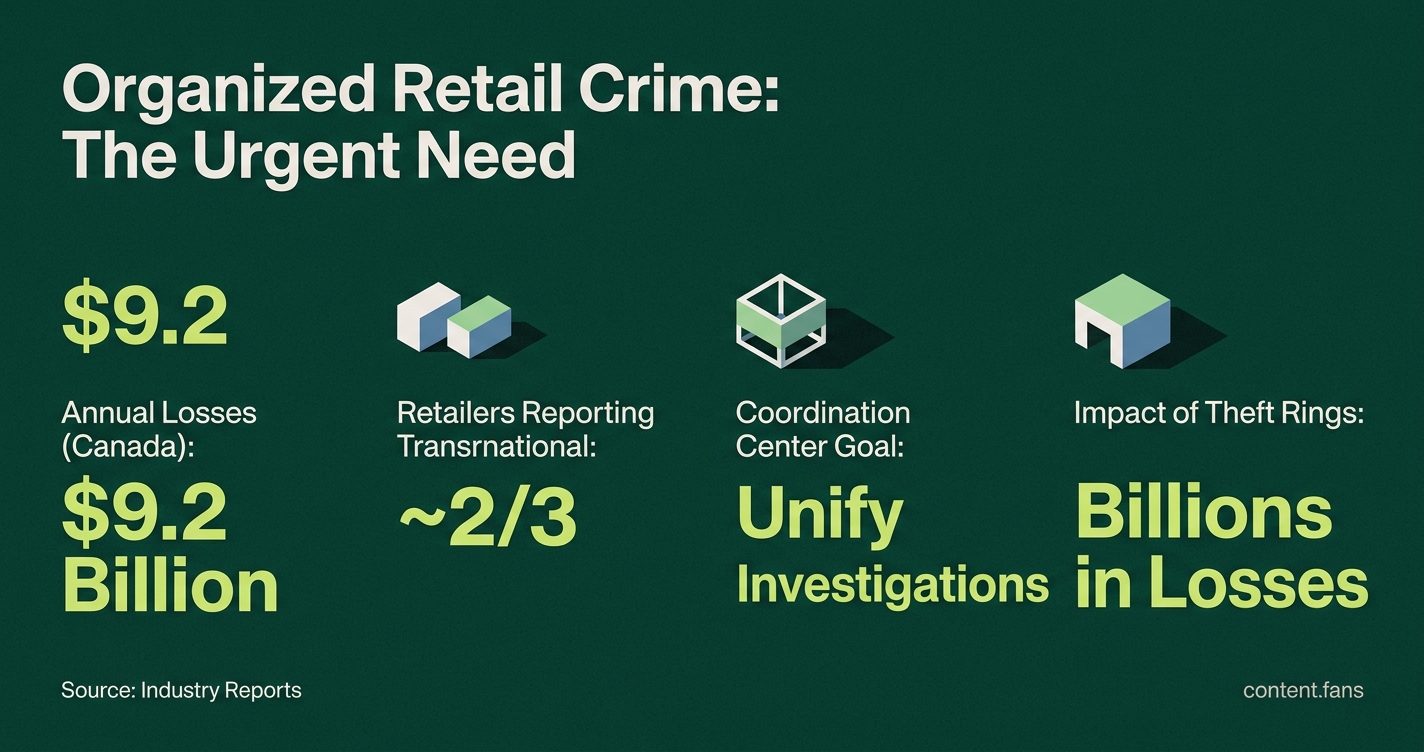
Advocates highlight the severe financial impact of these crimes. According to industry reports, Canadian retailers experienced approximately $9.2 billion in annual losses from overall retail shrink, demonstrating the significant scope of retail theft challenges. Research indicates that a small group of offenders is responsible for a disproportionate share of losses, pointing to highly organized networks, not random shoplifting. While overall retail shrink represents substantial losses according to industry reports, experts note that organized crime is only one component.
What the Coordination Center would do
The proposed Organized Retail Crime Coordination Center, established by H.R. 2853, would serve as a national nexus for intelligence and enforcement. Key responsibilities include:
- Coordinating federal investigations to prevent conflicting efforts.
- Establishing a secure system for sharing information among federal, state, local, and tribal law enforcement.
- Forging partnerships with private sector entities in retail, logistics, and e-commerce.
- Analyzing national crime trends and publishing an annual public report.
- Offering training and technical assistance for complex theft and money laundering investigations.
Testifying before the Senate, DHS Homeland Security Investigations officials emphasized that the Center would integrate disparate investigations into cargo theft, online fencing of stolen goods, and in-store theft rings.
Trendlines worth watching
Recent crime trends underscore the urgency of federal action. According to industry reports, retailers have seen significant increases in shoplifting and violent threats in recent years. Furthermore, approximately two-thirds of retailers report observing transnational elements in these crimes, suggesting proceeds may be moving internationally. Proponents argue this cross-border activity necessitates a federal response.
Passage of the bill remains uncertain despite concerted lobbying efforts. Trade groups like the Retail Industry Leaders Association are formally pressuring senators to schedule a vote before adjourning. In the meantime, the bill languishes in committee as losses from organized retail crime are projected to continue their upward trend based on current estimates.
What exactly would the Coordination Center do?
It would be the nation's one-stop hub for combating organized retail crime by knitting federal, state, local and private partners into the same daily workflow.
- Intelligence clearinghouse - merge cargo-theft tips, ORC booster-crew chatter, and state loss reports into one picture
- Threat analytics - publish an annual report and quarterly dashboards showing hot-spots, cargo lanes and repeat-offender networks
- Case support - let a county task-force request federal grand-jury time, forensics help or cross-border wiretaps without calling three different agencies
- Training grants - subsidize local prosecutors, loss-prevention teams and detectives to turn scattered misdemeanor cases into larger conspiracy indictments
Why is the Senate still holding the bill?
The House passed the bill with strong bipartisan support, but the Senate companion has stayed in the Judiciary Committee without a markup or floor vote.
Retail associations, cargo insurers and several state attorneys-general recently sent coalition letters urging Majority leadership to calendar the bill before the August recess; committee staff say a markup is "likely after the pending SCOTUS confirmations" but no date has been set.
How big is the damage today?
Latest industry snapshot puts significant merchandise losses from ORC crews, with organized rings moving loads across multiple states within 48 hours of theft. Industry reports indicate that a small percentage of offenders account for a disproportionate share of the dollar losses. Cargo hijacks from truck lots and rail yards are rising fastest, with organized rings moving loads across multiple states within 48 hours of theft.
Will the Center duplicate existing task-forces?
Supporters say it fills a gap, not a footprint. HSI-led Joint Task- Forces already exist for cargo theft, but they focus on ports, interstate highways and rail heads; the new Center adds retail theft, e-commerce fencing sites and supply-chain fraud to the same map. DHS budget tables show no new field offices are authorized - the bill reallocates existing Homeland Security Intelligence funds and caps federal staff at 150 detailees, so appropriations scorecards list the bill as "no significant additional out-year spending".
What happens next on Capitol Hill?
Chairman Durbin's office circulated a manager's-amendment packet covering data-privacy, tribal consultation and five-year sunset language; if that substitutes before markup, observers expect a committee vote in the coming weeks, clearing the path to likely unanimous-consent floor passage given the bill's bipartisan, bicameral sponsorship.