
Sanders proposes $7 trillion AI fund, wants 50% public stake in AI firms
Serge Bulaev
Senator Sanders has proposed a plan where companies making at least $200 million a year from AI would give half their shares to a public fund, which might be worth about $7 trillion. A special commission would manage these shares and could give out about $1,000 a year to each person, but experts say this amount is not certain and depends on company profits. The bill does not have support from Republicans or other Democrats, and many say it is unlikely to pass in the current Congress. Some people worry the plan could lower company values and mix up government roles, while others say it could give the public more control over AI.

Senator Bernie Sanders proposes a $7 trillion AI fund that would give the U.S. government a majority stake in the nation's top AI companies. The plan positions the government as a large shareholder in a concentrated industry, handing an independent commission the voting power tied to the stock.
How the $7 Trillion AI Sovereign Wealth Fund Would Work
The proposal requires companies with over $200 million in AI revenue to transfer 50% of their equity into a public trust. This fund, governed by a new commission, would use its voting power on corporate boards and distribute an estimated 5% annual dividend to the public.
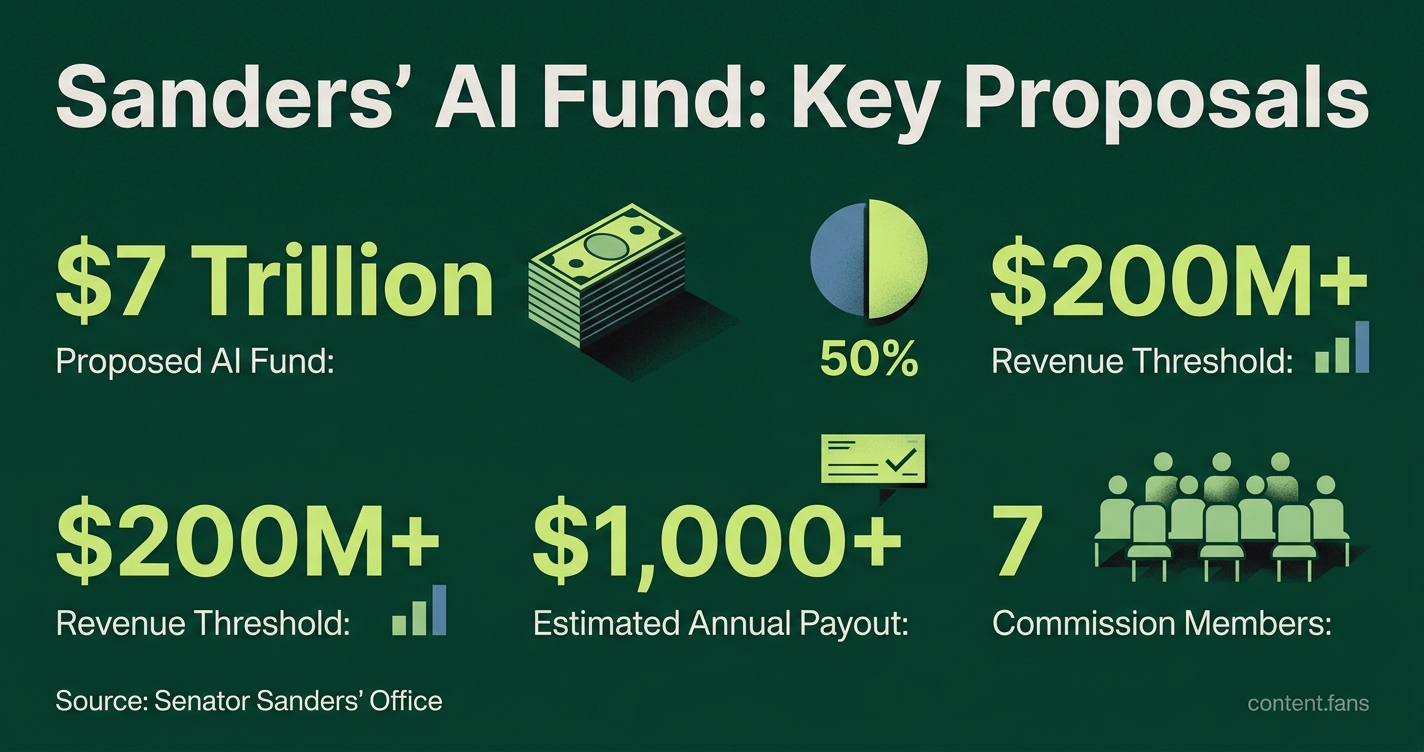
The proposed legislation mandates that companies with annual AI revenues exceeding $200 million transfer 50% of their equity into a new public trust. The $7 trillion valuation is an estimate from Senator Sanders' office and the bill text. A seven-member Independent Commission for Democratic AI, appointed by the president and confirmed by the Senate, would manage the shares, exercise voting rights on corporate boards, and oversee a projected 5% annual payout, which Sanders's office estimates could exceed $1,000 per person annually.
The fund targets 50% of the AI business segments of major tech firms (like OpenAI, Anthropic, and the AI divisions of Google/Microsoft) or firms primarily defined by AI revenue. Companies with mixed business lines would need to spin off their AI divisions, a requirement that could trigger complex corporate reorganizations.
Political Challenges and Bipartisan Hurdles
The bill faces significant political challenges in Congress. Commentators for Reason have labeled the plan a "major redistribution and partial nationalization," placing it far outside the policy mainstream. The Associated Press reports that industry lobbyists consider the mandated stock transfer expropriatory, suggesting a difficult path in the GOP-led Senate.
While Sanders has reportedly discussed the proposal with OpenAI CEO Sam Altman and former President Donald Trump, neither has offered a public endorsement.
Economic Impact and Unresolved Questions
General economic consensus suggests that forced, massive equity dilution typically harms valuations and increases capital costs, but no specific warning from named economists regarding AI firms and this exact percentage has been documented in public sources. No analysis from the Boston Globe supporting claims about AI firms' profitability and uncertain cash dividends for public payouts has been identified. The promised $1,000 annual checks would depend on board decisions that may not happen quickly.
Critics also raise concerns that government ownership could create a conflict of interest, blurring the line between regulator and investor and potentially undermining future antitrust or safety enforcement. Proponents argue public voting power would give citizens direct influence over technologies impacting employment, privacy, and national security.
- Key Provisions of the Proposal:
- A one-time equity transfer from major AI firms into the public fund.
- Governance by a seven-member commission with full stock voting rights.
- An annual dividend for public payouts and services.
- Applies to companies with significant annual AI revenue.
Legislative Outlook and Future Prospects
Political analysts widely agree that the bill's passage in the current Congress is highly improbable without significant revisions. Instead, the proposal is viewed as a strategic move to initiate a broader public conversation about the distribution of wealth generated by AI. The coming months will reveal if a narrower compromise, such as voluntary trusts or reduced share requirements, can gain political traction.
What exactly is the $7 trillion AI fund that Senator Sanders has proposed?
The American AI Sovereign Wealth Fund Act would use a one-time stock-based transfer from companies that earn at least $200 million a year from AI to create a public fund currently valued at roughly $7 trillion. The shares would not be bought; they would be seized from existing investors, giving the U.S. public an ownership claim in the AI divisions of major tech firms. Instead of cash, the fund would hold voting equity and begin distributing returns via an annual dividend projected at over $1,000 per American each year.
How would the fund be governed?
A new Independent Commission for Democratic AI - seven members nominated by the president and confirmed by the Senate - would run the fund. The commission would use its voting power to sit on company boards and block or reshape decisions that the public might consider harmful, ranging from safety roll-outs to data-collection practices. Annual dividends would flow straight to citizens, not the Treasury, making the fund a hybrid between a Norwegian-style sovereign wealth vehicle and a universal basic-dividend scheme.
Which companies would be affected?
Any firm that books significant annual AI-related revenue would surrender shares equal to a portion of its AI business. If the company also has non-AI lines, it would have to legally spin off or isolate the AI unit so the public stake concentrates only on the technology that Sanders argues was built with society's data, labor, and risk. Early industry screens suggest many large technology corporations would meet the threshold today.
What economic impact is expected if the bill passes?
Valuations would drop immediately: a forced equity dilution is seen by investors as expropriation risk, pushing down share prices. Capital raising could tighten - venture funds and public markets might demand higher returns or avoid U.S. AI start-ups altogether. Public revenue would rise: even with a lower realized fund value, an annual payout might still yield significant amounts to each resident. Industry reports warn that IPO delays and innovation flight are probable if the bill becomes law.
How likely is the plan to become law?
Political odds are very low. The bill faces significant opposition in the Senate as well as skepticism from many centrist Democrats. Constitutional challenges are expected over the seizure of private equity without cash compensation, and lobbying by technology giants is already intense. Many observers describe the measure as a strategic move designed to shift the debate toward who owns the gains of AI rather than a bill destined for enactment.