
Sanders bill proposes 50% public stake in AI firms, $7 trillion fund
Serge Bulaev
Sanders has proposed a bill that would give the public a 50% ownership stake in large AI companies and create a $7 trillion fund. The bill would require these companies to give half their stock to the government, which would be managed by a special commission. Supporters say this might help control how AI is used and provide yearly payments to citizens, but critics warn it could hurt investment and is unlikely to pass Congress. Experts suggest that while public ownership could attract private co-investment, it may also weaken oversight and create risks. There are also suggestions that other partnership models might offer similar benefits with fewer problems.

Senator Bernie Sanders has announced plans to introduce legislation proposing that the public receive a 50% ownership stake in large AI companies through the creation of a sovereign wealth fund. The proposed legislation aims to distribute the financial benefits of artificial intelligence directly to citizens through annual payments and exert public control over the technology's deployment.
What the bill would do
The proposed legislation would mandate that major AI companies transfer 50% of their stock to the U.S. government. This equity would form a sovereign wealth fund, managed by an independent commission with the goal of distributing annual payments to all American citizens.
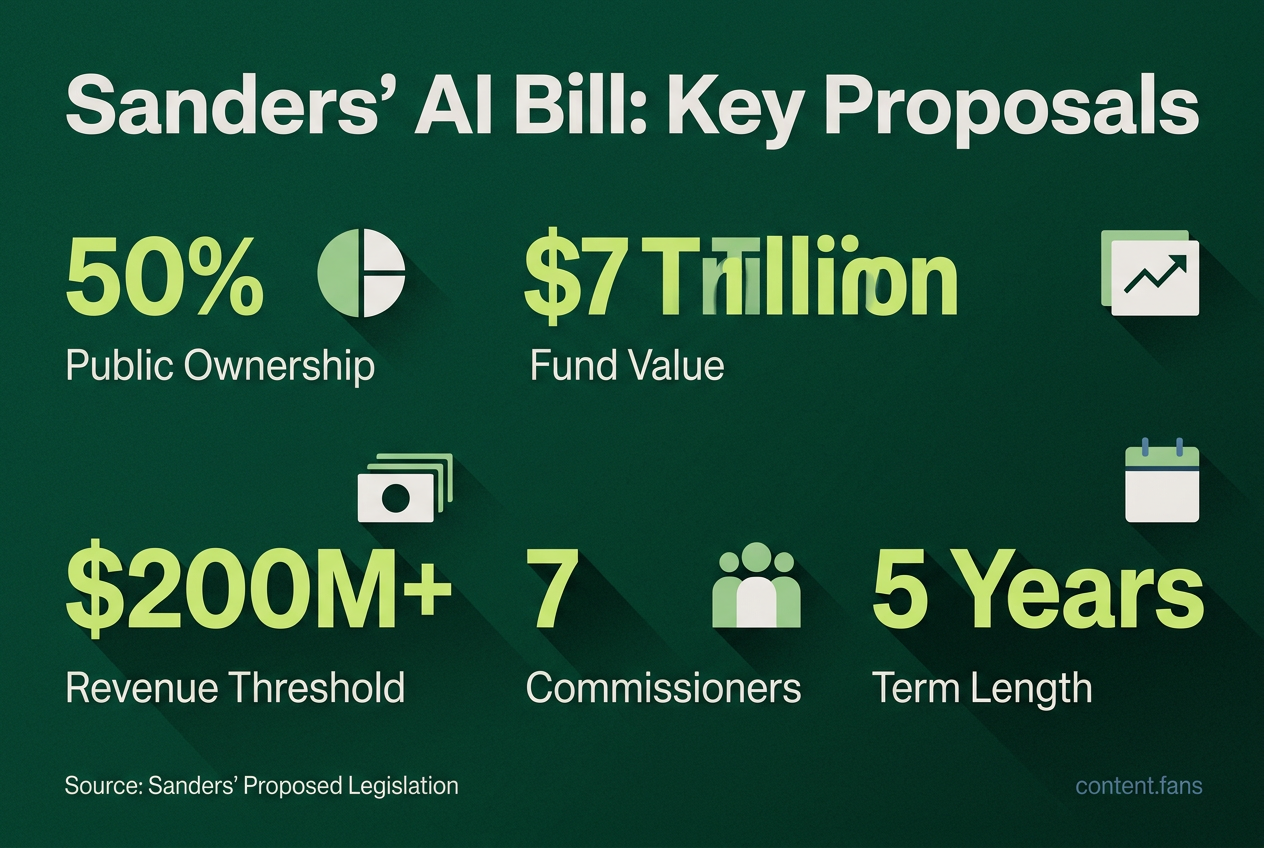
Under the proposal, AI companies with annual gross receipts of $200 million or more would face a one-time "50 percent stock tax." These firms would transfer half of their equity to a new sovereign wealth fund managed by a seven-person independent commission nominated by the President and confirmed by the Senate. Commissioners would serve five-year terms. Their role includes wielding voting power on corporate boards to block decisions deemed harmful to the public, with the commission seeking separate board seats in each company.
How much money and who pays
Treasury analysts estimate the stock transfer would establish a fund valued at approximately $7 trillion. The bill explicitly names OpenAI, Anthropic, and xAI as the primary examples. It applies to any AI firm with over $200 million in annual revenue, which could include Google and Microsoft, but they were not the specific companies highlighted in the initial announcement as the primary targets. Critics highlight that many of these companies are not yet issuing regular dividends, potentially limiting the fund's short-term cash flow. The proposal includes a mandatory breakup clause for conglomerates, ensuring the public stake is isolated to AI-specific operations.
Where the plan stands in Congress
As of June 23, 2026, Sanders has announced he would 'soon introduce' the American AI Sovereign Wealth Fund Act, but the bill has not yet been formally introduced as law or referred to committee. Political observers expect significant challenges for any such legislation in Congress. The proposal has drawn sharp criticism from industry groups, with concerns that it could stifle investment in the crucial, capital-intensive stages of AI development.
Expert views on government ownership
Expert opinions on government ownership models in technology are divided. Some researchers suggest that government equity stakes can provide patient capital, while others warn this could create challenges where regulatory oversight is compromised. Various analysts suggest that government partnership models - acting as a buyer, regulator, and infrastructure provider - could offer benefits with different risk profiles than direct ownership.
How would the fund acquire its 50% stake in AI companies?
The American AI Sovereign Wealth Fund Act would levy a one-time 50% stock tax on any AI-related firm with $200 million or more in annual gross receipts. Instead of cash, the Treasury would receive actual voting shares, instantly giving the public half-ownership of companies like OpenAI, Anthropic, and xAI. Estimates place the resulting fund at $7 trillion at current market valuations.
Who controls the fund and the voting rights attached to those shares?
Operational control would sit with a new independent commission - a seven-person panel nominated by the President and confirmed by the Senate. The Commission would exercise full voting rights, appoint board directors, and veto any corporate decisions deemed harmful to the American public. Terms would last five years and nominees must come from a bipartisan congressional shortlist.
How would the annual dividend reach citizens?
The bill proposes distributing 5% of the fund's total value annually as direct payments to every American (man, woman, and child), estimated at over $1,000 per person. This would be funneled through existing IRS payment rails. If companies do not yet pay dividends, the Commission can liquidate a portion of shares to fund the payout, ensuring the cash transfer happens regardless of current profitability.
Are there any global precedents for this kind of state ownership and citizen dividend?
Existing sovereign wealth funds - including Saudi Arabia's Public Investment Fund, Singapore's Temasek and GIC, and Abu Dhabi's Mubadala - have invested significantly in private tech companies, yet none distribute direct cash dividends to citizens. Norway's oil fund only channels returns into the national budget. Sanders' proposal would therefore be unprecedented in scale and structure for direct citizen dividends from technology investments.
What are expert views on innovation and investment under such heavy public ownership?
Policy researchers note that while government equity can supply patient capital, it may also raise questions about competition, private investment incentives and regulatory dynamics when the state is both owner and overseer. Some analysts caution that mixed ownership arrangements can create complex dependencies. Others conclude that partnership approaches - with government acting as buyer, regulator and infrastructure provider rather than shareholder - may offer alternative models for public-private collaboration in emerging technologies.