
Salesforce shares AI agent playbook from 20,000 enterprise deployments
Serge Bulaev
Salesforce has shared lessons from 20,000 enterprise AI agent deployments, and usage data suggests their use may be growing even more widely. Teams that succeeded often started small, set clear goals, and put trust and safety measures in place early. Salesforce says most of the work comes after launching, with teams needing to review and fix issues often. Adoption metrics suggest that use of these agents is quickly increasing, with the number of deals and conversations growing fast. Salesforce also notes that agents may soon work together and act through different systems, not just chat, and recommends watching agent behavior closely and improving it over time.

Salesforce has released its AI agent playbook, distilling key lessons from 20,000 enterprise deployments that highlight a clear path from pilot to full-scale production. With its own support agent processing millions of conversations, the company's data reveals critical strategies for success and points to rapidly accelerating adoption across the industry.
Pre-launch foundations
Successful AI agent deployment hinges on starting with a narrow scope, defining clear KPIs, and embedding trust and safety guardrails before launch. While architecture is important, Salesforce emphasizes that disciplined scoping and a focus on pre-launch fundamentals are the most critical factors for initial success. The company outlines an 'Agentic Enterprise' stack with distinct layers for engagement, agents, and systems of work, all grounded in a central context layer. A cross-cutting trust layer is essential for controlling policy and permissions at runtime, ensuring security from day one.
Post-launch workload dominates
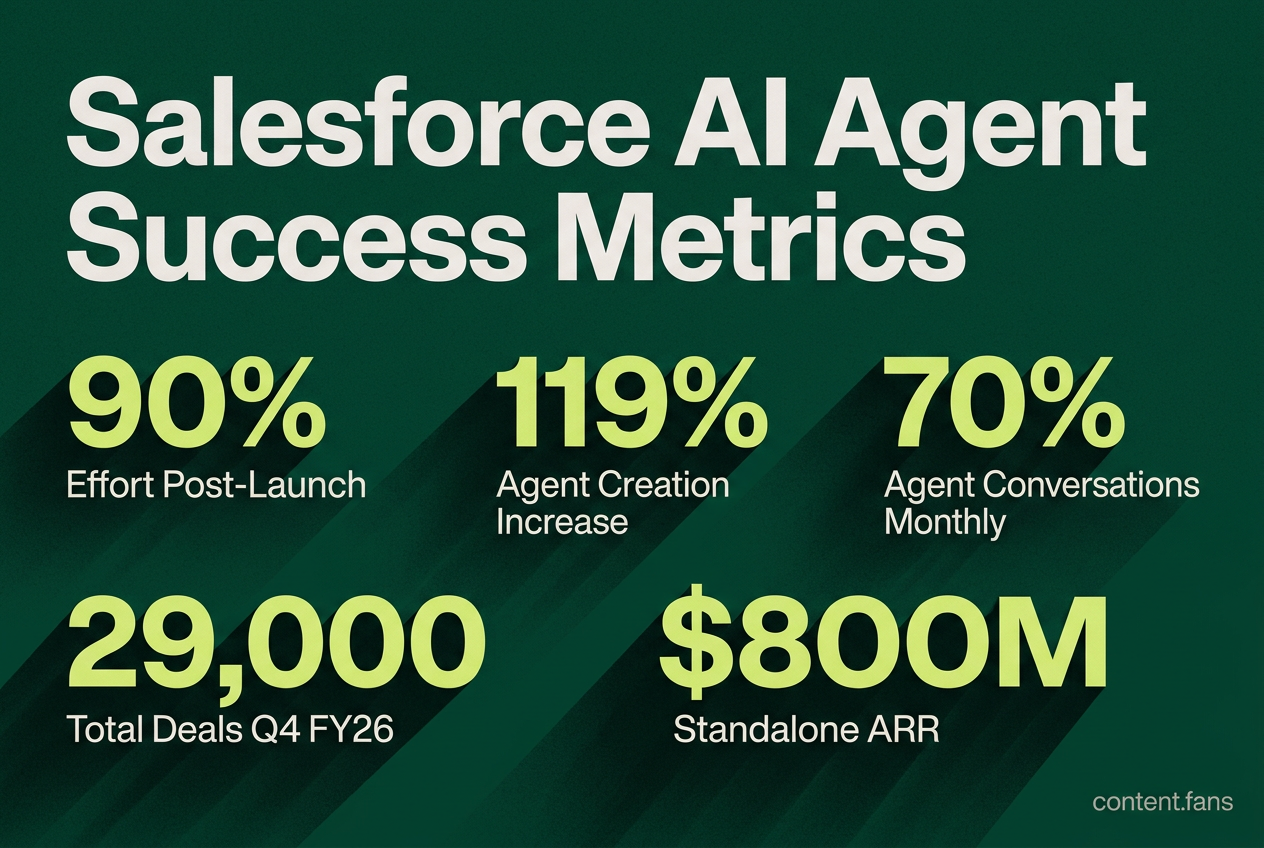
According to Salesforce, approximately 90 percent of the effort begins after an AI agent goes live. Successful teams establish rapid feedback loops to triage issues into distinct categories: tone, logic, data quality, and coverage gaps. Comprehensive conversation logging for replay and debugging is crucial. High-risk deployments require daily reviews, tapering to weekly only after performance metrics stabilize.
A common anti-pattern list has emerged:
- Over-relying on raw LLM reasoning instead of cheaper, safer rule-based systems.
- Attempting to "prompt harder" to fix issues instead of encoding policies in code or tools.
- Providing the agent with poor-quality or stale context, which degrades performance over time.
Adoption metrics in 2025-2026
Adoption metrics show significant growth in enterprise AI agent deployment. In Q3 FY2026, Futurum Group reported 18,500 Agentforce deals and over 9,500 paid contracts. By Q4 FY2026, subsequent analysis tracked 29,000 total deals, with an estimated $800 million in standalone Agentforce Annual Recurring Revenue (ARR).
Salesforce's H1 2025 "Agentic Enterprise Index" further validates this trend, showing a 119% increase in agent creation and a 70% monthly rise in agent-initiated conversations. This data indicates a significant shift from isolated experiments to full-scale production deployments.
Agents beyond chat
The future of AI agents extends beyond simple chat interfaces. Salesforce anticipates a shift toward multi-agent orchestration, where specialized agents collaborate and execute tasks via APIs and workflow triggers. As orchestration layers mature through 2026, enterprises will require stronger governance, auditability, and rollback capabilities for these autonomous actions. The current guidance remains pragmatic: launch a minimal viable agent, monitor its performance obsessively, and continuously refine its permissions and instructions in a perpetual operating loop.
What makes Agentforce deployments succeed after go-live?
Success after launch, where 90% of the work occurs, depends on establishing rapid feedback loops. Drawing on experience from its own agent - which has handled 3 million conversations using 135,000 help articles - Salesforce finds that systematically triaging issues into tone, logic, data, and coverage categories can cut stabilization time in half.
- Prioritize three core KPIs: task completion rate, human override percentage, and repeat-contact rate.
- Analyze escalation reasons daily for the first month, then weekly after metrics stabilize.
- Maintain a human-in-the-loop for any action involving financial transactions, data modification, or compliance.
Which anti-patterns kill agent performance most often?
Three common anti-patterns consistently degrade agent performance: over-relying on LLM reasoning for tasks suited to rules, attempting to fix problems by 'prompting harder' instead of encoding policy, and neglecting context engineering. Analysis of 20,000 deployments showed that moving policy into structured guardrails reduced errors by 38%.
- Use structured rules for core policies, reserving prompts for dynamic or nuanced situations.
- Implement version control for every model, prompt, and tool to make performance regressions traceable.
- Utilize logged sessions for replay and debugging to diagnose issues before considering a system-wide rollback.
How is multi-agent orchestration evolving in 2025-2026?
The year 2026 is projected as a key inflection point for scaling, with enterprises transitioning from single agents to supervisor-agent architectures. In this model, specialist agents collaborate on tasks overseen by a human or a primary meta-agent. Early adopters, particularly in finance and healthcare, are already leveraging modular agent teams, driving 70% quarter-over-quarter growth in production.
- Begin with bounded workflows that have clearly defined hand-off criteria between agents.
- Adopt open interoperability protocols to ensure agents can be flexibly recomposed for new tasks.
- Embed comprehensive audit trails and cancellation mechanisms into every inter-agent communication.
What ROI are real enterprises seeing from Agentforce?
The return on investment is tangible and accelerating. By Q4 FY2026, Agentforce had secured 29,000 deals and $800M in standalone ARR. A significant 84% of customers report improved satisfaction or positive ROI, typically achieving payback within 6-12 months. Some deployments have seen returns in just 4.5 months, while Salesforce's internal agent resolves 84% of cases autonomously.
- Demonstrate value quickly by tracking cost per resolved task and customer deflection rate.
- Prioritize low-risk, high-volume workflows to accelerate the payback period.
- Leverage existing knowledge bases (like Salesforce's 135k articles) to minimize training time.
What should be on the post-launch dashboard from day one?
An effective, enterprise-ready dashboard must track eight key metrics from day one: latency percentiles, task completion rate, tool success rate, human override rate, hallucination score, repeat contact rate, cost per task, and security violation count. Monitoring these metrics allows teams to identify 72% of production issues proactively.
- Configure alerts based on your own performance baseline, not generic industry averages.
- Manually review a 10% sample of agent outputs until the human override rate falls below 3%.
- Pause new feature development until drift detection confirms metrics have remained stable for at least 14 days.