
Salesforce Pivots AI Pricing to Seat-Based Model After Outcome Test
Serge Bulaev
Salesforce talked about charging customers based on the outcomes their AI creates, but found this hard to measure and scale. By late 2025, they said charging by the number of users (seat-based pricing) was becoming more common for their AI products. Industry trends suggest that mixed models - using both subscriptions and outcome-based fees - are growing, but measuring outcomes and making contracts can be difficult. Salesforce's CEO said the company is still figuring out the best way to price AI and may keep offering different options to customers.

Salesforce is adjusting its AI pricing strategy, shifting toward a seat-based model after experiments with charging customers based on generated outcomes proved difficult to scale. While CEO Marc Benioff had promoted an early vision of an "outcome era" where vendors would share in the value they create, the company has since prioritized more predictable licensing structures.
The Pivot from Outcomes to User Seats
The initial concept centered on monetizing measurable results like closed deals or recovered revenue. However, according to industry reports, Benioff acknowledged significant scaling challenges, noting that attributing results can be "hard to scale, because sometimes the outcomes are debatable." Industry reports suggest that seat-based pricing is becoming the norm for Salesforce AI. Analysts note that investors favor the stability of predictable subscription revenue.
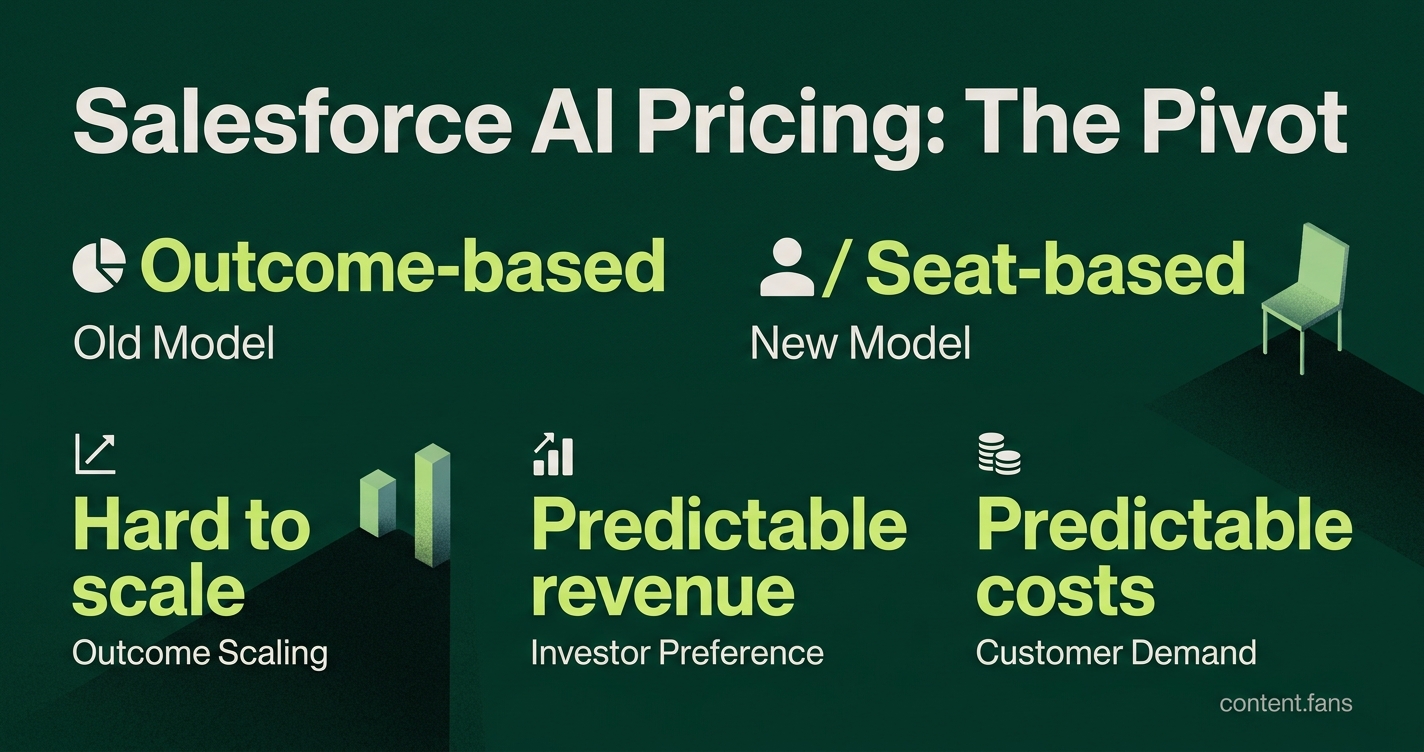
Salesforce shifted its AI pricing due to the complexities of measuring direct business results and strong customer demand for predictable, budget-friendly subscription costs. The company found that attributing specific outcomes to AI was often debatable, making a scalable, purely value-based model impractical for its enterprise clients.
Hybrid Pricing Models Gain Industry Traction
While Salesforce standardizes on seats, the broader software industry is embracing hybrid models. These strategies blend traditional subscriptions with usage or outcome-based metrics. Industry reports suggest such approaches could account for a significant portion of software revenue in the coming years. For example, Zendesk and Intercom charge for each AI-resolved ticket, while ServiceNow and Adobe bundle credits with base fees.
A few common approaches emerging in the market include:
- Fixed User Seats: Bundled with optional outcome-based bonuses (Salesforce licensing models).
- Per-Resolution Fees: Charging for each ticket or issue resolved by AI (Zendesk, Sierra).
- Credit Packs: Tying costs to completed workflows or tasks (ServiceNow).
- Consumption Meters: Billing based on the resources consumed by AI agents (UiPath, Automation Anywhere).
Measurement and Contractual Hurdles Remain
The move away from pure outcome-based pricing highlights persistent operational barriers. Reports from Monetizely and Vayu note that vendors must establish auditable baselines, build complex data pipelines for invoicing, and create contracts with clawback clauses for missed targets. Industry reports suggest these complexities can significantly lengthen sales cycles. Furthermore, finance teams grapple with variable-consideration accounting rules that complicate revenue recognition.
According to industry reports, Benioff maintains that flexibility is key, stating that Salesforce is "still working out the best approach" and aims to give customers choices. This aligns with industry projections, which suggest vendors will continue mixing seat, usage, and outcome levers as AI attribution methods mature.
What made Salesforce abandon outcome-based pricing for AI agents?
Customer demand for budget certainty was the primary driver. After early pilots revealed that buyers resisted variable, per-interaction fees, Salesforce has been developing new licensing models that provide finance teams with predictable annual costs while allowing for flexible agent usage.
How does the revised seat model still let Salesforce capture extra value?
According to industry reports, Benioff explained to investors that the new licenses can significantly multiply monetization. This is because a single employee seat now includes unmetered use of multiple agents. A sales representative can deploy research, email, and forecasting agents without incurring extra line-item charges, allowing deal sizes to expand under a simple "per-user" metric.
Are other large vendors following the same route?
Most large vendors are adopting hybrid models rather than returning purely to seats or outcomes. Adobe, ServiceNow, and UiPath blend base subscriptions with usage credits and performance kickers, while Zendesk and Intercom have already established per-resolved-ticket pricing. Industry data suggests mixed pricing is becoming the norm, with a growing number of SaaS vendors expected to offer outcome-based options in the coming years.
What operational hurdles delayed outcome-only pricing for Salesforce?
Attribution disputes and measurement gaps were the main obstacles. Benioff conceded that outcomes are "debatable" when multiple systems contribute to a result. Additionally, finance teams cautioned that variable consideration accounting complicates revenue recognition. Without standard metrics, each contract required lengthy legal negotiations, significantly extending sales cycles.
Will outcome pricing make a comeback once metrics mature?
Salesforce is keeping the option open. The company continues to offer Flex Credits that link cost to specific jobs-to-be-done, and its product teams are developing telemetry layers to better audit AI contributions. While the current strategy prioritizes "ultimate flexibility," insiders anticipate that outcome-linked bonuses may be integrated into future contracts once standard KPIs are established and customer trust is built.