
Anthropic nears $300M acquisition of dev tools startup Stainless
Serge Bulaev
Anthropic is in advanced talks to buy the developer tools startup Stainless for at least $300 million, according to several reports. The deal may be more strategic than just about size, since Stainless helps developers and AI agents connect to top AI models faster and is used by companies like OpenAI, Google, and Anthropic itself. Acquiring Stainless might give Anthropic more control over important developer tools that its rivals also use and could offer better insight into how its models are accessed. The final terms, including payment details, are still being worked out, and no official announcement has been made yet. The $300 million price appears to be a minimum, not a final number, and Stainless could still attract other buyers if the deal changes.

AI safety and research company Anthropic is nearing a deal for the acquisition of developer tools startup Stainless for at least $300 million. Reports describe the talks as "advanced," framing the potential purchase as a key strategic move for Anthropic to control essential AI development infrastructure (Marketscreener report). The acquisition would bring Stainless's software, which helps developers and AI agents connect to top AI models, in-house, giving Anthropic significant leverage over a toolset also used by competitors like OpenAI and Google.
What Stainless Brings to the Table
Stainless is a developer tools startup that creates software to help developers and AI agents connect more efficiently with large AI models. Its platform is already used by major AI companies, including Anthropic, OpenAI, and Google, making its acquisition a strategic move to control key infrastructure.
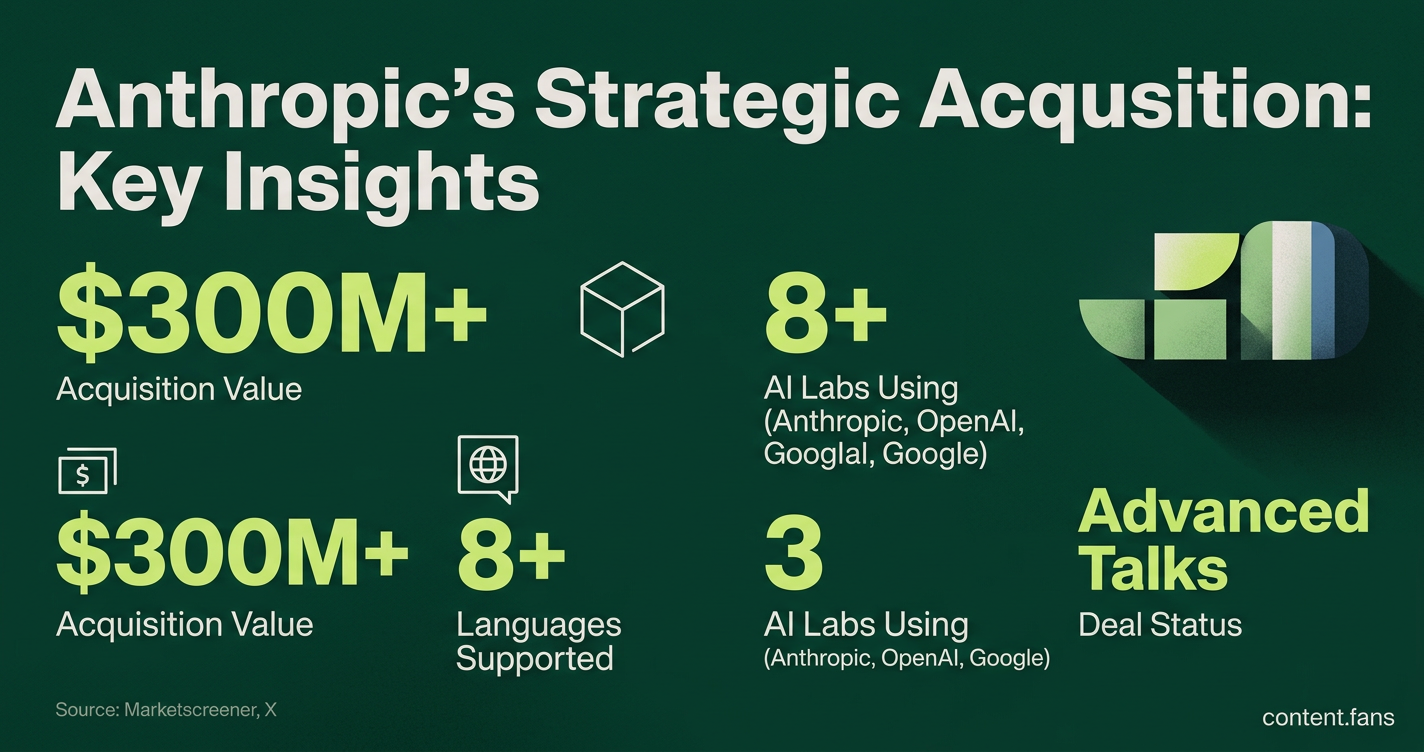
Stainless provides a platform that automates the generation of Software Development Kits (SDKs) from an OpenAPI specification. It currently supports eight programming languages, with plans to add Terraform, Rust, and Swift. The company's tools are praised for their idiomatic code and rapid performance. Core features include:
- Rich type support for improved autocompletion and documentation
- Built-in auto-pagination and exponential-backoff retries
- Streamlined authentication across all client libraries
According to reports, the platform is already used by major AI labs including Anthropic, OpenAI, and Google. This existing customer base highlights its strategic value, as acquiring the company would allow Anthropic to control "an important supplier of tech to rivals OpenAI and Google," as noted by Stephanie Palazzolo on X (X post).
Competitive Ripple Effects in the AI Market
The demand for model-access tools has surged with the growing use of AI agents like Claude Code and OpenClaw. Industry reports suggest significant growth in token processing volumes, highlighting a strong market for infrastructure that handles high-volume model interactions.
By acquiring Stainless, Anthropic could gain valuable insights into how developers and competing agent platforms use its models. This data could influence future pricing strategies and rate-limit policies, particularly as companies continue to adapt their services for agentic workloads.
Deal Status and Final Terms
As of May 13, 2026, no official announcement has been made by Anthropic, Stainless, or other involved parties. Reports suggest the final payment could include Anthropic stock, and negotiations are ongoing. If the deal does not close, Stainless is expected to remain a highly attractive acquisition target for other major tech companies looking to enhance their AI development capabilities.
What is Stainless and why is Anthropic willing to pay a significant sum for it?
Stainless is a startup that automatically turns OpenAPI specs into production-grade SDKs in eight languages - TypeScript, Python, Go, Java, Kotlin, Ruby, PHP and C#. Instead of hiring a dedicated team for every language, an API provider uploads its spec and gets idiomatic, type-safe client libraries that already include auto-pagination, exponential-back-off retries and seamless authentication. The service starts at $250 per month and is already trusted by Anthropic, OpenAI and Google to ship the libraries their own developers download every day.
How does the Stainless engine actually work?
A user drops an OpenAPI file into the Stainless dashboard - "it doesn't have to be perfect," the company says - and the platform returns a complete SDK in minutes. Behind the scenes the generator is tuned for code readability and debuggability: Hacker-news testers praise the resulting code base as "easier to navigate than any competitor," and recent benchmarks show 30 of 31 test cases scoring 1.0 for correctness while still finishing in the fastest time (68.7 s). A companion Stainless Studio lets engineers refine the spec visually before the final build, removing the usual SDK maintenance burden.
Why is ownership of Stainless suddenly strategic in the AI-agent era?
The rise of long-running agents such as Claude Code and OpenClaw has turned model access from an occasional call into a persistent, high-volume stream. According to industry reports, token traffic has grown substantially, and Claude Code alone is generating significant revenue. Owning the layer that packages and delivers the models - Stainless - gives Anthropic direct influence over how developers, non-technical users and rival agents consume its own and competitors' endpoints.
Would the deal cut off OpenAI and Google from the same tooling?
Not immediately. If the acquisition closes, Anthropic will control the roadmap of a library generator that OpenAI and Google rely on today. The same sources that revealed the price tag note the talks are still "advanced" but not final, and one analysis frames the move as a way to "take out an important supplier of tech to rivals." Long term, Anthropic could prioritise Claude-specific features or pricing, nudging the ecosystem toward its own stack while still collecting licensing revenue from competitors.
How big is the market for SDK and model-access tooling, and who competes with Stainless?
Industry analysts expect a significant portion of enterprise applications to embed task-specific agents in the coming years, pushing the total agent-related market to substantial growth. Beyond Stainless, developers can choose Fern (adds WebSocket, gRPC, on-prem installs), Speakeasy (GitHub-native) or legacy platforms such as Postman and MuleSoft. None of the alternatives, however, matches Stainless's combination of speed, language breadth and polished idiomatic output, which is why Anthropic is willing to pay a premium before someone else does.