
CEPI Adopts AI to Speed Pandemic Vaccine Development, Hits Beta in 2026
Serge Bulaev
CEPI is using artificial intelligence to make pandemic prediction and vaccine development much faster with its Pandemic Preparedness Engine (PPE). By 2026, the PPE may help researchers find vaccine targets in minutes or days instead of months, but there are still technical and data-sharing challenges. Funding comes from governments, organizations, and grants, and CEPI is working with partners in different countries. Some experts say making a vaccine in 100 days might still be hard for some diseases. New AI tools and safety rules are being tested, and more progress may be seen by 2027 as these systems are built and checked.

The Coalition for Epidemic Preparedness Innovations (CEPI) is using AI to accelerate pandemic vaccine development with its Pandemic Preparedness Engine (PPE), a platform designed to significantly reduce the time needed to identify potential vaccine candidates. According to its plan for a global AI platform, the initiative aims to create a virtual R&D collaborator for scientists worldwide. While the PPE is in development, significant technical and data-sharing challenges remain.
Core Features in Development
CEPI's PPE is a planned end-to-end digital platform in development, with core features described but not yet at beta. The platform is designed to analyze genomic, epidemiological, and manufacturing data. Industry reports detail its core AI functions: synthesizing research data, optimizing mRNA production investments, and acting as a "digital radar" for emerging threats CEPI's Pandemic Preparedness engine uses AI to predict outbreaks. The platform's initial model training focuses on coronaviruses, filoviruses, and arenaviruses.
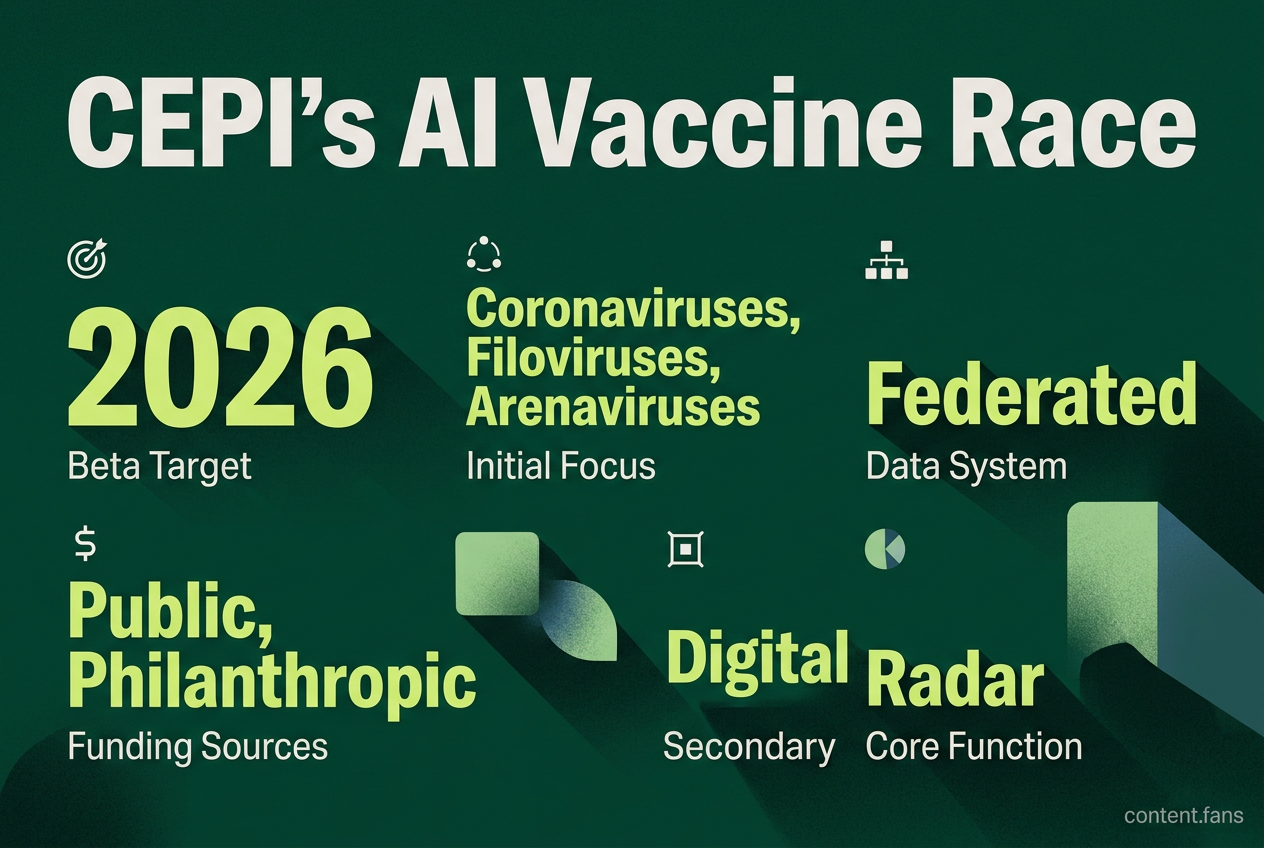
The engine trains on data from CEPI's internal vaccine repository and partner datasets. Through active collaborations on antigen design and supply-chain analytics AI projects, CEPI is developing a federated system of secure, shared data nodes rather than a single centralized database.
Funding Streams and Early Milestones
Development of the PPE is backed by a mix of public and philanthropic funding. Recent key investments include:
- Funding from Sentinel Bio to promote responsible development and reduce biosecurity risks associated with PPE Sentinel Bio.
- An agreement with the Pan American Health Organization (PAHO) to build an AI-enabled clinical intelligence platform PAHO news.
- Progress noted in the CEPI 3.0 Strategy, including support for multiple vaccine candidates and candidates designed with AI techniques.
These allocations build upon previous support from Germany, Japan, Norway, the Gates Foundation, and the Wellcome Trust, as detailed in CEPI's AI overview Artificial intelligence.
Technical and Biosecurity Hurdles Remain
CEPI's Pandemic Preparedness Engine faces significant challenges, including the integration of vast, disparate datasets and ensuring equitable access in low-resource regions. Key technical hurdles involve scaling up thermostable mRNA vaccine manufacturing and establishing real-time global surveillance systems, which remain logistical constraints to the 100-day vaccine goal.
To address data and hardware gaps, CEPI is establishing regional "AI factories" in Africa, Asia, and Latin America. However, experts caution that the ambitious vaccine timeline targets may face challenges for complex pathogens due to ongoing manufacturing and surveillance constraints. Biosecurity is another primary concern. CEPI is implementing a "biosecurity-by-design" framework with researcher vetting and real-time monitoring to prevent the misuse of its powerful generative AI models.
Outlook: Key Milestones Ahead
Key milestones that will signal the PPE's progress include:
1. Completion of the first "AI factories" and their cloud infrastructure.
2. External validation studies that confirm PPE-suggested antigen designs accelerate preclinical timelines.
3. Regulatory sandbox pilots that test the PAHO clinical intelligence platform in real-world scenarios.
The achievement of these milestones will be a strong indicator of CEPI's progress toward a system capable of moving a vaccine prototype to clinical production within the 100-day target.
What exactly is CEPI's Pandemic Preparedness Engine?
The Pandemic Preparedness Engine (PPE) is an AI-powered platform that acts like a "ChatGPT for vaccine developers". It integrates genomic data, epidemiological reports, and regulatory pathways into a single secure workspace. Researchers can ask the system natural-language questions such as "Which antigens look most promising for a novel coronavirus?" and receive candidate vaccine designs significantly faster than traditional methods.
How realistic is the 100-day vaccine target?
According to industry reports, real-world projects show dramatic timeline compression:
- Antigen discovery can now be completed much faster than traditional methods
- Clinical-trial data analysis that once required significant time can be rerun much more quickly using AI tools
- CEPI's own Vaccine Library stores many pre-validated antigen blueprints for priority virus families, ready to be pulled off the shelf when a new threat emerges
Industry consensus suggests that ambitious vaccine timeline goals are achievable for coordinated, well-funded efforts, provided manufacturing and regulatory frameworks keep pace.
What AI technologies power the platform?
The engine combines machine-learning models already proven in other outbreaks:
- Random forests and gradient boosting for supply-chain optimization
- Deep-learning networks (CNNs, RNNs, GANs) for epitope prediction and adaptive trial simulation
- Generative language models - similar to ChatGPT - that let scientists query datasets in plain English and get step-by-step R&D guidance
These components sit on high-performance "AI factories" spread across multiple continents to avoid single-point failures.
How does CEPI address biosecurity and data-access concerns?
CEPI has adopted a biosecurity-by-design policy:
- All data and tools are pre-screened for dual-use risk
- Role-based access limits sensitive capabilities to verified institutions
- A dedicated AI/biosecurity approach, supported by funding to promote responsible development, monitors usage patterns
Who else is building comparable systems?
According to industry reports, few organizations offer comprehensive, ChatGPT-style vaccine accelerators. Related efforts - such as UC Davis' SpillOver platform or the Rosetta immunogen-design suite - focus on narrower tasks like viral-risk ranking or protein-structure modeling and are already feeding their outputs into CEPI's engine rather than competing with it.