
Salesforce Marketing Cloud Unveils AI Predictive Tools, Flow Builder Upgrades
Serge Bulaev
Salesforce Marketing Cloud's new updates include AI tools that may help predict customer actions and automate marketing tasks. Real-time data syncing and improved Flow Builder features suggest users can quickly connect and use data across different systems. Some features, like Predictive Scores and Audiences, are in public beta and might change as they develop. Experts believe these changes could make marketing more data-driven, but full benefits may depend on data quality, licensing, and user training. Salesforce appears to be moving toward one data system and easier automation, but how fast companies use these tools might vary.

The latest Salesforce Marketing Cloud release introduces powerful AI predictive tools and significant Flow Builder upgrades, advancing its enterprise automation capabilities. These updates represent significant enhancements for marketers according to industry reports.
AI-driven predictive analytics
Salesforce is launching new AI-driven predictive analytics through its "Predictive Journeys" initiative. This includes Predictive Scores to rate customer action likelihood and Predictive Audiences for instant segmentation. These features aim to shift marketing from reactive messaging to data-informed, proactive engagement.
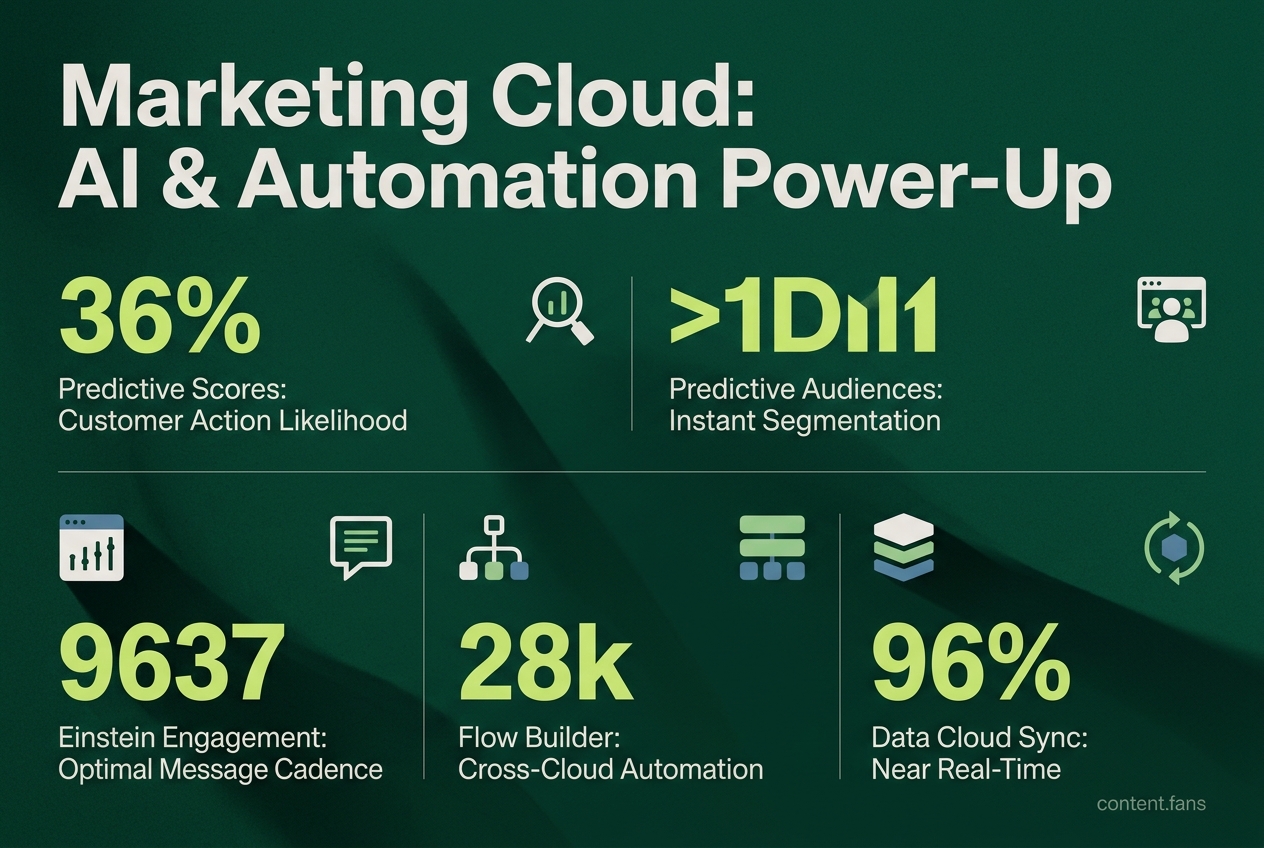
The "Predictive Journeys" initiative bundles Predictive Scores and Predictive Audiences. Both are in testing phases, with Scores assigning a likelihood rating for actions like opens or purchases, and Audiences using those scores for segmentation.
The Einstein AI layer also receives several key enhancements:
- Einstein Engagement Frequency: Now available in the Enterprise edition, this tool estimates the optimal message cadence for each contact.
- Einstein Send Time Optimization: The Winter '25 update made this feature business-unit aware, improving its precision across different teams.
- Multi-Touch Attribution: Released in the Winter '24 release, this gives marketers clear visibility into which touchpoints drive revenue.
Industry experts note these tools enable a strategic shift from reactive messaging to data-driven journeys, although successful implementation depends on data integrity and appropriate licensing.
Enterprise automation inside Flow Builder
Recent releases establish Flow Builder as the central engine for cross-cloud automation. Marketers can now trigger Marketing Cloud Engagement emails directly from a Flow, even passing complex JSON from Apex for transactional messages. On-demand flows can also be launched via API, allowing events like a web registration to instantly trigger an SMS.
Journey Builder also receives key efficiency updates. The Path Optimizer feature can automatically promote the winning branch based on performance metrics, while the Wait Until Event activity accepts custom events (API events) defined in the system, not just email clicks. These enhancements reflect a move toward dynamic, outcome-based orchestration over rigid, pre-scheduled campaigns.
Real-time data synchronization with Data Cloud
Data Cloud streams to Marketing Cloud with near-real-time synchronization capabilities. Structured data ingested from CRM and Commerce Cloud typically still consumes Data Cloud credits for ingestion and storage, though specific pricing tiers or exemptions may apply. Additionally, a new data-space selector in Flow ensures automations pull from the correct data source.
Agentforce and new automation agents
The Summer '26 release introduced the Account Nurturing Agent, an AI-powered routine that identifies buying groups and automates follow-ups as sales opportunities evolve. This builds on the Summer '26 enhanced Agentforce Service Agent email handling capabilities (via Agent Script) for more deterministic and governed behavior, blurring the lines between marketing and service interactions.
Edition availability snapshot
Feature availability is tied to specific Marketing Cloud editions. Einstein Engagement Frequency and Scoring are typically available in Enterprise or higher editions of Salesforce. Note that licensing structures for features may evolve upon their general release.
Expanded third-party integration options
New Data Pipelines enable data ingestion from over 50 external sources using a simple three-click setup. Furthermore, Flow Builder can now orchestrate messages containing data from MuleSoft or other middleware, which simplifies complex integrations that once required custom API development.
Marketing Cloud Personalization now features enhanced real-time click-through tracking for external campaigns. This allows for immediate cross-channel decisioning when a visitor arrives from a partner site. While impression tracking isn't included, the immediate click data is sufficient for triggering relevant next-best-offer logic.
Taken together, these updates show Salesforce standardizing on a single data layer (Data Cloud) and declarative automation (Flow Builder), using AI to enhance prediction and attribution. The pace of enterprise adoption will likely depend on factors like data governance, user training, and the ability to demonstrate incremental ROI.
What new AI predictive capabilities are launching in Marketing Cloud and when?
Salesforce's Predictive Journeys initiative is in testing phases according to industry reports.
It delivers two headline features:
- Predictive Scores - every contact receives a likelihood-to-act score (open, click, purchase, churn) updated in near real-time.
- Predictive Audiences - auto-builds segments from those scores, letting marketers suppress fatigue-risk contacts or double-down on high-propensity buyers.
Additional AI helpers that became generally available:
- Einstein Engagement Frequency - pinpoints the exact number of messages each contact can tolerate before unsubscribing.
- Einstein Send Time Optimization - predicts the hour and day a person is most likely to engage and queues the send automatically.
- Multi-Touch Attribution - traces touchpoint revenue impact along the customer journey, released in the Winter '24 release.
How do the Flow Builder upgrades change day-to-day campaign execution?
Marketers can now trigger Marketing Cloud Engagement emails directly inside Salesforce Flows without writing code or switching screens.
Three concrete wins:
- Apex data mapping - complex order, renewal, or invoice data from external systems can be injected into an email payload from within the same Flow step.
- On-demand API flows - a single REST call can spin up a Flow that sends an SMS or email the moment a web form is submitted.
- Conditional completion - new branching logic runs a post-send segmentation job only when the prospect meets chosen criteria, eliminating the need for separate automation studio programs.
The upgrade effectively collapses CRM orchestration and marketing execution into one canvas.
What real-time data synchronization improvements ship with recent releases?
Data Cloud serves as the profile layer for Marketing Cloud.
Key upgrades:
- Data ingestion - structured data from Sales Cloud, Service Cloud, Commerce Cloud, and over 50 external sources via Data Pipelines can be connected, though credit consumption varies by pricing tier.
- Granular source control - you can pick which objects, fields, or events feed dynamic email content, letting you keep PII out while still personalizing.
- Safe migration of form-triggered flows - when moving between sandbox and production, the form data mappings travel with the flow, preventing sync breakage during enterprise deployments.
Which third-party integrations received the biggest boost?
- 50+ pre-built Data Pipelines (Google Ads, Amazon, Facebook, etc.) connect in three clicks - no ETL scripts required.
- Canvas SDK and Lightning Container now allow marketers to embed external dashboards (e.g., Power BI, Looker) inside Journey Builder so they can tweak audiences without leaving the canvas.
- Marketing Cloud Personalization captures real-time click-throughs from external campaigns and immediately surfaces that signal in decisioning logic, enabling cross-channel next-best-action within seconds.
How should organizations prepare for these updates today?
- Audit your current data sources - list every CSV import, FTP job, or custom API; many can be replaced by the new Data Pipelines once generally available.
- Skill-up on Flow Builder - every admin who can write a screen flow can now own entire trigger-based email or SMS journeys; schedule Trailhead modules for upcoming releases.
- License check - Einstein Engagement Frequency and Scoring are typically available in Enterprise or higher editions of Salesforce; budget planning should reflect appropriate licensing requirements.