
Salesforce acquires m3ter, pivots to usage-based AI pricing
Serge Bulaev
Salesforce recently announced plans to buy m3ter, a company that measures and manages how much customers use software, and may move to usage-based pricing for its AI products. Around the same time, Salesforce confirmed layoffs, with reports suggesting fewer than 1,000 jobs cut, as the company shifts toward AI-focused roles. This move appears to be part of a larger strategy to reduce costs and focus on new AI revenue models, but some reports say employees feel uncertain. The stock price has dropped, and Wall Street's reaction is mixed, with some analysts citing possible short-term challenges from layoffs and the m3ter deal. More information on the changes and their effects may come when Salesforce shares its next financial results.

Salesforce is making significant strategic moves, highlighted by its plan to acquire m3ter and pivot toward usage-based pricing for its AI products. These developments, coupled with a new round of layoffs, have caused investor uncertainty and market volatility, even as analysts watch for long-term AI-driven growth.
Layoffs Tighten Spending for AI Expansion
Salesforce is undertaking a strategic realignment, acquiring usage-metering specialist m3ter to support a new pay-as-you-go AI pricing model. Concurrently, the company is reducing its workforce by fewer than 1,000 roles to shift resources and skills toward its expanding AI-centric product lines.
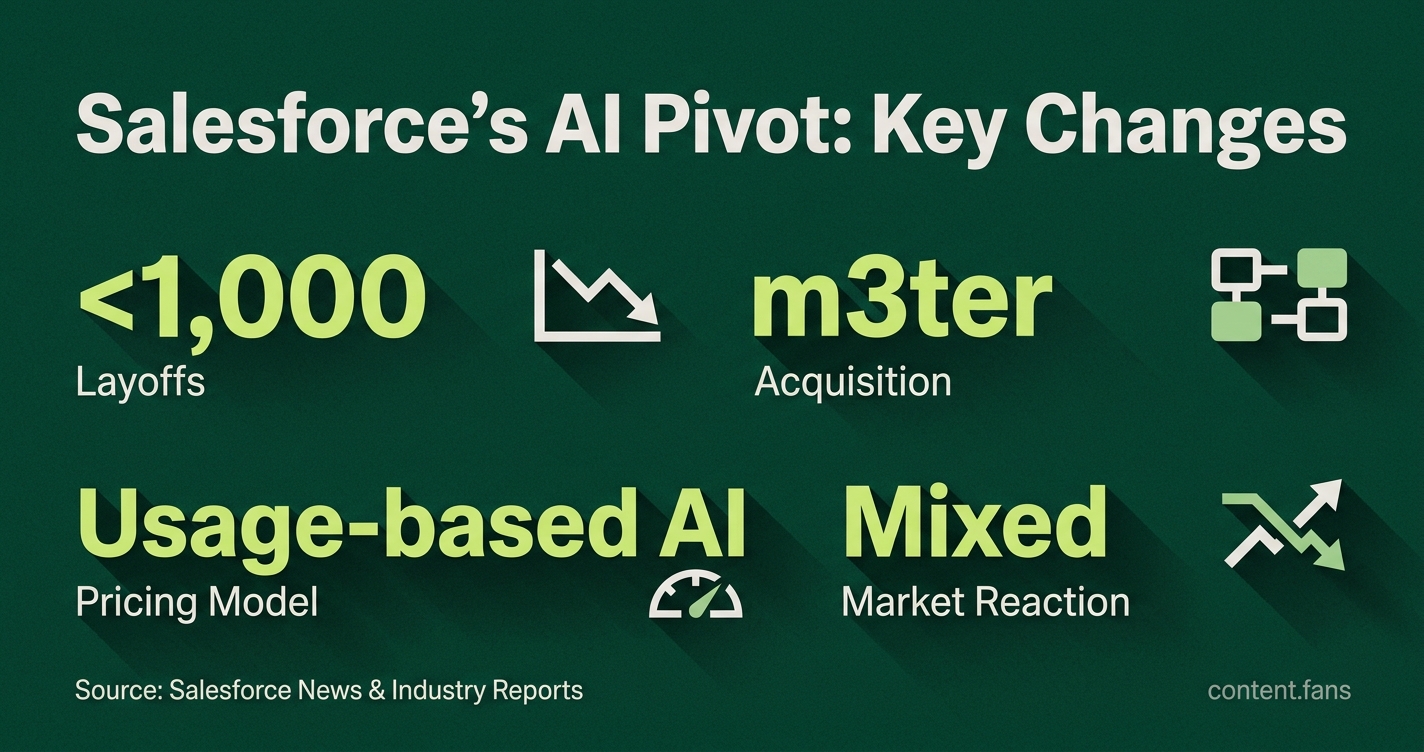
In early June, Salesforce initiated layoffs impacting "fewer than 1,000" employees across its Agentforce, MuleSoft, and Marketing Cloud units. According to Business Insider, management presented the cuts as a necessary realignment to support AI-focused product development, which requires a different mix of skills. This move aligns with CEO Marc Benioff's previous statements that AI efficiencies would mean the company "needed fewer heads," signaling a strategic shift away from roles supporting legacy license revenue.
m3ter Acquisition Enables Usage-Based AI Revenue Models
One day before the layoffs were reported, Salesforce announced its definitive agreement to acquire m3ter, a platform designed to meter and manage high-volume software usage. According to the Salesforce statement, m3ter will be integrated into Agentforce Revenue Management, enabling customers to deploy pay-as-you-go and outcome-based pricing models directly within the CRM. This acquisition provides the critical infrastructure to monetize AI agents, API calls, and automated workflows by consumption volume rather than by traditional per-user licenses. Financial terms of the deal were not disclosed.
Wall Street Reaction Remains Mixed Amid Strategic Shift
The combination of layoffs and the m3ter acquisition triggered a market retreat, with Salesforce's stock experiencing notable declines in mid-June according to industry reports. Despite the short-term volatility and downward price target revisions, overall analyst sentiment remains positive. A significant majority of analysts maintain favorable recommendations, with many setting optimistic price targets. Investors appear to be weighing the immediate margin pressures of the restructuring against the long-term potential of a high-margin, consumption-based AI revenue stream.
Further details on the financial impact of these strategic changes, including cost savings from the workforce reduction and early adoption of new pricing models, are anticipated in Salesforce's upcoming second-quarter financial results.
What does Salesforce gain by acquiring m3ter?
Salesforce gains native, high-volume metering and rating capabilities inside Agentforce Revenue Management. The deal gives customers the ability to launch, track, and bill usage-based and outcome-based pricing models without leaving the Salesforce platform. Salesforce also eliminates the need for external billing tool integrations, which should shorten billing cycles and cut reconciliation errors. Financial terms are not disclosed, but the impact is expected to be product and revenue-model expansion rather than a near-term profit boost.
Why is this the moment to pivot to usage-based AI pricing?
Agentforce already processes billions of AI-driven API calls and agent actions each month. Industry reports suggest that AI services, APIs, and agents represent a significant revenue opportunity, but only if Salesforce can meter and monetize consumption at scale. By embedding m3ter's near real-time ingestion and dynamic rating, Salesforce positions itself to capture incremental revenue from every model invocation, workflow, or agent outcome, turning variable AI workloads into predictable revenue streams.
How will customers actually bill for AI usage after the integration?
• Metering: m3ter ingests product-usage data in near real-time, so customers can capture per-token, per-query, or per-result volumes.
• Rating & Invoicing: configure tiered, tier-plus-overage, or outcome-based pricing directly inside Agentforce Revenue Management.
• FinOps dashboards: built-in spending alerts, quotas, and chargeback reports help customers monitor and control AI costs.
This single-path approach replaces the multi-tool sprawl that many enterprises use today, reducing implementation time from months to days.
Which Salesforce teams are affected by the June layoffs and why?
A California WARN notice lists 86 roles in California, while broader reporting points to Agentforce, MuleSoft, and Marketing Cloud divisions worldwide. The cuts appear to be reshaping staffing around AI productivity rather than broad cost-cutting: sales operations, general administration, and overlapping product/engineering functions were trimmed, but the core Agentforce engineering team was reportedly spared. Marc Benioff previously stated that AI automation is creating a need for fewer support heads, aligning headcount with the company's consumption-based monetization shift.
What does the stock drop say about investor sentiment?
Salesforce shares experienced significant declines over multiple trading sessions in mid-June according to market reports. Despite the price drop, a significant majority of analysts maintain favorable ratings, with many setting optimistic price targets. Investors seem to be weighing near-term margin pressure from layoff costs and acquisition integration against long-term upside from higher-margin, usage-based AI revenue.