
Salesforce acquires Fin for $3.6 billion, boosts Agentforce AI
Serge Bulaev
Salesforce has agreed to buy the AI customer-service firm Fin for about $3.6 billion, which may make its Agentforce automation platform stronger. Fin reportedly helps over 30,000 companies and can resolve up to 76 percent of support tickets automatically. This deal suggests Salesforce wants to focus more on customer-service agents designed for specific tasks, and it might help businesses use autonomous agents more easily. Some analysts say this move could increase competition with other big tech companies in the AI agent market. The integration may give customers more ways to use and control AI agents within Salesforce's systems.

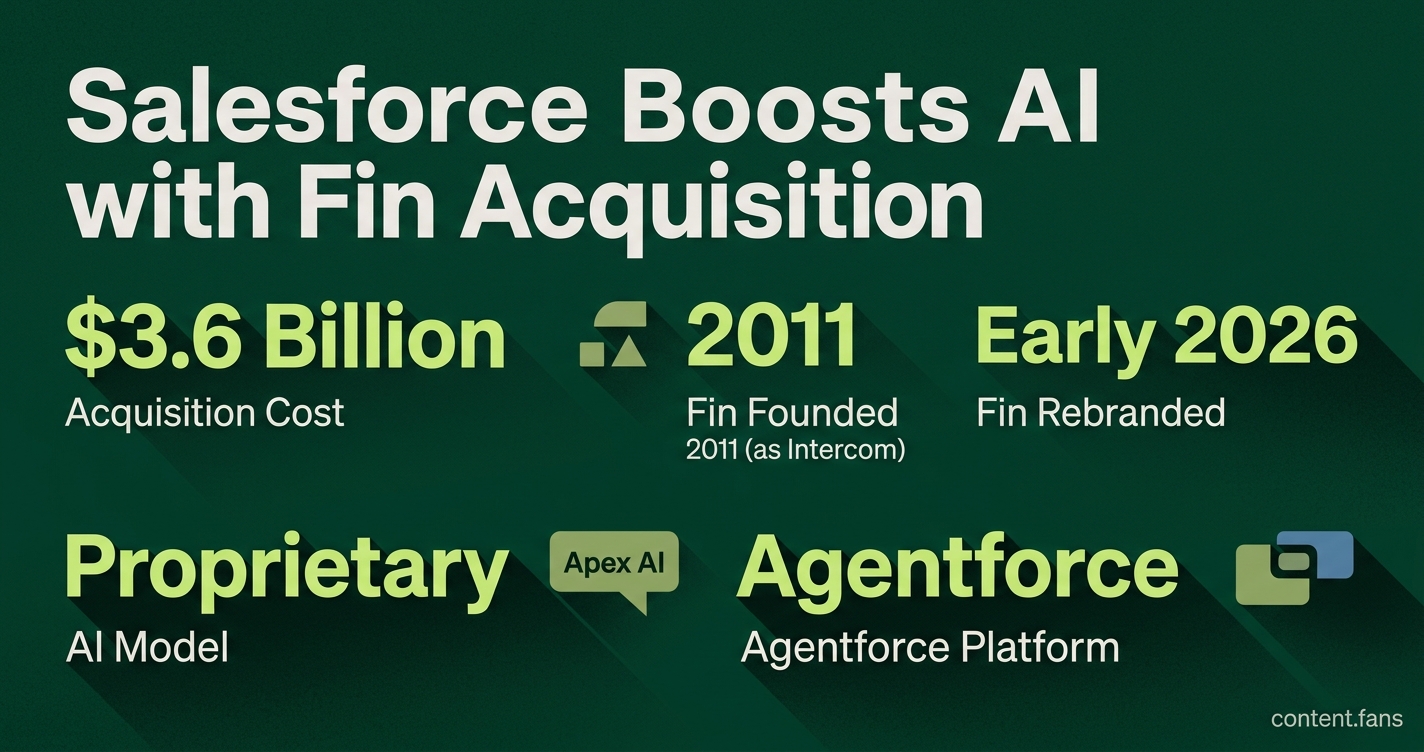
In a landmark deal, Salesforce acquires Fin, an AI-powered customer service firm, for approximately $3.6 billion. The acquisition, confirmed in a CNBC report, is set to significantly strengthen Salesforce's Agentforce automation platform. A Salesforce announcement highlights that Fin brings rapid deployment options, proprietary AI models, and a substantial customer base, enabling broader access to autonomous agents at scale.
This strategic purchase signals a major industry shift away from general-purpose AI copilots toward highly specialized, domain-specific agents for customer service. The move positions Salesforce's Agentforce platform as a more formidable competitor in the rapidly evolving enterprise AI market of 2026.
What Fin Brings to Agentforce
Salesforce is acquiring Fin to integrate its advanced, end-to-end support automation capabilities into the Agentforce platform. Fin adds a proven system trusted by many companies, featuring a proprietary AI model that can autonomously resolve a significant portion of customer support tickets across multiple channels.
Formerly known as Intercom (founded 2011) and rebranded in early 2026, Fin specializes in end-to-end support automation. The platform processes a substantial volume of support incidents for its growing user base. Central to its success is a proprietary Apex AI model, which is fine-tuned for customer support and allows clients to achieve significant ticket resolution without human intervention. Fin's capabilities include multichannel communication (chat, email, WhatsApp, SMS, voice, Slack) and customizable workflows via its 'Fin Procedures' tool.
Strategic Rationale and Market Context
The acquisition provides a critical boost to Agentforce, which has shown strong growth according to industry reports. By integrating Fin, Salesforce adds a turnkey AI agent solution designed to accelerate deployment for small and midsize businesses, while still offering the robust governance and customization features required by large enterprises.
Industry analysts view this as a decisive move in the race among tech giants to dominate the "agent layer" - the software that orchestrates foundational AI models. Key competitors include Microsoft's Copilot Studio, Google's Vertex AI with Gemini, AWS's Bedrock agent tools, and ServiceNow's workflow automation. While rivals focus on productivity suites (Microsoft) or AI infrastructure (Google, AWS), Salesforce aims to win with its deep, native CRM integration, low-code tools, and secure data governance within Customer 360.
Key Numbers at a Glance
- Deal Value: ~$3.6 billion
- Fin's Customer Base: Substantial enterprise presence
- Agentforce Performance: Strong growth according to industry reports
- Apex Model: Significant autonomous resolution capabilities
- Incident Volume: High-volume processing capabilities
Early Integration Signals
Salesforce has confirmed that Fin's technology will integrate directly with its core AI tools, including Agent Builder, the Atlas Reasoning Engine, and the new Agent Script language. This integration will offer customers greater flexibility in AI model orchestration and voice capabilities, alongside expanded support for models from OpenAI, Anthropic, and Google, all managed under the security of Data 360.
For the market, this acquisition intensifies pressure on competitors to offer similarly packaged, fast-to-deploy AI agent solutions with strong interoperability. For Salesforce customers, the merger promises to significantly lower the barrier to entry for adopting powerful autonomous agents, all while ensuring business processes remain securely within the trusted Customer 360 data environment.
What exactly is Salesforce buying in this major deal?
Salesforce is acquiring Fin - the customer-agent platform that evolved from Intercom - to add turnkey autonomous support to its Agentforce line. Fin brings a proprietary Apex language model, proven workflows that already resolve a significant portion of customer volume without human touch, and an installed base of many companies. The combination will let Agentforce customers launch an AI agent in hours instead of weeks while keeping the deep Salesforce integration they expect.
How will Fin's technology plug into the existing Agentforce platform?
Fin's stack is being embedded as the fast-deployment tier inside Agentforce, sitting next to the existing low-code Agent Builder canvas. Customers who need immediate time-to-value can deploy a pre-tuned Fin agent across chat, email, WhatsApp, SMS, Slack, and voice; those who require deeper orchestration can still use Agent Builder scripts or the Atlas Reasoning Engine. Both paths will run on the same Customer 360 data layer, so permissions, audit trails, and escalation to humans remain consistent.
What does this mean for Salesforce's competitive position against Microsoft, Google, and ServiceNow?
With Fin inside Agentforce, Salesforce now offers two things rivals currently lack:
- CRM-native autonomy - agents can update Salesforce records, trigger Flows, and access governed data in real time.
- Packaged plus customizable - SMBs get instant value while enterprises keep full control.
Industry analysts see the move as Salesforce racing to own the customer-service agent layer and pushing competitors to match a dual-speed deployment model.
Which customer segments will feel the biggest impact first?
Mid-market and commercial teams that rely on Service Cloud but do not have large in-house AI teams are expected to adopt Fin-powered agents fastest. Salesforce says these organizations will see lower cost-to-serve and faster ROI because Fin's workflows are already tuned for common support intents. Enterprise accounts will benefit later via deeper integration with Sales Cloud, Field Service, and Commerce Cloud.
When will the new capabilities reach existing Agentforce customers?
Salesforce announced the definitive agreement on June 15, 2026, and typical Salesforce acquisitions close within 90 to 120 days. Early-access pilots are likely to start in Winter '27, with general availability planned for Spring '27. Current Agentforce customers can expect a seamless license upgrade path and self-service migration guides when the deal closes.