
SaaS 'Max Bill' Guarantee Caps Enterprise AI Spending Ahead of $2 Trillion Market
Serge Bulaev
The SaaS 'Max Bill' Guarantee aims to limit how much companies spend on AI each month as costs for language models and GPUs may rise sharply and unpredictably. Experts suggest AI spending could reach $2 trillion by 2026, and many companies reportedly went over their budgets in 2025. The Max Bill service may help by offering a set maximum bill, monitoring usage in real time, switching to cheaper models if needed, and giving refunds if spending goes over the limit. No major cloud provider currently promises this type of total cost cap, so this new guarantee could fill a gap for businesses worried about unexpected AI costs.

As worldwide AI spending climbs toward Gartner's projected $2.59 trillion in 2026, organizations are exploring new approaches to control the sharp, unpredictable rise in AI costs from language models and infrastructure. Companies like MaxBill are developing next-generation AI billing solutions for service providers, while enterprises increasingly negotiate contractual spending caps through real-time monitoring and automated cost controls.
Why AI Spending Control Solutions Resonate in 2026
Enterprise AI cost management typically involves negotiated contractual caps combined with technical monitoring systems. These work by tracking usage in real-time, implementing automated controls to stay within budget, and establishing clear financial boundaries through service agreements.
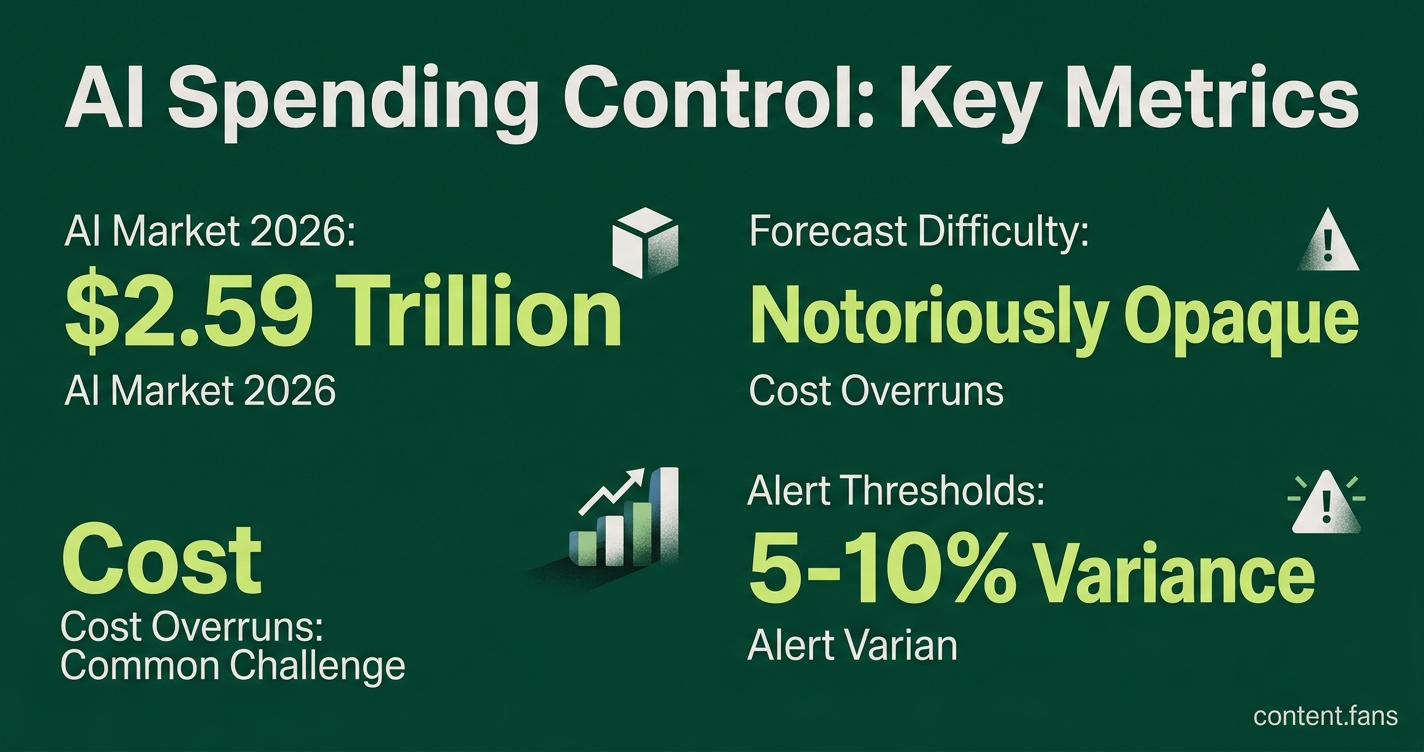
AI cost forecasting remains notoriously opaque for finance leaders. While precise industry-wide statistics vary, AI forecasting is widely recognized as difficult, with cost overruns being a common challenge across enterprises. This stems largely from underestimated data preparation costs and "ungoverned inference" from runaway API calls. Ceiling-enforcement systems directly address this by tracking tokens, GPU hours, and vector database queries in a unified ledger.
While current FinOps platforms provide visibility, they typically stop short of offering contractual caps. Specialized tools from companies like Finout or Vantage expose per-model charges on usage-based terms. Advanced cost control concepts extend this stack with engineered throttles that can reroute workloads to cheaper models and establish financial pools to manage budget overruns.
Core Components of AI Cost Control Systems
- Continuous Telemetry: Tags every prompt or GPU action with its owner and associated cost unit.
- Automated Rule Engine: Initiates "graceful degradation," such as shifting from premium to smaller models when budget thresholds are approached.
- Proactive Alerting: Triggers notifications tied to forecast variance targets, with materiality thresholds varying by organization size and typically ranging from 5-10% or fixed dollar amounts.
- Financial Controls: Utilizes various contractual mechanisms and risk management approaches that allocate portions of service revenue for cost management.
For enterprises in regulated sectors, where AI projects represent a significant and growing portion of IT budgets, expense controls are particularly attractive for audit compliance. While Reserved Instances or Savings Plans lock in cloud compute rates, they fail to cover volatile token-based pricing. Advanced cost control applies similar principles at the application layer, working toward more predictable costs per task regardless of the underlying model mix.
Competitive Landscape and Differentiation
Incumbents like Datadog, CloudZero, and Flexera now surface LLM costs within their observability suites, but most do not contractually guarantee spending ceilings. This leaves a market opportunity for purpose-built cost control services that integrate with, rather than replace, existing observability feeds.
Industry analysts report that inference represents a dominant portion of AI-optimized infrastructure spending, with some reports citing ranges of 60-70%. A comprehensive cost control offering must therefore meter all ancillary components - not just model endpoints. This requires vendors who can provide granular, virtual tagging across multicloud resources.
While legal precedent is limited - Azure offers price-match guarantees and AWS customers negotiate various cost controls, but no hyperscaler guarantees total AI service costs - advanced cost management creates new hybrid contracts. These merge the language of cloud Reserved Instance agreements with standard technology coverage to offer enhanced financial predictability.
What are AI spending control solutions in enterprise environments?
AI spending control solutions are contractual and technical systems ensuring enterprise AI spending stays within negotiated thresholds. Unlike cost monitoring tools that only report expenses, these approaches actively combine real-time enforcement (like model routing) with financial controls (like contractual caps) to reduce budget volatility.
This approach addresses a critical market challenge. AI forecasting is notoriously difficult, and cost overruns are commonly reported across the industry, with infrastructure costs often significantly exceeding initial estimates.
Why are enterprises struggling with AI cost predictability despite falling token prices?
Cost unpredictability persists because token prices represent only a portion of total AI expenditure. While specific breakdowns vary by organization, mature AI implementations typically allocate substantial portions of their budgets to infrastructure, data pipelines, vector databases, and orchestration tools beyond just model costs.
Several factors drive this unpredictability:
- Data Preparation Costs: Cleaning, labeling, and RAG pipeline construction often represent major budget components beyond API expenses.
- Ungoverned Inference: Uncontrolled API calls consume budget without clear ROI tracking.
- Executive-Led Initiatives: According to BCG's AI Radar 2026 study, 72% of CEOs report being the primary decision-makers regarding AI in their organization, often bypassing traditional IT financial controls.
Even as token prices fall, total spending rises as usage scales faster, with AI spending projected to reach approximately 1.7% of average revenue in 2026, according to BCG.
How does automated model routing reduce costs without degrading performance?
Intelligent model routing intercepts API requests and directs them based on task complexity, with industry reports suggesting significant cost reductions are possible. The system uses tiered execution to match cost with complexity:
Organizations are moving away from the "one model for everything" paradigm toward specialized, cost-optimized model selection. Simple tasks like classification can often be handled by smaller, less expensive models, while complex reasoning tasks may require premium models. This approach is further enhanced by techniques like request batching and intelligent caching.
What existing solutions compete in AI cost management, and where are the gaps?
The AI FinOps market is split between platforms offering visibility and those offering rate locks, with varying levels of spending protection.
Specialized platforms like Finout, Vantage, and CloudZero offer tracking and anomaly detection capabilities with different levels of cost control features. They provide insight into spending patterns and usage analytics.
Cloud providers offer different discount mechanisms: AWS and Azure provide Savings Plans, while Google Cloud offers Committed Use Discounts (CUDs). These are discount mechanisms for predictable usage and do not inherently cap or prevent usage spikes from ungoverned inference, though they reduce the cost of such spikes.
A significant gap remains in comprehensive "spend insurance" where providers contractually absorb overage risk beyond traditional discount programs.
Which enterprises benefit most from spending caps, and how is this positioned?
Regulated industries and procurement-driven organizations are often the primary candidates, approached through distinct value propositions:
To Finance and Procurement:
- Risk Reduction: Positioned as a tool comparable to other financial risk management approaches, providing budget predictability.
- Credibility: Maintaining forecast accuracy is critical for board credibility and organizational planning.
- Competitive Advantage: Predictable costs can eliminate uncertainty in procurement processes.
To Regulated Industries (Healthcare, Finance, Government):
- Compliance Infrastructure: Predictable operational expenditure supports regulatory capital planning requirements.
- Project Sustainability: Mitigates cancellation risk from cost uncertainty. While AI project failure rates are a known industry concern, proper cost governance can help sustain valuable initiatives.
Revenue models often combine subscription tiers with various cap structures, pilot programs, and shared-savings arrangements where providers capture portions of cost optimization benefits.