
Russia embeds AI in malware, uses 'AI poisoning' against Ukraine
Serge Bulaev
Ukrainian officials say that Russia is increasingly using artificial intelligence (AI) in its malware and is trying 'AI poisoning' tricks, based on reports reviewed by security experts. This may mean that Russian hackers are making their attacks faster and harder to detect by changing how their malware and commands work. Some experts believe that Russia might also try to trick the AI defenses used by Ukraine by feeding them bad data, which can cause security systems to miss real threats. There is still little public technical detail about these attacks, but many worry that AI-powered cyberattacks could get worse and harder to defend against.

According to industry reports and security analysts, Russia appears to be embedding AI in malware and using 'AI poisoning' against Ukraine, escalating a wave of sophisticated cyberattacks seen since 2022. Reports indicate Russian hackers are maintaining persistent attacks on Kyiv's critical services Industrial Cyber, while global security leaders now rank adversarial AI among their chief concerns Global Cybersecurity Outlook 2026. This emerging pattern suggests that Russian state-sponsored operators may be leveraging artificial intelligence to automate attacks, find vulnerabilities, and corrupt the data that defensive tools rely on.
AI-powered malware appears on the battlefield
Russian operators are reportedly embedding AI into malware to make attacks more evasive and automated. These AI-driven tools can rewrite their own command-and-control instructions in real time, making them harder for standard security systems to detect, and can automatically identify new vulnerabilities on compromised networks.
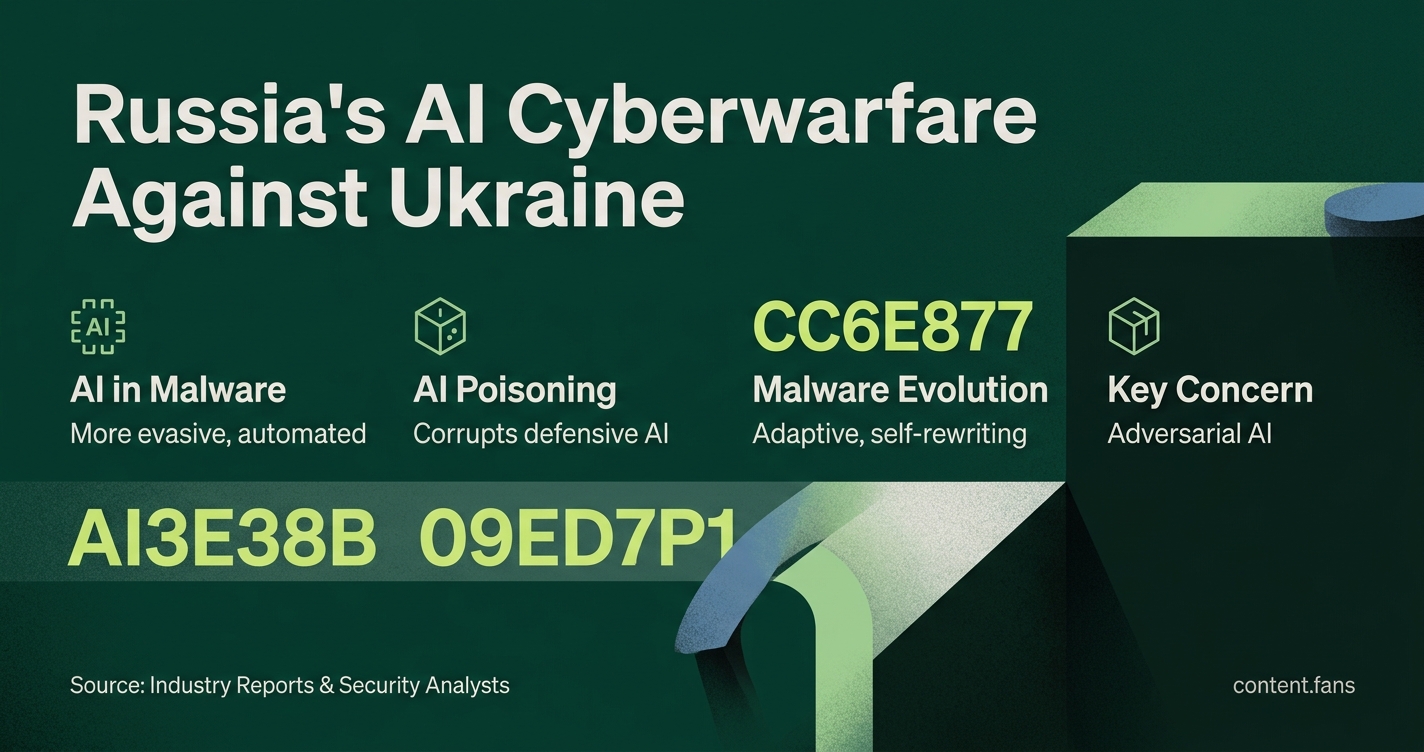
Ukrainian officials have reportedly observed AI-enhanced malware on their networks, a claim corroborated by international threat intelligence. Security research suggests that state-backed actors from Russia and other nations are increasingly using AI to automate and intensify cyberattacks. Security analysts theorize these malware variants use embedded language models to dynamically rewrite their command-and-control (C2) traffic, evading signature-based detection. This evolution marks a significant shift toward adaptive malware that learns from its environment to better conceal its activities.
'AI poisoning' challenges defenders
In addition to building smarter malware, Russian operators are reportedly using 'AI poisoning' to undermine Ukraine's defenses. This technique involves deliberately corrupting the data used to train defensive AI systems. According to NIST guidance, attackers insert manipulated data during the AI model's training phase, causing it to misclassify threats. By feeding tainted information to Ukrainian security platforms, attackers could trick defensive AI into ignoring real intrusions while raising false alarms. Key concerns stemming from this tactic include:
- Degraded malware and anomaly detection accuracy
- Hidden backdoors triggered by specific inputs
- Skewed prioritization of alerts in security operations centers
Strategic implications for Ukraine
The strategic implications for Ukraine are significant. Cyberattacks, such as the December 2023 wiper attack on Kyivstar that disconnected millions, serve as powerful digital extensions of kinetic warfare. Experts warn that incorporating AI into these attacks shortens attacker dwell time, accelerates their operations, and significantly complicates incident response. Although detailed technical evidence of Russia's AI-powered malware has not been publicly released, Ukrainian officials are clear that the threat is evolving. In response, Ukraine and its allies must bolster their defenses by rigorously auditing data pipelines, validating AI training models, and actively monitoring for anomalous behavior to counter this next generation of cyber threats.
What exactly does "AI poisoning" mean in the context of Russian cyber operations?
"AI poisoning" refers to deliberate corruption of the datasets or model parameters that feed defensive AI systems. Attackers inject manipulated or fake data during the training phase so the model learns to mis-classify malicious traffic as safe, suppress alerts, or otherwise behave incorrectly. NIST warns that such attacks can occur across the entire AI pipeline - from the data supply chain to live production updates - making them hard to isolate and even harder to roll back once embedded.
How is Russia embedding AI inside malware against Ukraine?
Recent Ukrainian government alerts - echoed by reports in The Record - describe families such as LAMEHUG (linked to APT28/Fancy Bear) where AI modules are compiled directly into the malware binary. These modules use pre-trained language models to:
- generate new command-and-control (C2) strings on the fly, raising the cost of signature-based blocking
- re-encode payloads in real time to frustrate static and dynamic analysis
- prioritise reconnaissance targets by scoring data packets for likely strategic value
In other words, the malware is no longer a static implant; it becomes a learning agent on the victim network.
Which defensive AI components are most at risk from poisoning?
According to industry reports, the most vulnerable points include:
- SOC triage models - sorting incidents based on user-supplied open-source threat intel feeds that can be seeded with false negatives
- E-mail security gateways - training corpora updated from public repositories such as VirusTotal or Abuse.ch that adversaries can subtly pollute
- UEBA (user and entity behaviour analytics) - models that continuously retrain on current telemetry streams are especially exposed to data-drift attacks
Industry surveys suggest a significant portion of enterprise SOCs already rely on generative-AI copilots; any one poisoned feed can propagate across thousands of downstream queries and alerts.
What measurable impact has AI poisoning had so far?
Published incident data is scarce, but security research indicates that:
- injecting small amounts of poisoned samples into a malware detection dataset can significantly reduce precision and recall
- backdoor triggers hidden in benign PDF metadata can cause models to mis-classify weaponised files when the trigger is present while maintaining normal performance on clean samples
These results mirror observations that poisoned threat-intel feeds can blind defenders for extended periods before analysts notice the drift.
What can organisations do today to detect or limit AI poisoning?
Security teams should treat AI pipelines like any other critical data supply chain:
- Verify provenance - cryptographically sign every dataset and model version before ingestion
- Run integrity checks - compare new training batches against known-good hashes and statistical baselines
- Segment control access - limit who can upload or modify training data, and log every change with immutable audit trails
- Monitor for drift - deploy automated tests that flag sudden drops in precision or recall on a gold-standard validation set
Security guidance emphasizes that there is "no foolproof defence", so layered safeguards and rapid rollback capability are essential.