
Rubrik launches agent management software, validating AI governance market
Serge Bulaev
Rubrik has launched new software to help companies keep track of and control autonomous agents, which may show that security leaders see agent governance as important. Experts suggest that organizations need to discover all agents, classify their risks, and monitor them all the time, rather than just reviewing them once. Companies appear to want systems that check agent actions, record everything agents do, and let humans approve risky actions. Market signs indicate that businesses may move toward continuous monitoring and frequent reviews. Rubrik's strong revenue growth might suggest that investing in agent management is becoming a standard part of security planning.

Rubrik's new agent management software launch confirms a major shift in the AI governance market, as what was once a concept becomes a formal budget item for enterprises. This move signals that CISOs now consider robust controls for autonomous AI agents non-negotiable. Mirroring this trend, industry playbooks like Thinking Inc.'s AI Agent Governance Framework call for a dedicated governance layer to authenticate agents, enforce policies, and create a complete audit trail of their actions. This guide outlines the key requirements that security, product, and risk leaders are demanding from agent management platforms.
Why Agent Governance Is a C-Suite Priority
Autonomous AI agents are increasingly integrated with core business systems, accessing sensitive customer records, financial data, and cloud infrastructure. This direct access creates significant risk without proper oversight. Experts agree that one-time reviews are insufficient; instead, organizations need continuous discovery, risk classification, and real-time monitoring of all agent activity.
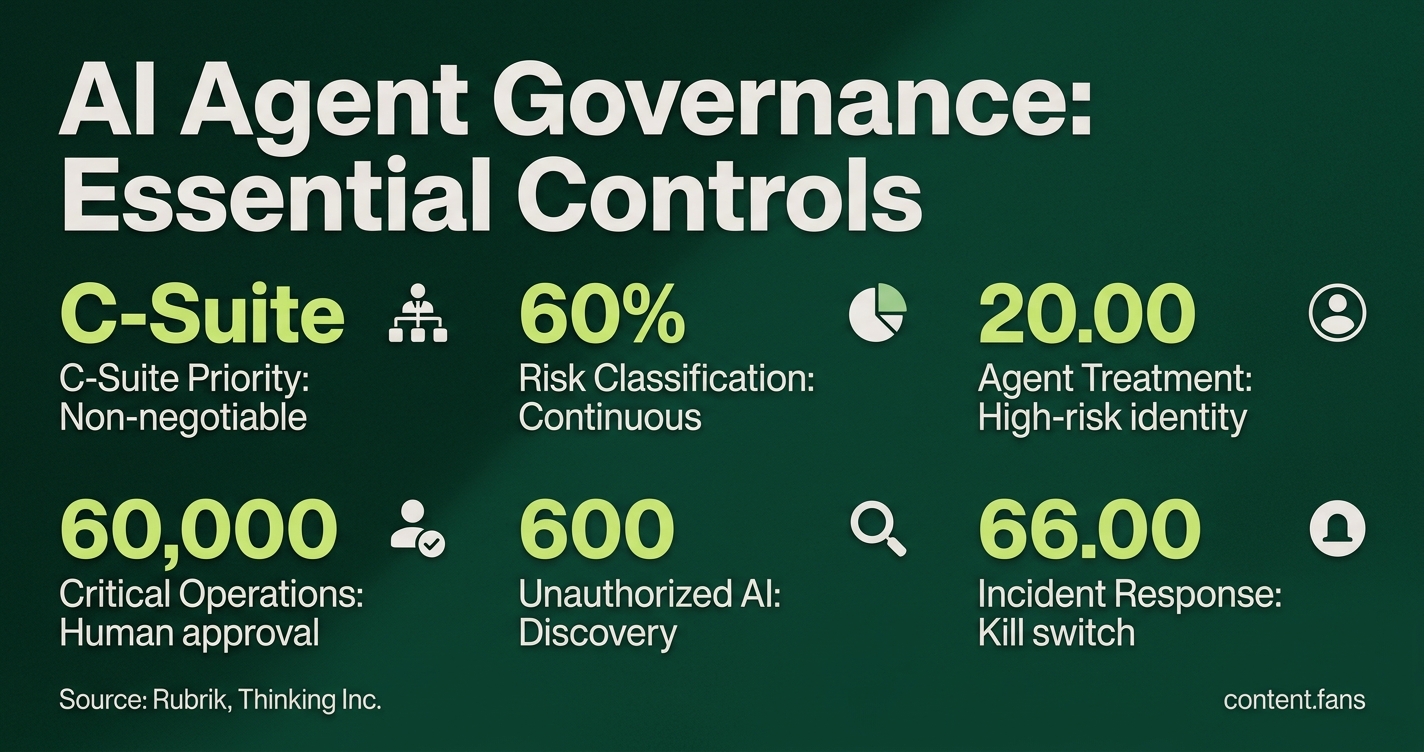
Enterprises require robust agent governance because autonomous agents interact with sensitive customer data, financial systems, and critical cloud infrastructure. Without strict controls, these agents pose significant security, compliance, and operational risks, making continuous monitoring, risk classification, and clear accountability essential for safe enterprise AI adoption.
To manage these risks, security leaders are establishing clear accountability frameworks. Each agent must have a designated owner, a defined purpose, and an assigned autonomy level to ensure that high-impact agents undergo stricter scrutiny. Many CISOs now treat agents as high-risk identities, applying principles like expiring credentials, least-privilege access, and mandatory human approval for critical operations. This strategy focuses on controlling agent actions, not just their initial prompts, to provide effective containment.
Core Capabilities of an Agent Management Platform
When evaluating agent management solutions, buyers consistently prioritize a specific set of functional requirements:
- Discovery and Inventory: Automatically detect all agents, including unauthorized "shadow AI."
- Access Control: Enforce role-based access and least-privilege principles for agent credentials.
- Policy Enforcement: Implement pre-execution checks to block prohibited actions and enforce security rules.
- Auditable Logging: Stream detailed logs - including agent ID, tools used, and policy decisions - for compliance and analysis.
- Incident Response: Provide a "kill switch" to immediately halt agent activity and support rollback procedures.
- Ecosystem Integration: Offer pre-built adapters for IAM, SIEM, SOAR, and GG stacks.
These requirements align with the governance models described in guides like Composio's on enterprise AI agent management, which frame the solution as an identity and access management (IAM) layer for AI, complete with authentication, authorization, and human oversight.
Emerging Platform Patterns in AI Governance
As the market matures, three distinct platform categories are emerging to address AI agent governance:
- Agent Control Planes: Centralized registries for managing agent identities, owners, and lifecycle states.
- Runtime Policy Engines: High-speed engines that intercept agent actions in real-time, delivering "allow" or "deny" decisions in under 100ms.
- Telemetry and Monitoring Hubs: Specialized platforms that feed structured agent logs into SIEMs and use behavioral analysis to flag anomalous activity.
This architectural pattern is reinforced by industry guidance. IBM emphasizes strong authentication and authorization before agents access regulated data. Meanwhile, firms like TEKsystems recommend establishing governance boards for continuous oversight, with monthly reviews and quarterly re-authorizations becoming the new standard over annual certifications.
Financial Context: Why Rubrik's Move Matters
Rubrik's entry into this market is backed by significant financial momentum. The company reported $387.1 million in total revenue for Q1 FY2027, a 39% year-over-year increase, as detailed in its StockTitan earnings summary. While investors noted some valuation concerns, the strong performance underscores a key point for security leaders: major, publicly-traded security vendors are now making substantial investments in AI agent governance. This commitment of capital signals that the market category is not a fleeting trend but a permanent fixture in the enterprise security landscape.
A Practical Implementation Roadmap
Industry reports and early adopter experiences point to a clear, phased approach for implementing AI agent governance:
- Inventory: Begin by creating a comprehensive inventory of all agents, including those embedded in SaaS applications.
- Classify: Categorize each agent based on its level of autonomy and the sensitivity of the data it can access.
- Identify: Assign a unique, tightly-scoped identity to every agent to enable granular control.
- Monitor & Enforce: Deploy runtime policy enforcement and continuous behavioral monitoring.
- Prepare: Develop and test incident response plans, including drills using a functional kill switch.
- Review: Institute a cadence of monthly reviews and quarterly re-authorizations to ensure ongoing compliance.
Following this roadmap helps organizations establish a strong governance baseline, aligning with industry best practices and mitigating risks identified during early adopter security assessments.