
Retool Expands Internal App Building Across Multiple LLMs
Serge Bulaev
Retool now lets teams build internal apps with several large language models (LLMs) using one system that keeps controls consistent. Teams can try free hosting on Retool Cloud until July 1, after which a free plan for up to five users will stay available. The platform uses a three-layer access model and strong security steps, so every action is logged and certain changes may need human approval. Retool may suit large companies because it supports different teams and models under shared policies, and lets departments manage their own areas. Pricing reportedly stays the same for cloud and self-hosted options, and may be higher than open-source rivals, but Retool offers more built-in features and controls.

Retool now enables internal app building across multiple LLMs, offering a governed runtime that ensures consistent security and control. The platform streamlines the development of model-driven tools by embedding security and permissions beneath the application layer. As detailed in a recent platform walkthrough, this architecture guarantees that every query, whether from a human or an LLM, adheres to the same predefined guardrails.
To encourage adoption, Retool offers free hosting options on Retool Cloud. Following promotional periods, a permanent free plan is available for small teams, as outlined in the official pricing summary.
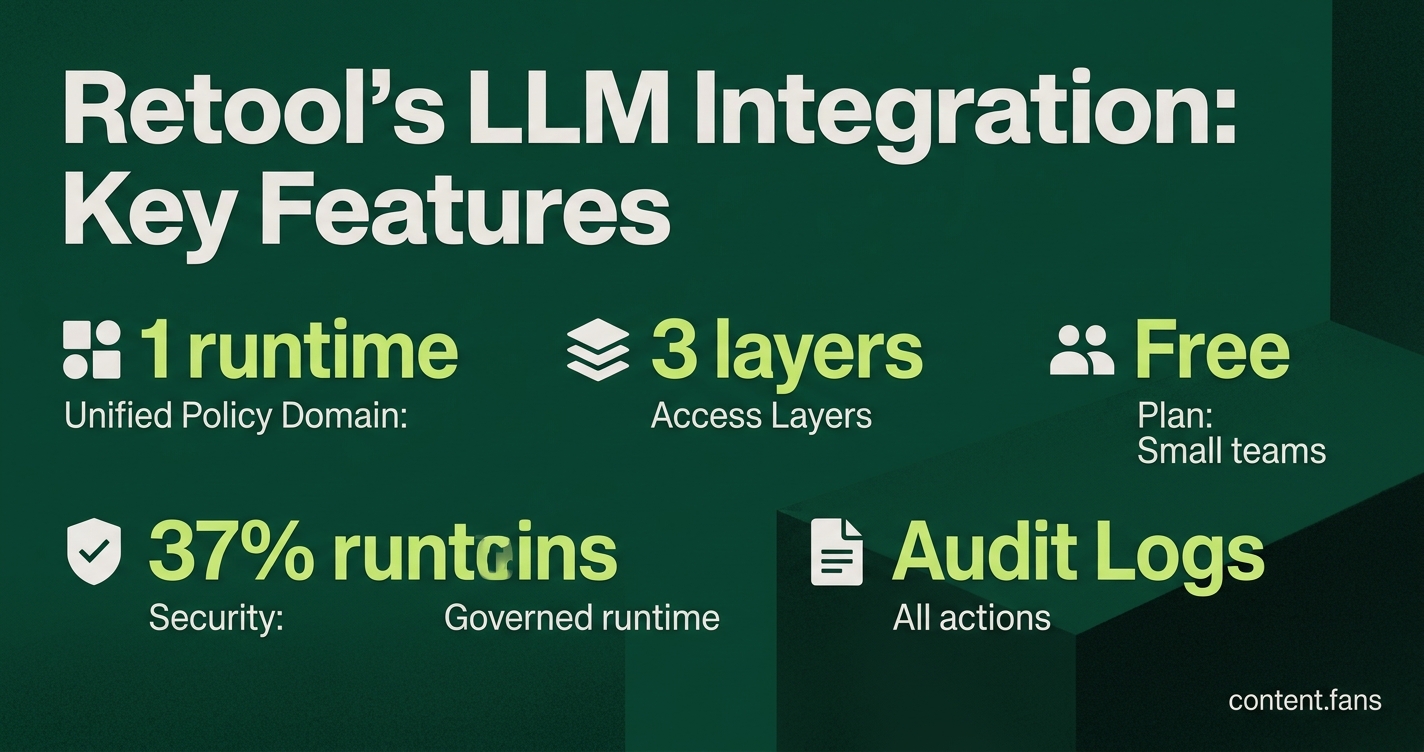
One runtime, many models
Retool's governed runtime allows teams to connect to various LLM APIs, such as OpenAI and Anthropic, within a unified system. This single policy domain enforces consistent permissions, logging, and rate limits across all models, ensuring that AI-generated workflows adhere to organizational standards without requiring separate configurations.
Retool's governed runtime processes API calls to models from OpenAI, Anthropic, and other providers, executing all workflows within a single policy domain. According to the governance guide, permissions are bound to data sources rather than application code. This prevents an LLM-generated query from accessing a production database without explicit authorization. The architecture enables large organizations to standardize logging, rate limits, and approval flows, even as different teams experiment with various models.
Three-layer access model
- Organizational Access: Controls who can log in to the platform.
- Project Access: Defines which specific applications a user can open.
- Data Access: Manages permissions for specific data rows or API endpoints.
All actions are recorded in detailed audit logs, and Git integration allows for versioning and rollbacks of any LLM-driven changes. Furthermore, workflows that modify data can be configured to require human approval, providing a crucial safeguard against unintended actions.
Spaces and APIs for scale
For enterprise-level scale, Retool offers "Spaces," which are isolated environments allowing departments to manage their own apps and resources under a shared infrastructure. The platform's APIs support programmatic user provisioning, SSO group role mapping, and automated Space creation, an approach that analysts note aligns with modern platform-engineering practices.
Pricing after the trial window
Retool maintains consistent per-user pricing for both cloud and self-hosted deployments. According to industry reports, the following tiers are available:
- Free plan: Available for small teams with limited workflow runs per month.
- Team plan: Mid-tier pricing per builder and viewer with workflow runs included.
- Business plan: Higher-tier pricing per builder and viewer, adding audit logs and external-user portals.
Workflow run overages and external user seats are available at additional cost. Final pricing may vary by contract.
Competitive context
In the competitive landscape, open-source alternatives like Appsmith focus on unlimited self-hosted seats, while competitors such as Superblocks emphasize private-VPC governance. Retool differentiates itself by offering richer UI components, extensive integrations, and built-in AI assistance at a higher per-seat price. For organizations prioritizing development speed and consistent policy enforcement across multiple LLMs, Retool's governed runtime may justify the higher cost.
How does Retool let me plug several LLMs into one internal app without losing control?
Retool gives every app - no matter if it was sketched by hand or generated by Claude Code, Codex or Replit - the same governed runtime. That means authentication, row-level permissions, audit logs and approval gates are enforced below the application, so a rogue prompt or insecure piece of generated code cannot bypass your company rules. In practice, you connect each LLM as a resource once, assign RBAC policies, and every downstream app inherits those policies automatically Retool platform walkthrough.
What governance rules actually apply to LLM-built apps?
Security in Retool lives at three nested levels:
1. Organizational access - who can open Retool at all.
2. Project access - which apps that person sees.
3. Data access - what rows or columns they can read or write.
Even AI-generated queries are resource-bound: if a user does not have SELECT on the production database, any query the LLM writes will be rejected before it runs Governance docs.
Is there still a free way to try this after promotional periods?
Yes. The free tier remains available for small teams with limited workflow runs and AI credits per month. According to industry reports, this tier continues to be offered as part of Retool's pricing structure CheckThat.AI pricing table.
How does Retool compare with open-source rivals like Appsmith?
| Aspect | Retool | Appsmith |
|---|---|---|
| License / lock-in | SaaS or self-host options | Apache 2.0 - fully self-hosted |
| AI-assisted builder | Native AI editor + LLM connectors | Bring-your-own LLM via JS |
| Per-user cost | Tiered pricing per user depending on plan | Free self-host / paid cloud options |
| Governance polish | Pre-built RBAC, SSO, audit logs | You configure RBAC and audit layers |
Bottom line: choose Retool when you need turnkey governance and are willing to pay per seat; pick Appsmith when you want zero license cost and full control of the stack.
Can I see exactly what an AI agent changed before it commits data?
Absolutely. Retool tracks every query, workflow or agent action in immutable audit logs with diff views. When an AI agent wants to run an INSERT or UPDATE, the platform can insert a human-in-the-loop approval gate. You get a side-by-side diff of the proposed change versus the current state, plus context such as the prompt, model, and estimated cost Retool YouTube demo.