
Retailers integrate AR, AI to boost sales and cut returns in 2026
Serge Bulaev
Retailers in 2026 are using augmented reality (AR) and artificial intelligence (AI) to help customers try products and make decisions faster, which may lower return rates and boost sales. Reports suggest that tools like virtual try-ons and smart mirrors are making shopping more interactive and personal, while real-time data allows stores to quickly update offers and manage inventory. Early examples from brands such as Warby Parker and Tommy Hilfiger appear to show benefits like fewer returns and more store visits. However, experts warn there might be challenges, like privacy rules and high upfront costs for new technology. Overall, these changes suggest shopping is becoming more guided by customer needs in the moment, but long-term advantages are not guaranteed.

In 2026, leading retailers integrate AR and AI to boost sales and cut returns, placing customer experience at the forefront of shopper marketing. This strategic shift addresses challenges like stagnant customer loyalty and high acquisition costs by using immersive tools that allow shoppers to interact with products instantly. The new retail playbook blends augmented reality with real-time data, creating adaptive and highly personalized shopping sessions.
Why augmented reality leads the toolkit
Augmented reality is a leading retail tool because it empowers customers to visualize products in their own space, from trying on fashion to placing furniture. This virtual try-on capability removes purchase guesswork, significantly boosts buyer confidence, and directly accelerates the decision-making process at the critical point of sale.
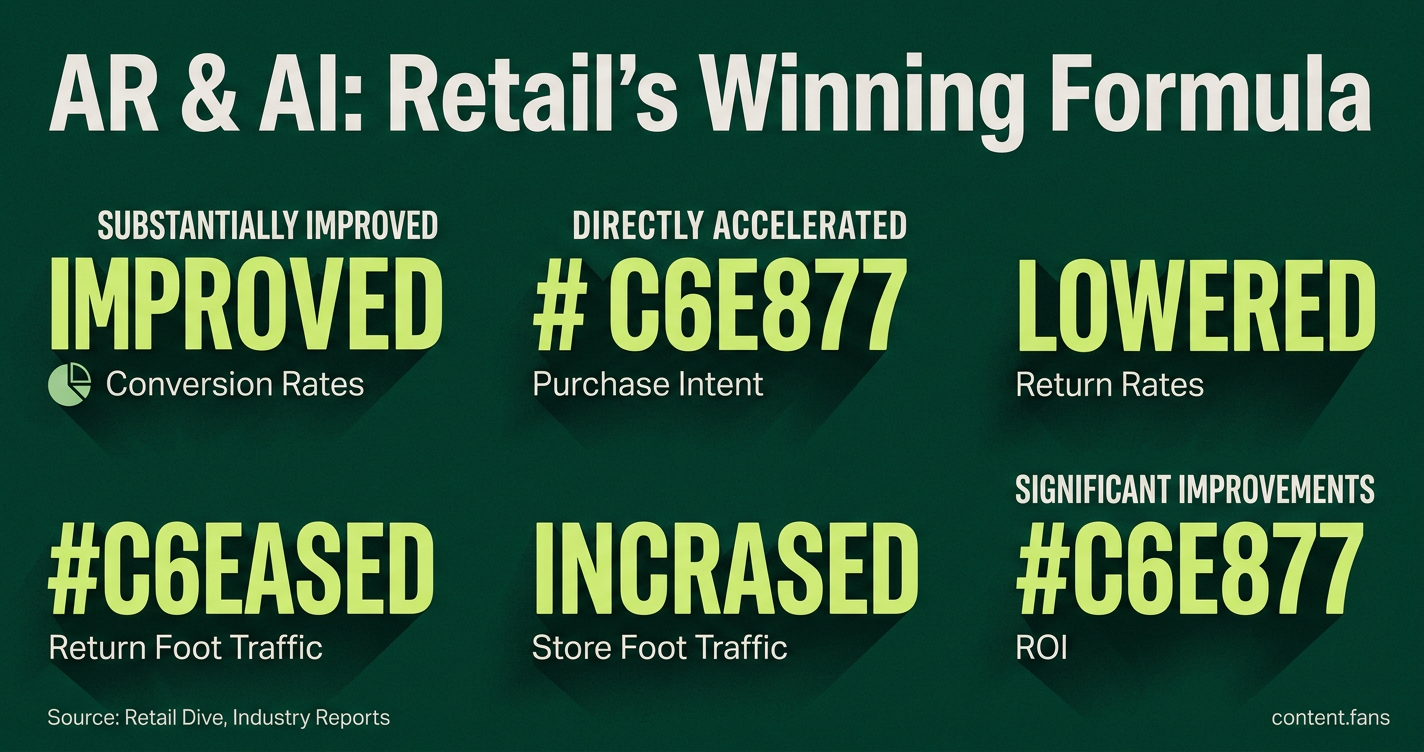
Industry analysis highlights augmented reality as a top future shopping feature for its ability to eliminate guesswork. For instance, Target's 'See It In Your Space' tool lets customers place virtual 3D furniture in their homes, reducing purchase uncertainty AR tops list of future shopping experiences | Retail Dive. Beauty and fashion have scaled this further; according to industry reports, Ulta's Snapchat lens drove significant virtual try-ons and sales. These immersive experiences are highly measurable, with data showing that products with 3D or AR viewers can substantially improve conversion rates, proving that AR directly accelerates purchase intent.
AI and inventory meet in the aisle
Beyond the front-end AR experience, the underlying data infrastructure is critical. Industry reports indicate how retailers are combining AI-powered computer vision with in-store beacons to detect inventory gaps in real time Maximize your retail impact: Digital marketing trends to watch in 2025. This live data can instantly trigger dynamic promotions within an AR interface, ensuring offers align with available stock. For example, according to industry reports, some sportswear brands have implemented AI messaging systems that adapt marketing content based on live inventory and browsing behavior, achieving significant ROI improvements and substantial increases in new customers.
Measured outcomes from early adopters
Early results from leading brands demonstrate a clear pattern of success:
- Warby Parker attributes lower return rates to its virtual AR frame try-on feature.
- Tommy Hilfiger saw significant store foot traffic increases after installing smart mirrors, with Zero10 reporting that integrating AR mirrors in pilot projects led to substantial increases in try-ons and foot traffic for brands generally.
- Gucci's AR sneaker lens generated substantial engagements and notable lift in purchase intent according to industry reports.
- American Eagle linked higher click-through rates directly to its holiday-themed AR lenses.
These outcomes depend on tight data feedback loops where interaction data continuously refines recommendation engines. This signals a move from simple personalization to anticipatory suggestions, where AI can predict and offer complementary products in real time.
Challenges that temper enthusiasm
Despite the strong results, industry leaders note significant challenges. The decline of third-party cookies due to privacy regulations means brands must rely on first-party data gathered from opt-in AR interactions. Furthermore, the rise of agentic AI assistants, as forecast by Gartner, threatens to shorten product discovery, requiring retailers to deliver compelling content instantly or be bypassed by a consumer's personal buying bot. High upfront implementation costs for technology like 3D asset creation and robotics also remain a barrier, prompting experts to recommend focused pilot programs in high-return categories to prove ROI.
What 2026 shopper marketing looks like day to day
In daily practice, the evolving customer journey forms a continuous loop: a shopper finds inspiration through social AR, visualizes the product on-site, and receives predictive offers tied to live inventory before even reaching checkout. By unifying these steps under a single customer ID, retailers can monitor engagement and optimize the experience in real time. This ecosystem is expanding to include shoppertainment, live video, and creator content, all serving to collect valuable first-party data. Ultimately, while no single technology guarantees a permanent edge, the trend is clear: shopper marketing is shifting from broad outreach to adaptive, data-driven sessions that reduce customer uncertainty and justify their investment through lower return rates.
How are retailers using AR to reduce product returns?
Retailers are deploying AR virtual try-on technology to let customers visualize products in their actual environments before purchasing. Warby Parker's AR mobile app allows shoppers to see how frames fit their faces in real time, while Target's AR feature enables customers to place virtual furniture in their living spaces. This "see-it-in-your-space" capability directly addresses a primary driver of returns: purchase uncertainty. By allowing shoppers to verify fit, style, and compatibility with their surroundings, AR has proven to significantly lower return rates for direct-to-consumer brands, turning what was once a major cost center into a competitive advantage.
What measurable sales impact does AR-driven personalization deliver?
The numbers show promising results. Products featuring 3D/AR content achieve substantially higher conversion rates than those without it according to industry reports. Ulta Beauty's Snapchat AR makeup catalog generated significant try-ons and sales according to industry reports. Similarly, Gucci's AR shoe try-on lens drove substantially more product page views and notable increases in purchase intent according to industry reports. Beyond individual campaigns, retailers report that personalized AR experiences can raise overall sales significantly, with US retail engagement projected to grow substantially due to virtual try-on technology adoption.
How does real-time data integration enhance the AR shopping experience?
The true power of 2026's retail technology lies in combining AR visualization with AI-driven real-time data. Every interaction within an AR environment - which products a customer tries, how they customize items, where they place virtual furniture - generates data points that feed predictive analytics systems. This creates a feedback loop where retailers can deliver instant, tailored recommendations based on browsing behavior, purchase history, and demographic profiles. For example, beacons and IoT devices in physical stores now work with mobile apps to push location-based offers that complement what a shopper is currently visualizing in AR, effectively merging digital convenience with in-store sensory experience.
What challenges remain in implementing AR and AI for shopper marketing?
Despite proven ROI, retailers face several hurdles. Technology integration complexity remains significant - connecting AR platforms with legacy inventory systems, CRM databases, and real-time analytics requires substantial investment. Privacy concerns are escalating as these technologies collect increasingly granular behavioral data, pushing retailers toward first-party data strategies to replace deprecated third-party cookies. Additionally, content production costs for high-quality 3D product models can be prohibitive at scale. Perhaps most critically, there's a talent gap: organizations need professionals who understand both the technical implementation and the shopper psychology that makes AR experiences genuinely compelling rather than gimmicky.
What's the next evolution beyond AR and real-time data in shopper marketing?
Looking toward 2026-2027, the frontier is agentic AI - autonomous shopping agents that act on behalf of consumers. Rather than browsing themselves, shoppers will brief AI agents with purchase intent ("find me sustainable mascara under $25") and let algorithms execute optimized transactions. Industry reports suggest that a significant portion of enterprise applications are projected to include task-specific AI agents, and retailers must prepare for a landscape where discovery strategies adapt to agent-mediated shopping. This represents a fundamental shift: from retailers personalizing experiences for customers, to customers delegating entire purchase journeys to intelligent systems that negotiate on their behalf.