
Retailers Expand AI Investment to 20% by 2026, Scaling for Personalization
Serge Bulaev
Many retailers are starting to use AI to help improve productivity and make shopping more personal. Reports suggest that by 2026, around 20% of their technology budgets may be spent on AI, up from 15% in 2024. While AI use is growing fast, adoption differs from company to company, and not all retailers have rolled out AI fully. Some examples show that AI might help reduce stock shortages and overstocking, and may improve customer experiences through tools like virtual try-ons and chat assistants. However, keeping data organized and safe appears to be a challenge, and experts suggest that good data management could help retailers scale their AI efforts more successfully.

As retailers expand AI investment to enhance productivity and personalized shopping, adoption is accelerating across the sector. Data shows that AI is becoming a core strategic asset, with industry reports indicating growing adoption among retail and CPG companies (Vention, Netguru). This trend demonstrates that retail leaders recognize measurable value in using AI for both back-office efficiency and customer-facing experiences.
AI Deployment Patterns in Retail: 2024-2026
Retailers are scaling AI by shifting from isolated pilots to enterprise-wide programs focused on demand forecasting, dynamic pricing, and hyper-personalization. This strategic expansion is reflected in budget increases, with planned AI spending representing a growing portion of technology budgets.
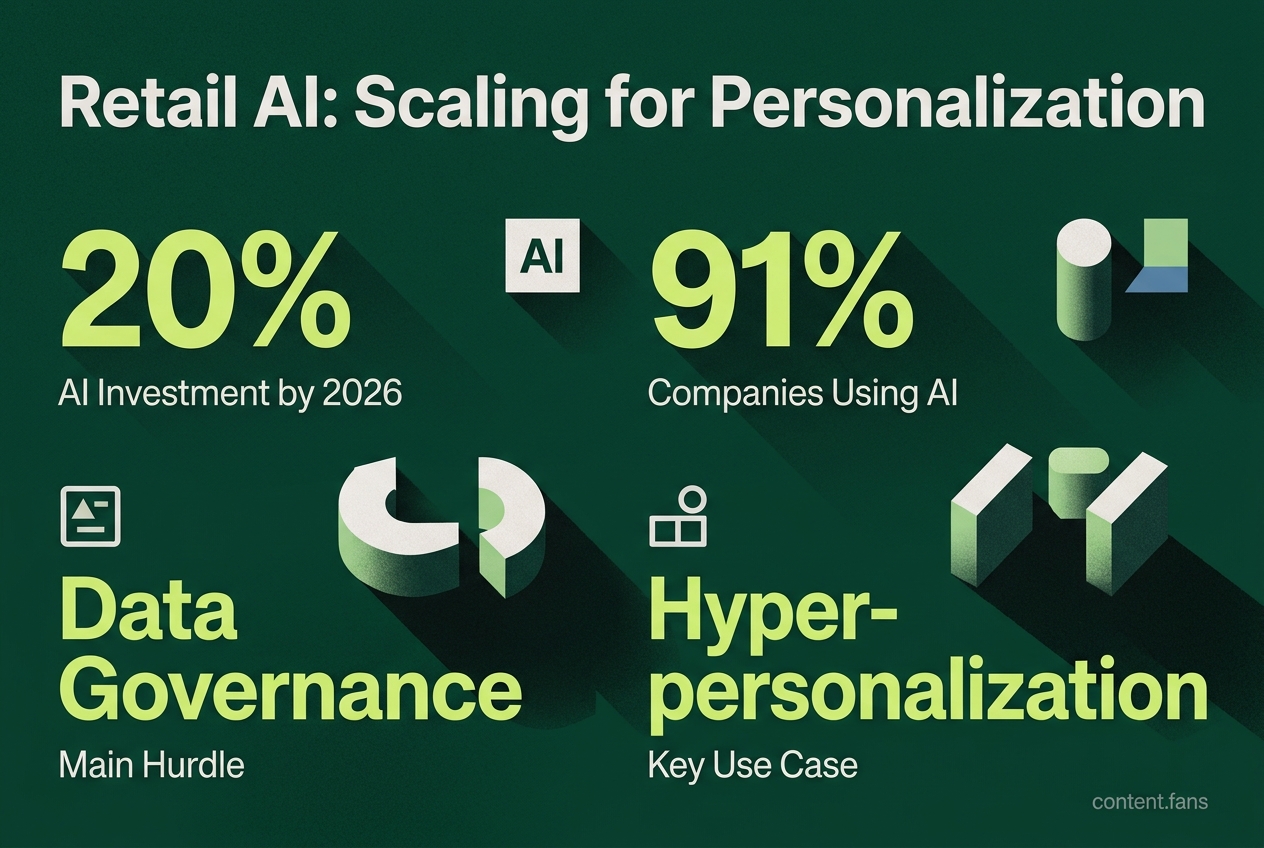
While adoption is widespread, it remains uneven. According to NVIDIA's 2026 survey, 91% of respondents said their companies are either actively using or assessing AI. The current focus is shifting from initial adoption to scaling proven solutions across the enterprise. For example, Walmart uses AI for demand forecasting, which has significantly reduced stockouts. Starbucks' Deep Brew platform personalizes mobile order suggestions, and Target deployed a generative AI chatbot to assist store associates.
Key AI Use Cases Impacting the Customer Experience
Several customer-facing AI applications are delivering proven results in 2024-2026 case studies:
- Hyper-personalized product recommendations based on browsing, purchase history, and real-time context.
- Virtual try-on tools, like Sephora's Virtual Artist, which overlay products onto a shopper's image.
- Voice and chat assistants, including Starbucks' My Starbucks Barista and other conversational agents.
- Computer-vision checkout at stores like Amazon Go, which reduces wait times and gathers in-store data.
Beyond customer experience, AI-powered inventory systems have significantly reduced overstocking, providing a direct path to margin improvement.
Data Governance: The Main Hurdle to Scaling Retail AI
Increased AI investment highlights the critical challenge of integrating scattered data under consistent governance. Legacy point-of-sale, e-commerce, and loyalty systems create data silos that compromise quality and hinder AI performance. Furthermore, emerging agentic AI tools demand governed, real-time data feeds, increasing the importance of privacy, lineage, and bias controls (BizTech Magazine).
Key governance challenges include fragmented data ownership, inconsistent definitions, and poor visibility into model drift. Best practices involve assigning clear data stewards, automating lineage capture, and embedding role-based access controls into AI workflows. Regulators' focus on consumer data protection also necessitates continuous monitoring rather than one-time audits.
Implications of Early AI Adoption for Future Retail Strategy
While most retailers are experimenting with AI, fewer than half have achieved enterprise-wide rollouts. This points to a transitional period where AI is moving from a strategic pilot to an operational necessity. The ability to scale pilots into sustainable programs that deliver productivity gains and deep personalization will depend on integration quality, budget allocation, and robust, real-time data governance.
What share of technology budgets are retailers allocating to AI?
Retailers are increasing AI investment as a significant portion of technology budgets, according to industry forecasts.
This step-up reflects the shift from early pilots to full-scale deployment, especially in hyper-personalized recommendations, demand forecasting and automated store operations.
How widespread is AI in retail today and where is it showing the strongest impact?
- A growing number of retail and consumer packaged goods companies are actively using AI or running pilots, with many applying AI across multiple use cases.
- Most report positive revenue impact and cite reduced operating costs from AI implementations.
Walmart, Target and Starbucks are the most widely documented success stories: AI is credited with significantly cutting Walmart stock-outs and powering Starbucks' voice ordering and personalization engine.
Which specific retail processes are AI transforming first?
The top use cases already delivering measurable ROI are:
1. Demand forecasting and inventory optimization - significantly reducing overstock
2. Dynamic pricing and promotion targeting
3. Hyper-personalized product recommendations and marketing content generation
4. Virtual try-ons and voice commerce (Sephora, Nike, Amazon)
5. Store-level GenAI assistants that help associates answer operational questions instantly (Target's rollout to store staff)
What are the biggest roadblocks retailers hit when scaling AI?
- Data silos and legacy systems - fragmented POS, e-commerce and loyalty data create integration bottlenecks
- Poor data quality and inconsistent definitions that degrade model accuracy
- Privacy and compliance risk under GDPR/CCPA when customer data is used for personalization
- Operational complexity at scale - the need for real-time contextual data without loosening governance controls
How are leading retailers solving data-governance and integration challenges?
Best-practice retailers adopt a unified governance framework that treats data quality, lineage, access control and ethics as a single program, not separate tasks.
Steps include:
- Automating metadata, lineage and drift monitoring
- Starting governance with high-impact data assets (customer, financial and operational feeds)
- Applying role-based permissions and prompt filtering to AI pipelines
- Using federated or lake-house architectures that let governed data feed real-time AI agents without compromising privacy