
Retailers Adopt 7-Layer Tech Stack for Discovery Commerce
Serge Bulaev
Retailers in 2025 may see online search traffic stay flat, while social media and AI make people buy things more suddenly. To keep up, stores might need to organize their technology and content to help both shoppers and computer systems find products easily. A 7-layer technology stack is suggested, focusing on AI, product data, and easy checkouts, while keeping systems flexible. Working with creators who co-design products may also help increase sales, and linking payment to real results, like sales, could work better than just counting views. Measuring success may require new ways to track if discovery features are really helping, and simple pilot projects can help teams learn and improve quickly.

Retailers are adopting a 7-layer Agentic Commerce Stack to enable AI agents to complete purchases on behalf of consumers. This shift demands a new operational model focused on serving algorithms as diligently as shoppers. This guide provides an actionable playbook for merchandising, marketing, and IT leaders, outlining the essential technology, content, creator, and measurement strategies to master agent-driven retail.
Build the 7-Layer Tech Spine
This model outlines how products move from a catalog to a consumer through AI agents. It consists of seven distinct technological layers, including AI surfaces, data protocols, and checkout execution, that work together to enable automated, agent-driven transactions from discovery to final purchase.
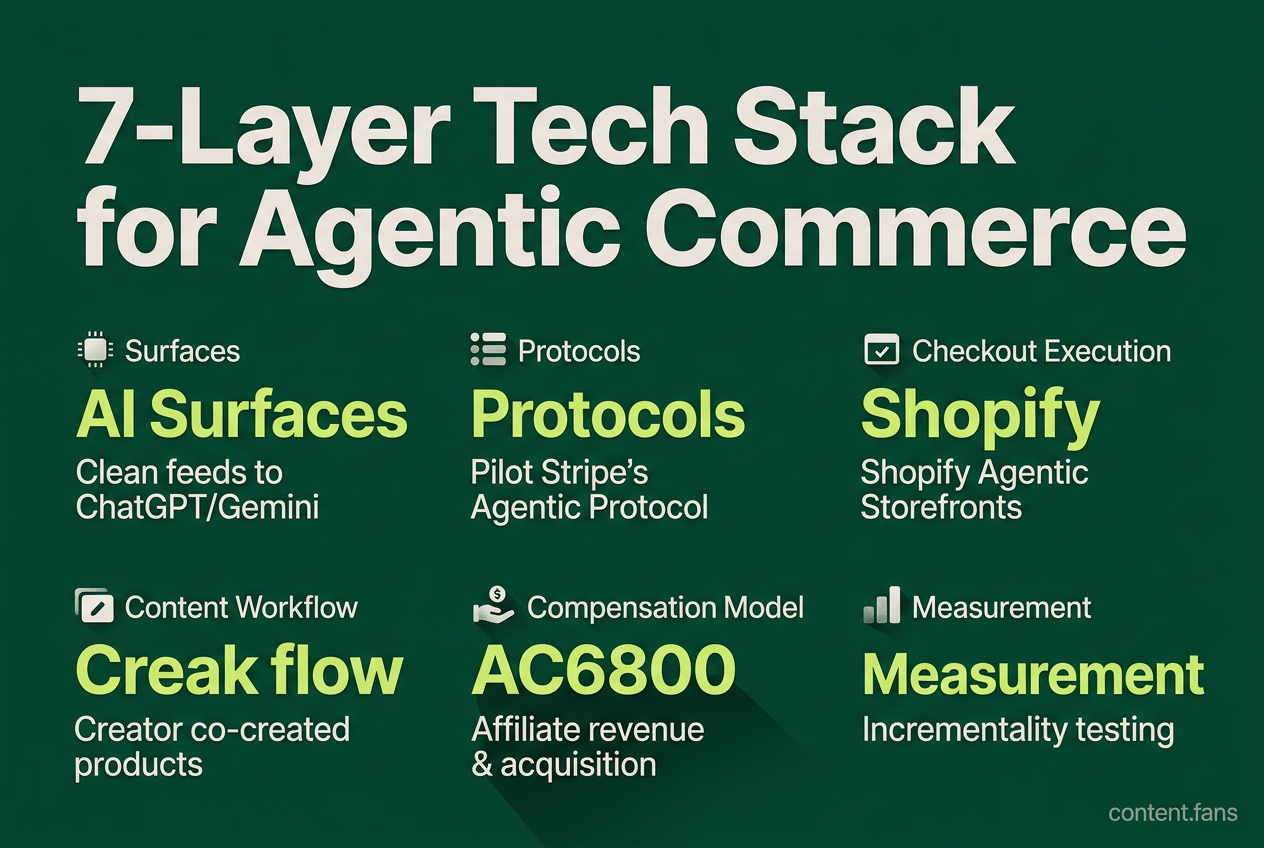
The 7-Layer Agentic Commerce Stack 7 Layer Agentic Commerce Stack provides a blueprint for how products move from catalog to consumer via AI agents. The seven layers each handle different aspects of the economic maturity and technical requirements, with payments attracting significant funding while checkout has fewer pure-play solutions:
- AI Surfaces: Ensure feeds to platforms like ChatGPT or Gemini include clean titles and rich product attributes.
- Protocols: Pilot Stripe's Agentic Commerce Protocol to allow AI agents to query live inventory.
- Checkout Execution: Use platforms like Shopify Agentic Storefronts for a turnkey path from AI recommendation to a completed order.
Adopting a composable architecture is critical. Experts advise decoupling discovery engines from core order management systems to simplify future upgrades and avoid costly replatforming.
Rewire Content and Creator Workflow
In agentic commerce, consistent, audience-aligned storytelling is more valuable than keyword optimization. Industry reports suggest that collaborating with creators on co-created products can drive significant sales growth. A proven workflow includes:
- Brief creators on brand objectives and guardrails.
- Allow creators to pitch concepts and formats in their own voice.
- Approve content through a four-step loop: proposal, legal review, first draft, and final cut.
- Tie compensation directly to affiliate revenue and customer acquisition, not just impressions.
- Review performance quarterly and expand partnerships with only the top performers.
This performance-based model is being tested by many platforms, with ambassador storefronts using commission structures to ensure mutual investment.
Measurement: Move Beyond Last Click
Traditional return on ad spend (ROAS) fails to capture the full value of agentic commerce. The new gold standard is incrementality testing incrementality testing, which measures the true upstream lift. Implement a two-layer KPI dashboard to track both business and discovery-specific outcomes:
| Layer | Example KPIs |
|---|---|
| Business Outcome | Revenue growth, gross margin, GMROI |
| Discovery Effectiveness | iROAS, branded search lift, new customer rate |
For optimal results, monitor add-to-cart rates and share of search weekly, and run semi-annual holdout tests to confirm the causal impact of your discovery initiatives.
Staffing and Governance
Success requires dedicated roles to manage the new workflows. Key positions include:
- Discovery Product Manager: Maps data feeds to agent protocols.
- Creator Partnership Lead: Manages sourcing, briefs, and performance dashboards.
- Merchandising Scientist: Sets override rules when AI promotes low-margin stock.
- Content Engineer: Structures copy and imagery for machine readability.
- Incrementality Analyst: Designs lift tests and aligns definitions across teams.
To ensure strategic alignment, the Discovery Product Manager should be embedded within the digital product office, synchronizing platform roadmaps with marketing calendars.
Low-Risk Pilots to Start Now
Begin with targeted, low-risk pilot programs to generate data and build momentum:
- Enable ACP on a limited SKU set through Stripe's sandbox environment.
- Recruit five micro-influencers to co-create a seasonal bundle with affiliate links.
- Run a four-week geo-split test measuring branded search lift against a control market.
- Integrate Constructor's hybrid search into a single category page to reduce zero-result queries.
Each pilot is designed to be completed within a single quarter, providing valuable data to refine your KPI dashboard and inform future strategy.
Ultimately, effective agentic commerce is built on a foundation of structured data, modular technology, and compounding creator relationships. The tactics outlined in this roadmap provide a clear path for operations and marketing teams to navigate the evolving landscape of AI-powered retail.
What exactly is the 7-layer tech stack for agentic commerce?
Retailers are moving away from the old "front-end vs. back-end" mindset and toward a 7-layer agentic commerce stack. Each layer handles one part of the journey from the moment an AI agent first learns about your product to the second the payment settles.
Layer 1 - AI Surfaces: ChatGPT, Gemini, Copilot, Perplexity and Claude are becoming significant sources of product discovery sessions.
Layer 2 - Protocols: Stripe's Agentic Commerce Protocol (ACP) and Visa's TAP standardize how these agents query your catalog.
Layer 3 - Payments & Identity: Stripe leads, followed by PayPal and Visa.
Layer 4 - Card Issuance: Stripe co-branded agent cards and Visa TAP credentials let agents "spend" on behalf of shoppers.
Layer 5 - Checkout Execution: Shopify Agentic Storefronts, Rye and Nekuda finalize the purchase.
Layer 6 - Merchant Enablement: Salesforce, commercetools, VTEX and Adobe syndicate your real-time inventory upstream to every AI surface.
Layer 7 - Trust & Security: Placer.ai and CenterCheck verify location and data integrity to stop hallucinated listings.
Put together, these layers replace the search bar with AI agents that summarize, compare and buy for consumers before they ever reach your site.
Which vendors should we shortlist if we need results by Q3 this year?
| Priority Tier | Vendor Mix | Rationale |
|---|---|---|
| Fast Validation | Shopify + Stripe + Constructor search | Shopify already supports Agentic Storefronts out of the box and integrates ACP in a single toggle. |
| Composable Scale | commercetools or VTEX headless APIs + Next.js front-end | Lets you swap discovery engines without replatforming and keeps options open for future channels. |
| Enterprise Control | Salesforce Commerce Cloud + PayPal Commerce Platform + Algolia hybrid search | Handles complex catalogs above 100 k SKUs and supports custom governance rules for margin or stock. |
Industry reports suggest that pilot implementations can be achieved with reasonable budgets and timelines for the fast validation stack.
How do creator partnerships fit into agentic commerce?
Creator content is the fuel that AI surfaces ingest. Brands that run long-term ambassador contracts with micro-creators see:
- Strong engagement rates
- Significant sales lift on featured product lines
- High renewal rates, lowering acquisition costs over time
Best practice is a three-step loop:
- Pilot with creators whose recent posts show genuine usage in your category.
- Grant creative freedom but use a simple approval flow: creator proposal → brand feedback → final post.
- Scale only the top performers into co-created drops or revenue-sharing storefronts.
Case study: a beauty brand moved from one-off posts to a co-created tinted moisturizer with one mid-tier TikTok creator - sales of the SKU showed substantial growth and retention on the creator's audience significantly outperformed paid-media look-alikes.
What KPIs prove that agentic commerce is working?
Traditional dashboards still track revenue, margin, conversion rate and inventory turnover, but agentic commerce success is measured one tier higher.
Agentic Commerce KPIs to add now
- Incrementality: did the AI exposure create sales that would not have happened otherwise?
- iROAS: incremental revenue per ad dollar, isolating baseline sales.
- Share of Search lift: growth in branded or category keyword volume after campaign flights.
- Conversion rate lift vs. control: compare cohorts who saw AI recommendation vs. those who did not.
- Basket lift & new-customer rate: higher AOV and fresh buyer share prove you are expanding the funnel.
Retail teams that combined these metrics with classic KPIs have shown significant reductions in reliance on last-click ROAS and successful re-allocation of spend to AI-driven surfaces while maintaining gross margin.
How do we staff and organize for agentic commerce?
A lightweight operating model used by recent implementations looks like this:
| Squad | Core Skills | Time Commitment |
|---|---|---|
| Agent Ops Lead 0.5 FTE | Data hygiene, ACP schema, governance rules | Weekly sprint |
| Creator Partnerships Manager 1 FTE | sourcing, contracts, briefs | Ongoing |
| Performance Analyst 0.5 FTE | Incrementality tests, iROAS, search-lift tracking | Monthly deep dive |
| Comms & Legal 0.2 FTE | Creator IP, agent data policies | Quarterly review |
Additional staffing investments are typically recovered within a reasonable timeframe through the uplift in new-customer revenue.