
Report outlines toolkit to resolve zombie firms, protect workers
Serge Bulaev
The report suggests that resolving zombie firms involves removing bad assets from banks while helping workers stay employed. Creating a national bad bank may speed up bank clean-ups, but effects may depend on careful coordination and timing. The report recommends phasing in reforms, using targeted public support tied to clear restructuring goals, and offering skills training and mobility support to workers. Success appears to depend on transparency, good governance, and timely help for affected workers. Experts believe positive results may only appear if credit and labour support reach people quickly enough.

A new report details a toolkit for resolving zombie firms by removing distressed assets from banks while protecting workers. This policy approach addresses a key challenge: executing bank clean-ups without tightening credit and causing layoffs, while avoiding delays that stall economic growth. This brief outlines a phased strategy to manage these competing risks effectively.
Bad-asset separation and phased recognition
The core strategy involves creating a national "bad bank" to absorb non-performing assets, enabling commercial banks to resume lending. According to McKinsey, such programs can effectively "expedite the clean-up of banks' balance sheets" and help "restore trust in the sector" (Bad banks: finding the right exit). While not an instant fix for growth, evidence from India confirms that bad banks "play a complementary role in restoring credit flows" when well-coordinated (How Effective are Bad Bank Resolutions?).
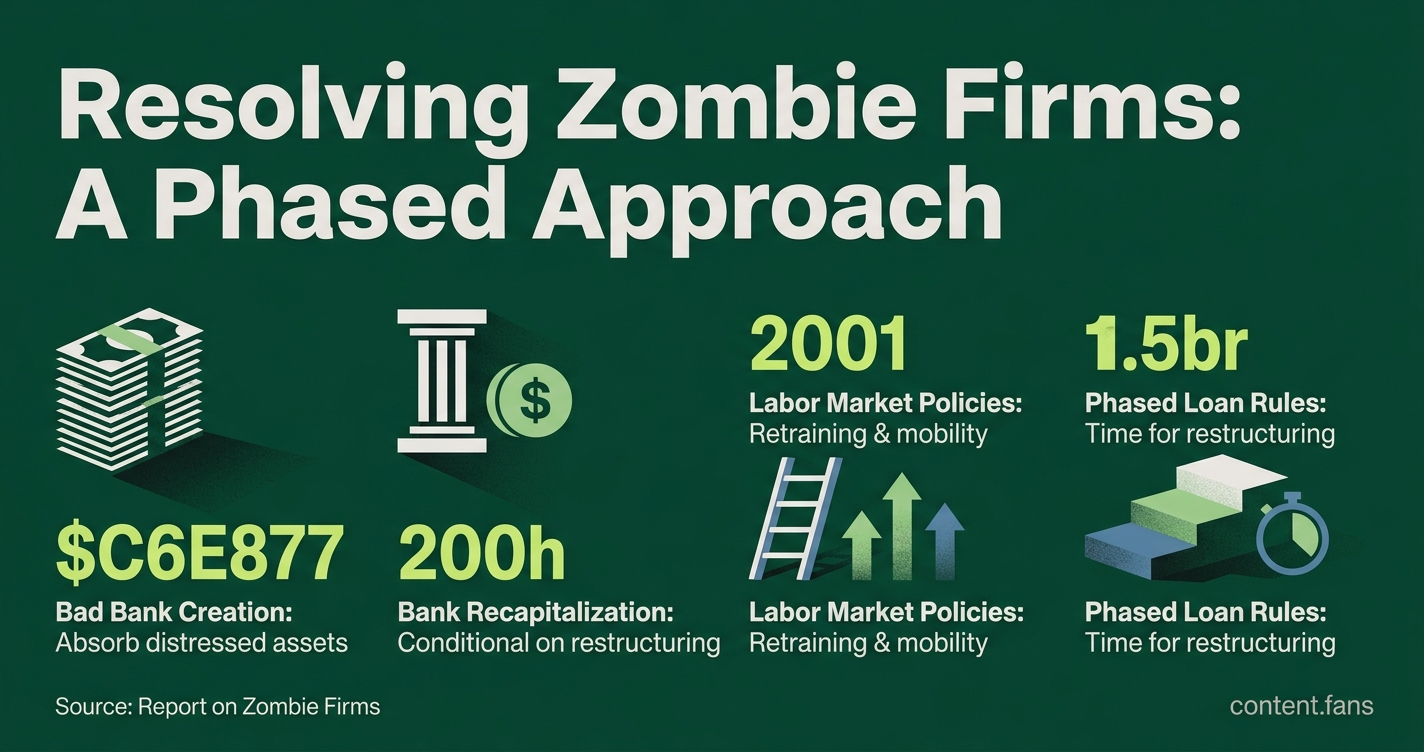
Resolving zombie firms requires a dual approach. First, a central "bad bank" acquires non-performing loans to clean up commercial bank balance sheets and restart lending. Second, active labor-market policies, such as targeted retraining and mobility support, are deployed to help workers transition to new jobs.
To soften the economic impact, regulators can also phase in stricter loan recognition rules, giving viable borrowers time to restructure.
Recapitalisation tied to restructuring targets
Public capital injections often face political resistance. To ensure accountability, any state support must be conditional and linked to clear restructuring milestones. IMF reporting and press material indicate that bank stress can lead to a pull-back or curtailment in lending, which can weaken growth. Therefore, recapitalization is contingent on deleveraging, governance improvements, and defined exit strategies for unviable firms.
One proposed sequence:
- Banks document impaired exposures and align with IFRS 9 expected-credit-loss rules.
- The bad bank purchases eligible assets at transparent prices.
- Government injects equity only into institutions that meet governance triggers, such as reduced party-affiliated lending.
- Independent monitors track compliance against quarterly targets.
Active labour-market policies to ease worker transitions
Protecting workers during this transition requires active labor-market policies. According to industry reports, employer-linked internships can significantly improve participants' employment prospects. The most effective programs focus on human capital, such as on-the-job training and apprenticeships, rather than short job-search courses. To minimize unemployment, the toolkit recommends pre-announced retraining vouchers and mobility stipends targeted to skills-rich roles with confirmed vacancies.
Strengthening governance and transparency
Strong governance and transparency are essential to prevent failure. Resolution efforts can be undermined if state-owned banks continue extending credit to politically connected firms. To combat this moral hazard, the framework demands full disclosure of ultimate beneficial owners and public, bank-by-bank data on non-performing loans (NPLs). Publishing clear timetables for reforms ensures market participants understand the process.
Phased Implementation Timeline
| Phase | Main action | Social-risk buffer |
|---|---|---|
| 0-6 months | Launch bad bank, map NPL stock, publish governance reforms | Job-matching portals, mobility stipends |
| 6-24 months | Transfer assets, start conditional recapitalisation | Employer-linked upskilling, regional redeployment grants |
| 24-48 months | Wind down bad bank portfolios, tighten subsidy criteria | Ongoing apprenticeship funding, targeted wage subsidies |
This phased approach with clear milestones provides clarity for investors while enabling labor agencies to deliver timely assistance to workers. The success of this framework hinges on speed. Experts caution that positive outcomes depend on swift credit expansion and the rapid deployment of worker support programs before mass layoffs occur.
What exactly is a "zombie firm," and why do governments worry about them?
A zombie firm is a company that earns just enough cash to cover interest payments but not the principal, keeping it alive only through repeated credit extensions. Economists warn that these firms tie up capital, workers, and bank credit that could fuel healthier businesses. Left unchecked, bank or financial stress can cause banks to curtail lending, which can weaken economic growth.
How would the proposed "bad bank" help clean up the system?
The toolkit suggests a national bad bank to buy impaired loans from commercial banks, freeing their balance sheets and restoring credit flow. Real-world evidence shows that well-structured bad banks can provide short-term stability and improve trust in the sector, according to McKinsey (Bad banks: finding the right exit). According to industry reports, such vehicles can enhance coordination and long-term resolution capacity, but caution that employment effects are indirect: jobs rebound only once the cleaned-up banks resume lending to firms and households.
What prevents banks from simply hiding problem loans forever?
To avoid endless forbearance, the framework calls for phased non-performing-loan (NPL) recognition. Global supervisors now demand earlier expected-credit-loss recognition (IFRS 9) and tighter provisioning timelines. For example, the ECB requires full provisioning on secured NPLs within 7-9 years, creating a time-based cost that forces banks to act. Freed capital is then redirected to viable firms under the condition that state recapitalization is tied to measurable restructuring outcomes.
How would workers be protected if their companies are shut down?
The plan pairs restructuring with active labor-market policies proven to work in pilot programs. According to industry reports, internship schemes can show significant improvements in employment probability and higher monthly wages for participants. The most durable gains come from human-capital-intensive training and employer-linked apprenticeships, not short job-search courses. Retraining is therefore targeted to sectors with confirmed demand, and subsidies are released only when workers are matched to real vacancies or apprenticeships.
Will taxpayers foot the bill for bank rescues again?
The blueprint minimizes moral hazard by making any public support conditional on productivity or consolidation benchmarks and on transparent governance reforms in state-owned banks. Rather than an open-ended bailout, recapitalization is tied to agreed restructuring plans and realistic timelines to prevent sudden shocks. Regulators increasingly expect banks to clean up balance sheets first - via NPL sales, securitization, and hybrid servicing - before fresh equity is injected, ensuring that private stakeholders absorb the first losses and taxpayers only finance outcomes, not mistakes.