
RAISE US raises $500M for AI workforce retraining
Serge Bulaev
RAISE US has secured $500 million in private and philanthropic funding to help retrain workers for jobs affected by AI, with early programs planned in several states. Google's Gemini 3.5 Flash now lets AI agents use computers directly, which may improve how tasks are done with less switching between tools. At the same time, intelligence agencies from five countries warned that new AI models might make cyber attacks and fixes much faster and more dangerous. These moves suggest that businesses, technology makers, and governments are trying to find ways to support workers, improve AI tools, and address new security risks, possibly all at once rather than step by step.

A new bipartisan initiative is exploring approaches to workforce retraining amid growing concerns about AI's impact on employment. This development comes as tech companies continue advancing AI capabilities and cybersecurity experts warn about evolving digital threats.
Testing New Corporate Incentives for Worker Transitions
A bipartisan coalition is developing pilot programs to retrain American workers for jobs impacted by artificial intelligence. The initiative aims to test employer incentives and worker support systems in several states through private and philanthropic funding.
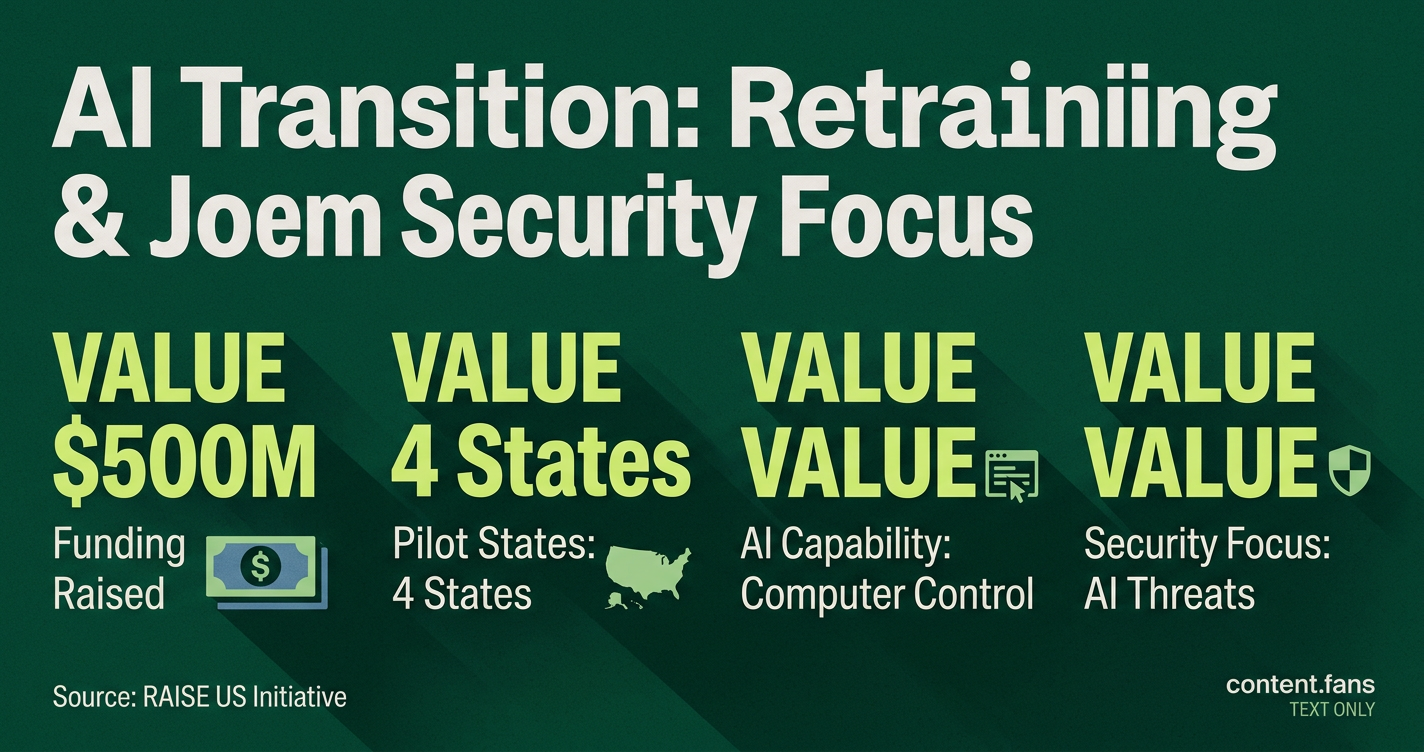
The effort involves former Commerce Secretary Gina Raimondo and former Indiana Governor Eric Holcomb, focusing on pilot programs in Arkansas, Connecticut, Maryland, and Utah - a mix selected for its bipartisan representation according to the Rockefeller Foundation. The funding approach emphasizes testing program incentives like tax credits and apprenticeship subsidies rather than direct cash transfers, suggesting a focus on scalable, structural solutions.
AI Models Gain Enhanced Computer Interaction
Google has been developing enhanced computer control capabilities for its AI models, allowing them to interpret screen elements and execute basic computer tasks. These developments represent ongoing efforts to create more autonomous AI systems that can interact directly with computer interfaces.
The technology enables AI models to perform complex tasks by seeing screens, interpreting user interface elements, and executing actions without requiring separate tools. This represents a significant advancement in AI agent capabilities, though specific performance metrics vary across different testing environments.
Cybersecurity Agencies Monitor AI-Driven Threats
Intelligence and cybersecurity agencies continue monitoring how AI developments may impact digital security landscapes. Security experts have identified growing concerns about how automated systems could accelerate cyber threat development and reduce response times for vulnerability management.
Key areas of focus include how AI might affect exploit generation timelines and the need for organizations to strengthen their security postures. Recommended measures include:
- Reducing exposed services and isolating critical systems
- Accelerating vulnerability patching processes
- Treating unsupported software as increased security risks
- Enforcing strict access controls with multifactor authentication
- Deploying AI-assisted defensive systems for threat detection
Security experts emphasize these measures are for risk mitigation rather than complete threat elimination, as AI capabilities continue evolving rapidly.
A Converging Trend: Parallel Development of Capabilities and Safeguards
These parallel developments - private initiatives exploring worker transition support, tech companies advancing autonomous AI systems, and security agencies monitoring emerging threats - signal significant industry attention to AI's broader implications. The trend suggests growing recognition of the need to address AI capabilities and their corresponding challenges simultaneously.
What is this workforce retraining initiative?
A bipartisan coalition involving former U.S. Secretary of Commerce Gina Raimondo and former Indiana Governor Eric Holcomb is developing programs to help workers adapt to AI-driven job changes. The initiative focuses on private and philanthropic funding rather than federal resources to support pilot programs and employer incentives.
Which companies and states are participating?
The initiative includes anchor partners such as Amazon, Microsoft, Anthropic and the OpenAI Foundation, plus Bank of America supporting advanced-manufacturing programs. Additional participants include AMD, Cisco, IBM, General Motors, Eli Lilly, The Rockefeller Foundation and other organizations. The first state pilots will operate in Arkansas, Connecticut, Maryland and Utah.
What types of training support are being explored?
The programs will support pilot grants that encourage employers to retrain existing staff rather than conducting layoffs, plus wraparound services such as childcare, stipends and career coaching. Early focus areas include advanced manufacturing, enterprise software and customer operations - sectors experiencing significant AI-driven changes.
How does this approach differ from traditional retraining efforts?
Unlike direct government programs, this operates as a private-public coalition designed for faster implementation and concrete employer commitments. The approach aims to create reproducible models that companies and states can adopt, focusing on systemic solutions rather than individual cash transfers.
What goals are being explored?
The coalition is developing targets around:
- Re-skilling workers across the pilot states
- Improving placement timelines for displaced workers
- Expanding to additional states once initial models are validated
- Leveraging employer matching funds to multiply the impact of initial investments