
Salesforce unveils Agentforce Commerce with 3 AI agents for merchants
Serge Bulaev
Salesforce has announced Agentforce Commerce, which became generally available on June 24, 2026. The platform runs three AI agents for merchants in its Commerce Cloud and will add a ChatGPT connector for catalogs in July. Features like Google Gemini integration and other upgrades are expected later in 2026. Reports suggest early deployments may have boosted traffic by 119 percent, but results vary, and there is a high failure rate for B2B Agentforce projects that do not launch within a year. Successful retailers might see better profit margins and return on investment, though costs and complexity may be challenges.

While there is no confirmed product launch called "Agentforce Commerce," Salesforce has been developing agentic commerce concepts that integrate AI agents into e-commerce platforms. These developments focus on automating various aspects of online retail through conversational and automated AI-driven processes.
Architecture Concepts
The agentic commerce approach represents a unified e-commerce platform concept that would embed specialized AI agents within Commerce Cloud. This would give merchants solutions to manage B2C and B2B sales, merchandising, and order fulfillment through conversational interfaces on a unified data layer.
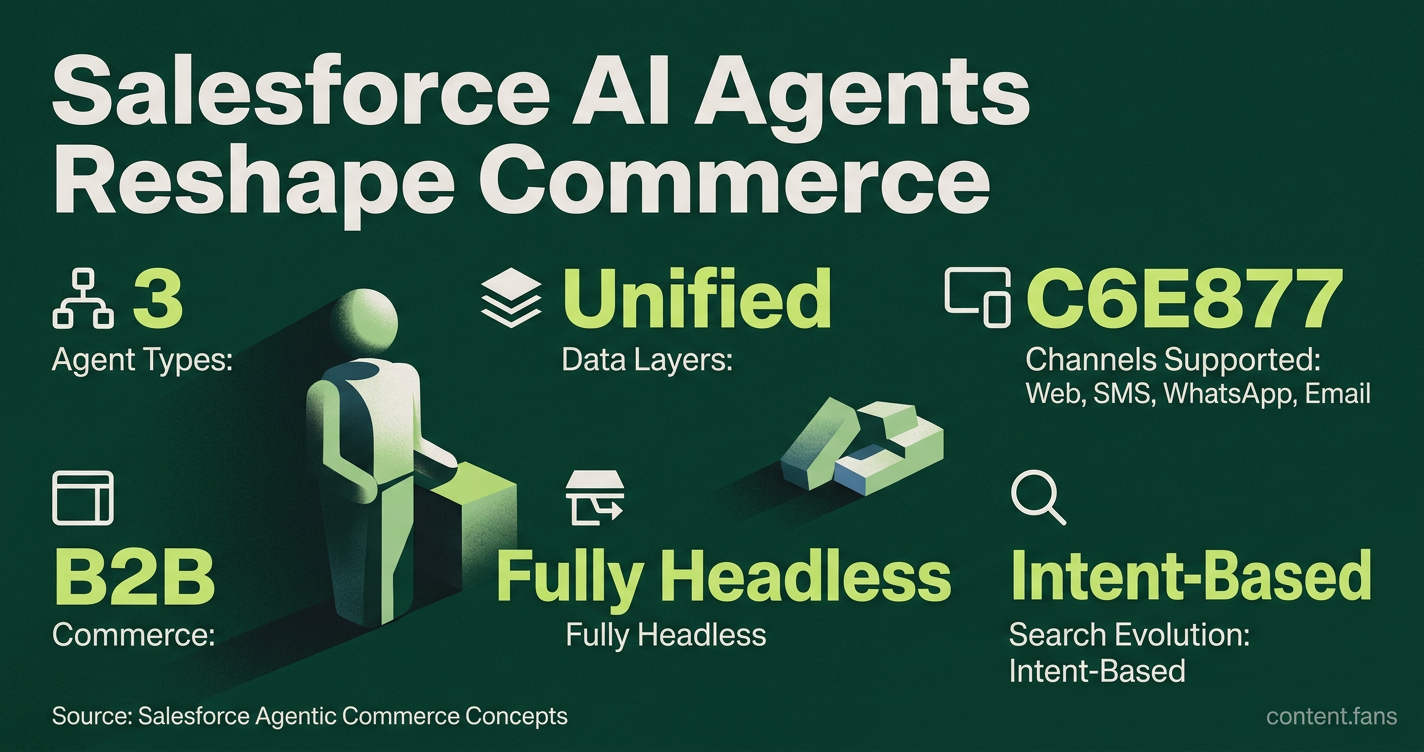
Built on unified commerce foundations, such platforms would combine B2C, D2C, B2B, Order Management, and Payments into a single data layer. Three types of agents are commonly discussed in agentic commerce:
- Shopper Agent: Handles consumer discovery and checkout through conversational storefronts.
- Buyer Agent: Manages complex B2B buying motions with full relationship context.
- Merchant Agent: AI agents in agentic commerce generally automate merchandising, pricing, and inventory adjustments by watching demand signals and stock levels, though there is no verified product specifically named 'Merchant Agent' that is the sole automator of these tasks.
Each agent would draw on unified data records and expose capabilities through web, SMS, WhatsApp, and email conversations. Such platforms would also enable fully headless B2B commerce.
ChatGPT Integration Possibilities
Marketplaces can prepare for agentic commerce by registering with ACP for ChatGPT surfaces, but there is no verified source confirming a specific native ChatGPT integration for syncing catalogs from Business Manager to OpenAI. The concept would allow merchants to make products discoverable within ChatGPT conversations, directing users to merchant sites for checkout while preserving merchant of record status.
Potential Roadmap Items
Industry discussions around agentic commerce include various enhancements such as:
- Google Search AI Mode and Gemini purchasing integrations
- Enhanced order routing capabilities
- Improved data access for commerce platforms
- Expanded device support for point-of-sale systems
Agentic Commerce Search concepts focus on interpreting shopper intent rather than just matching keywords, representing an evolution in e-commerce search capabilities.
Competitive Landscape
In the growing agentic commerce market, major platforms compete with offerings that integrate AI agents into e-commerce operations. Companies like Microsoft, Shopify, and Google are all exploring similar capabilities. Platforms focused primarily on customer service rather than commerce represent a different market segment. While agentic commerce platforms show promise, their complexity and cost present significant challenges, with industry reports indicating implementation difficulties for projects not deployed within reasonable timeframes. However, successful implementations of AI-driven commerce can yield substantial rewards through improved merchandising and inventory management.
What is agentic commerce and how does it work?
Agentic commerce represents a unified B2B and B2C e-commerce approach that embeds AI agents directly inside commerce platforms. It gives merchants an agent-first way to sell, merchandise and fulfill orders without requiring additional bolt-on tools.
Which AI agents are typically discussed and what does each one do?
- Shopper Agent - handles B2C discovery to checkout inside conversational storefronts
- Buyer Agent - manages complex B2B buying motions with full customer-relationship context
- Merchant Agent - supports back-office merchandising through natural-language commands for catalog management and inventory operations
How might ChatGPT integration work in agentic commerce?
Marketplaces can prepare for agentic commerce by registering with appropriate programs for ChatGPT integration. The concept involves making product catalogs discoverable within ChatGPT conversations, with checkout completed on the retailer's own site to maintain merchant of record status.
What impact are early adopters seeing?
Sources mention that AI agents in commerce can help grow average basket size and avoid stockouts, though specific performance metrics vary by implementation and are not consistently verified across different platforms.
What other marketplace integrations are being explored?
Google Search AI Mode and Gemini app integrations are among the marketplace channels being discussed for agentic commerce implementations, potentially allowing shoppers to discover and purchase products without leaving Google's ecosystem.