
PwC, McKinsey: AI Business Models Pivot to Usage-Based Pricing
Serge Bulaev
Recent research suggests that the most successful AI businesses may be those that use usage-based or outcome-based pricing models, which connect revenues to actual use and value. These models appear to help protect profits for partners and avoid overcharging customers. Partner-friendly designs and transparent governance may strengthen vendor relationships and trust, with clear rules and open systems possibly helping more businesses adopt AI. Early evidence also suggests that pairing subscription services with outcome-based features could make AI business models more sustainable. Overall, analysts suggest that long-term success in AI depends on fair pricing, partner incentives, and clear governance, rather than just technical advances.

PwC argues that AI workloads make consumption-based pricing structurally necessary and that pricing works best when the usage metric correlates with outcomes. While early generative tools captivated with technical demos, the focus now shifts to sustainable economics, transparent governance, and shared incentives as the true markers of long-term success. Technical breakthroughs create opportunity; transparent economics and shared incentives preserve it.
Why Usage-Based and Outcome-Based Pricing Are Gaining Traction
Industry leaders are championing new pricing strategies. PwC identifies nine new AI-driven business models, emphasizing usage, outcome, and services-as-software approaches that align revenue with fluctuating compute costs and protect partner margins (PwC overview). McKinsey notes that as AI begins to "perform work," vendors are shifting from per-seat licenses to pricing based on units of work completed, reflecting the actual value delivered (McKinsey analysis).
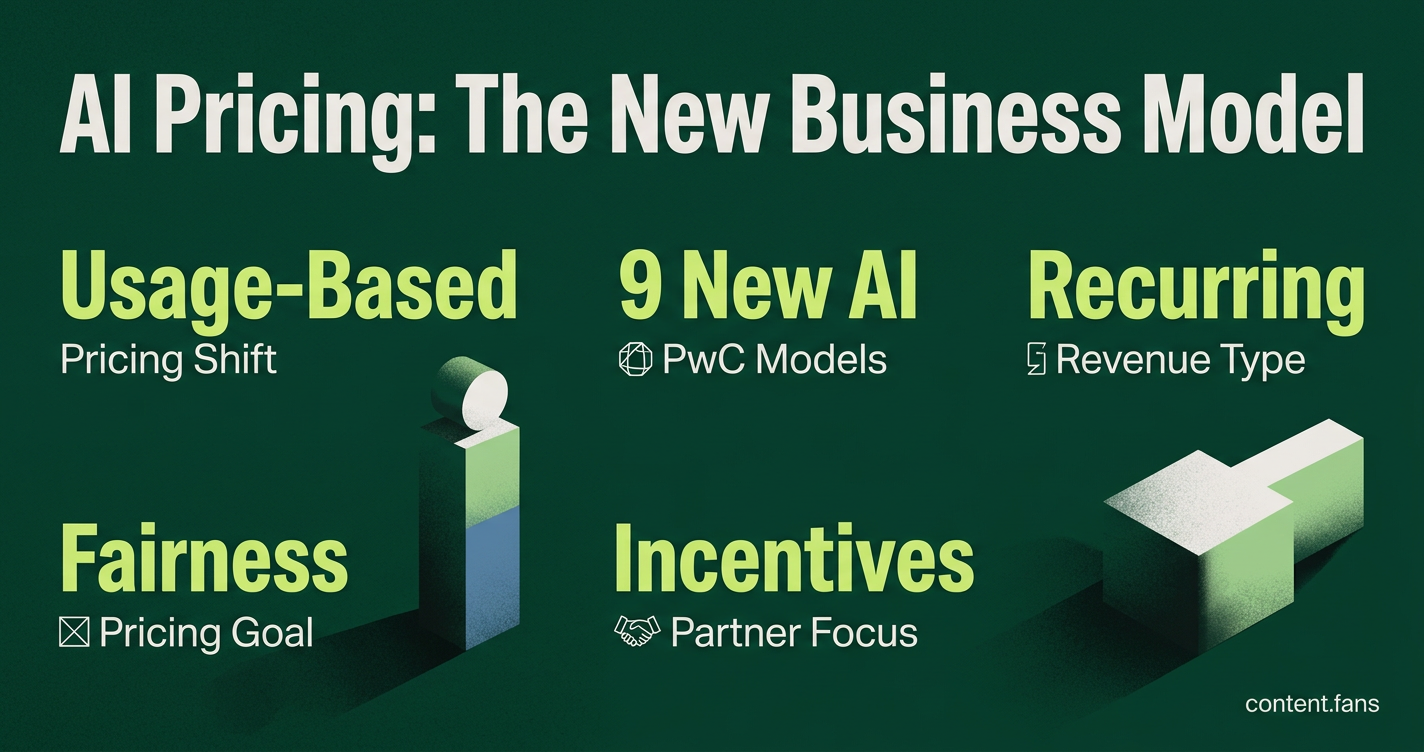
This shift to consumption-based models is driven by the need to align costs with customer value. It allows vendors to create sustainable, recurring revenue streams that cushion hardware costs, while ensuring low-volume users are not overcharged and ecosystem partners remain motivated through shared success.
These models are proving resilient for three key reasons:
- Sustainable Revenue: Recurring income helps absorb the costs of hardware and model refresh cycles.
- Fair Pricing: Variable pricing reflects the computational intensity of usage, preventing overcharging for low-volume customers.
- Partner Incentives: Revenue-sharing and success-fee structures keep cloud providers, data licensors, and system integrators invested.
Partner-First Economics: A Key to Market Dominance
Durable AI vendors foster "learning loops" with their partners by strategically allocating margin to channel distributors, implementation firms, and data contributors. According to industry reports, contracts based on success fees, particularly in sales or legal tech, are shown to improve renewal rates because all stakeholders share in the measurable ROI.
Firms are operationalizing partner economics through:
- Usage-Based Revenue Share: Compensating resellers for API calls they route.
- Service Attach Fees: Rewarding integrators for a client's ongoing workflow optimization.
- Data Licensing Credits: Crediting data contributors when their input measurably improves model accuracy.
This approach links cash flow directly to collaboration, discouraging vendors from undercutting their partners on price.
Transparent Governance as a Business Growth Strategy
Embedding responsibility and transparency into AI governance is not just an ethical imperative - it's a growth strategy. Industry analysts highlight that this approach unlocks business value while strengthening stakeholder confidence. Clear governance is linked to higher project success rates, whereas vague objectives risk project cancellations.
Interoperability is a crucial component. According to the OECD, transparent and interoperable systems empower smaller companies to integrate AI. In practice, this means open APIs, clear audit logs, and consistent metadata frameworks, which together reduce compliance risks and speed up deployments involving multiple vendors.
Early Evidence of Durable Business Models
Early market signals confirm the viability of these new models. For example, some sustainability-focused firms are successfully pairing subscription revenue with AI-driven predictive maintenance services, creating product-as-a-service loops that extend asset life and provide steady income for partners.
While industry analysts project continued expansion of the AI software market, many contend that market leaders will be defined by their ability to generate data flywheels, deliver measurable ROI, and build fair economic ecosystems - not just by model size. A recent Deloitte survey reveals that only one in five companies have mature governance for autonomous agents, highlighting a significant opportunity for vendors who can provide auditability and transparency as a core feature.
Ultimately, emerging industry research points to a clear formula for success in the AI market: combine outcome-aligned pricing with partner-friendly incentives, embed transparent governance, and design for interoperability. While technical innovation is crucial, long-term durability will depend on business models that support, rather than squeeze, customers and partners.
Why are PwC and McKinsey focusing on usage-based pricing for AI?
The two advisory giants see revenue that scales with real customer value as the only path to sustainable growth in the AI wave.
PwC's analysis identifies multiple distinct AI-fuelled business models - from services-as-software to dynamic-asset utilities - that rely on consumption or outcome metrics instead of upfront licences (PwC).
McKinsey adds that once AI moves from "supporting" to actually performing work, the natural unit of sale becomes the task, token, or unit of work completed (McKinsey).
Combined insight: pricing that rises and falls with usage keeps margins healthy while lowering buyer risk.
How does usage-based pricing align partner incentives?
When revenue is tied to tokens, calls, or completed workflows, every participant in the stack - model provider, cloud, integrator, data partner - can share the upside.
- Model/API vendors are paid for marginal usage.
- Cloud partners earn a margin per compute-hour.
- System integrators can layer implementation and recurring managed-service fees on top of pure usage share.
This structure is frequently cited as an important enabler of durable AI ecosystems in recent industry studies (PwC, McKinsey).
Which pricing levers are gaining importance?
A concise playbook has emerged:
| Lever | Why it matters |
|---|---|
| Token or call-based tiers | Matches customer spend to actual AI intensity |
| Outcome success fees | Lets vendors share upside when AI proves business ROI |
| Seat-plus-overage caps | Protects early adopters while preserving expansion revenue |
| Resale / channel margin | Rewards partners who originate demand and handle compliance |
| Data-licence credits | Compensates partners whose data improves the model |
McKinsey notes that combining subscription floors with variable usage ceilings is already the dominant hybrid structure for enterprise AI vendors (McKinsey).
What early signals show this model is working?
- Usage-share programmes launched by leading model providers have shown increased channel partner retention.
- Outcome pilots in sales-tech and legal-tech segments are posting strong net-revenue-retention when measured against traditional SaaS seats.
- Vertical AI companies that combine usage pricing with proprietary data report significant gross-margin expansion according to industry reports.
How can an AI vendor transition to usage-based pricing without alienating existing customers?
Industry sources recommend a multi-step approach:
- Hybrid offer: keep current seat subscription as a floor, add transparent overage meter priced per token/task.
- Outcome pilots: run parallel success-fee pilots on high-impact workflows to gather proof points.
- Governance layer: publish real-time dashboards so customers see exactly how usage converts into business value.
PwC's framework shows companies that give customers predictable usage caps and open APIs achieve faster negotiation cycles and lower churn (PwC).