
Publishers Adopt New Framework To Monetize B2B Brand Partnerships
Serge Bulaev
Publishers may benefit from new ways to work with B2B brands by focusing on close audience matches and creating content together. Experts suggest that starting with small projects like sponsored newsletters and growing into bigger efforts, such as research reports and events, can help. It appears that measuring success should go beyond just looking at impressions and should track things like leads and meetings. Capturing first-party data and building exclusive communities might become more important than reaching the largest number of people. Using clear goals and gradually expanding the partnership could make these collaborations more successful for both publishers and sponsors.

To effectively monetize B2B brand partnerships, publishers are moving beyond simple ad placements toward strategic content collaborations. Industry reports suggest that successful partnerships are built on precise audience matching and joint content creation. This framework outlines how to design packages that educate audiences, generate sales pipeline, and capture valuable first-party data for leaders in tech, media, and finance.
Designing Brand Partnerships to Reach Influential Audiences
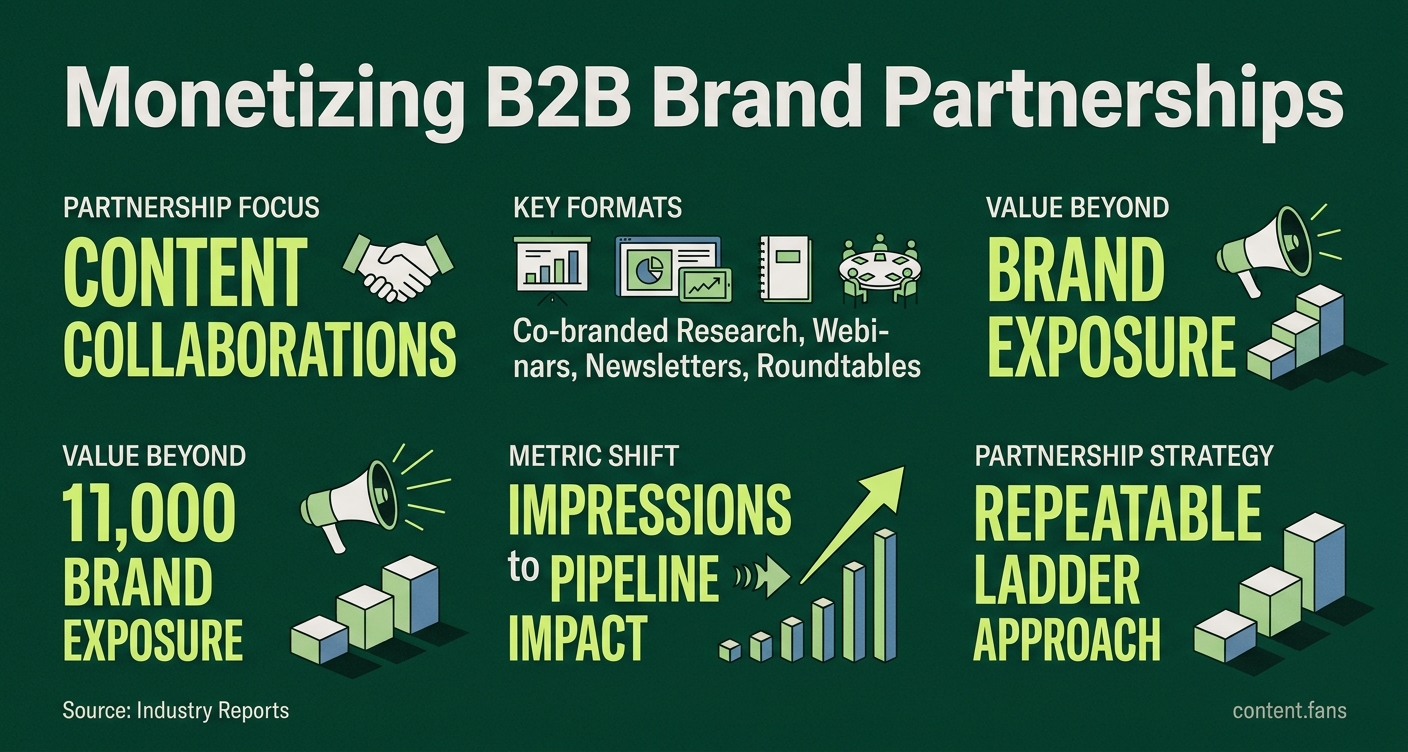
Effective partnerships blend sponsored content with exclusive access. Key formats include co-branded research reports, expert-led webinars, targeted newsletters, and executive roundtables. This multi-format approach extends reach through social amplification and CRM integration, creating a comprehensive package that delivers value beyond brand exposure.
Recommended components for a high-value partnership package include:
- Sponsored Newsletters: Targeted to segmented C-suite or decision-maker lists.
- Co-branded Research: Reports featuring original benchmark data and analysis.
- Expert-Led Briefings: Webinars or virtual events that provide actionable insights.
- Executive Roundtables: Exclusive, high-touch events linked to flagship conferences.
- Targeted Amplification: Coordinated promotion across social media and CRM channels.
Co-branded research is particularly effective when it delivers unique insights for senior leaders, while exclusive formats like executive roundtables can command premium pricing.
Measuring What Matters
To prove value, publishers must shift from tracking impressions to measuring pipeline impact. Industry frameworks advise tracking metrics aligned with the buyer journey. For sponsored newsletters targeting enterprise tech audiences, benchmarks vary widely but typically focus on cost per click (CPC) and cost per qualified lead (CPL) metrics. A significant lift in branded search is also a strong short-term awareness indicator.
For other formats, focus on downstream conversions:
- Co-branded Whitepapers: Monitor download volume, marketing-qualified lead (MQL) to sales-qualified lead (SQL) conversion rate, and total pipeline influenced.
- Event Sponsorships: Assess performance based on the cost per meeting booked and the total opportunity value generated.
Tracking these performance-based metrics demonstrates that a partnership is driving meaningful business results, not just surface-level engagement.
Building a Repeatable Partnership Ladder
The most durable and profitable brand partnerships are built progressively. Industry advisors recommend a "ladder" approach: start with a small, well-defined project, prove its performance, and then scale the engagement. A typical partnership ladder might progress as follows:
- Tier 1: A single sponsored newsletter to establish baseline performance.
- Tier 2: A multi-asset content syndication package (e.g., webinar + report).
- Tier 3: An annual partnership featuring a major research series and event sponsorship.
Regular performance reviews against clear KPIs are essential for determining when to advance to the next tier. Central to this model is first-party data capture. By gating research reports or requiring registration for events, publishers can enrich their audience data for better targeting and segmentation, creating a valuable asset in a cookieless world. This focus on deep engagement within a niche community is increasingly prized over broad, anonymous reach.
By combining precise audience alignment, transparent performance metrics, and a tiered partnership model, B2B publishers can build a sustainable revenue stream that enhances - rather than compromises - their editorial credibility. This strategic approach creates a clear path to long-term, repeatable success for both the publisher and its brand partners.
How should a B2B publisher choose the right brand-partner fit for 2025-2026?
Focus on three non-negotiables:
1. Audience overlap: the partner's Ideal Customer Profile must intersect with your readers in tech, media, or finance roles.
2. Non-competing value: products that solve adjacent or downstream problems generate stronger utility and trust.
3. Aligned values: shared editorial stance and privacy ethics prevent reputation risk.
Recent research shows publishers using this filter report significantly higher lead-to-opportunity conversion because the content feels native, not grafted.
What sponsorship formats deliver the highest engagement for senior decision-makers?
Data shows the top three:
- Co-branded research reports (especially salary benchmarks and AI-adoption studies). These outperform basic white-papers in download-to-SQL rate.
- Executive virtual briefings (15-minute analyst Q&A or product-category education) that feed directly into a nurture workflow.
- Sponsored newsletters woven into an existing high-trust editorial cadence, with strong CTRs when headlines remain objective.
Which ROI metrics should we promise sponsors in 2025?
Publishers are moving from "eyeballs" to pipeline accountability. Industry benchmarks for B2B buys include:
- Sponsored newsletters: CPC and cost per qualified lead metrics vary by audience and industry.
- Co-branded whitepapers: track downloads, then MQL-to-SQL rate and pipeline influenced. Benchmarks vary, so anchor to your last two similar assets.
- Event round-tables: cost per meeting booked and cost per opportunity are the conversion proxy metrics buyers now insist on.
How many touch-points should a partnership package contain?
The winning model is multi-channel, sequenced. Start with a gated asset (research or webinar) in Q1, move to a sponsored newsletter series in Q2, and finish with an invite-only dinner. Publishers using this "ladder" approach report larger renewals because performance is proven at each stage, not gambled in a single blast.
What new revenue streams will replace traditional display ads?
Publishers are doubling down on first-party monetization:
- Paid thought-leadership memberships (premium briefings, exclusive Slack communities).
- Audience data products - anonymized intent segments sold directly to ABM teams.
- Curated marketplaces where vendors bid on limited, high-trust inventory. Early adopters report a growing portion of revenue from these lines compared to previous years.