
PepsiCo, Calbee Expand Hybrid Snack-Drinks as Grazing Trends Shift Market
Serge Bulaev
Analysts suggest that snacks and drinks are blending together as more people want foods with added health benefits like protein and fiber. Companies like PepsiCo and Calbee are making new products that combine features of snacks and drinks, and these may change how food is organized in stores. This trend brings new challenges for making products and following rules about health and sustainability claims, which may now need more proof. Some brands are using subscriptions and flexible supply chains to keep up with demand for these daily nutrition products. Overall, it appears the market for hybrid snack-drinks is growing, but with some uncertainty about labeling and regulations.

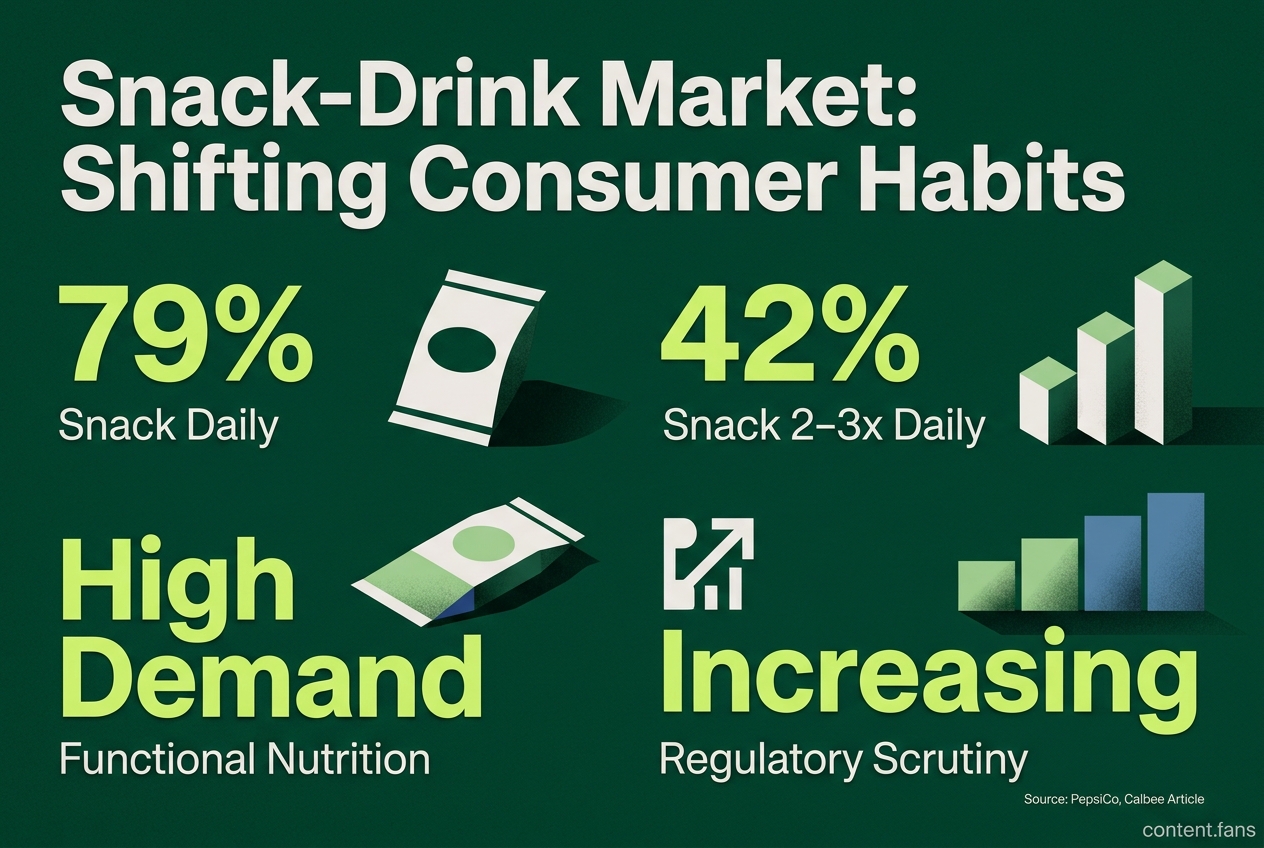
The market for hybrid snack-drinks is rapidly expanding as consumer demand for functional nutrition reshapes supermarket aisles. The article frames nutrient-dense grazing as part of a broader healthy-snacking trend and notes that 79% of consumers snack daily and 42% snack two to three times a day, blurring traditional food categories. Companies are responding with products that combine the convenience of snacks with the format of drinks, prioritizing substantiated health functions over traditional form factors. This shift suggests that the future of food categories will be defined by proven benefits, not just whether a product is solid or liquid.
Blurring Categories Put R&D Under Pressure
This convergence stems from the "intentional grazing" trend, where consumers replace traditional meals with smaller, nutrient-focused eating occasions. They demand products delivering tangible benefits like protein or fiber in convenient, single-serving formats, forcing brands to create hybrid products that defy old snack and drink classifications.
Industry leaders are already responding. PepsiCo frames its protein-fortified Quaker Oats beverage as a "mini-meal moment," while Singapore's Lullaa combines high-calcium SmartMilk shots with granola toppers. Similarly, Body Granola is a personalized granola product based on gut microbiome testing and prebiotic toppings, and Farm Fresh in Malaysia increased the protein in its yogurt drinks to rival meat snacks for satiety.
These innovations place new demands on R&D, requiring ingredient density, portability, and versatile textures for sipping or chewing. Formulators are increasingly relying on ingredients like hydrocolloids, milk proteins, and heat-stable probiotics that function across bars, pouches, and ready-to-drink formats.
Navigating Regulatory Hurdles and Evidence Gaps
The rise of functional hybrid products introduces significant regulatory challenges. In the U.S., new USDA-FSIS guidance requires that marketing claims related to animal raising or the environment be pre-approved and backed by extensive documentation like third-party certifications (FSIS-GD-2024-0006). While this rule initially targets meat, legal experts predict its high standard for proof will extend to plant-based and microbiome-related claims.
Similar trends are emerging in other regulatory jurisdictions, where authorities are increasingly requiring substantiation for sustainability claims. Consequently, brands marketing hybrid snack-drinks with ingredients like "pasture-raised whey" or "carbon-neutral oats" will face a higher burden of proof, requiring complex data that complicates product development.
New Routes to Market: Subscriptions and Flexible Supply Chains
To capture the "daily habit" consumer, brands are bypassing traditional retail for direct-to-consumer (DTC) subscription models. This channel represents a significant portion of the personalized nutrition market. For example, PepsiCo's SnackFutures is testing a service bundling nutritional shots with wearables, and Lullaa pairs microbiome tests with monthly granola refills.
Fulfilling this subscription demand requires a highly flexible supply chain. Agile co-manufacturing and versatile ingredient inventories - such as calcium lactate, soluble fiber, and spore-forming probiotics - are essential. These components can be used across both solid and liquid products, enabling just-in-time production at regional facilities to meet fluctuating demand.
A Commercial Playbook for the Hybrid Snack-Drink Market
To succeed in this converging market, companies should adopt a strategic playbook:
- Validate Claims Early: Use small-scale clinical or biomarker studies to substantiate multi-benefit claims, preventing costly relabeling down the line.
- Simplify Production: Develop product families from shared base ingredients (like an oat concentrate) to streamline inventory and forecasting.
- Optimize Retail Placement: Secure high-traffic aisle endcaps that attract both snack and beverage shoppers, especially during peak afternoon hours.
- Structure Subscription Tiers: Create offerings that include core product replenishment, data-integrated premium upgrades, and seasonal variations to maximize customer lifetime value.
By aligning these strategies with their supply chain capabilities and retail partnerships, brands can effectively serve the modern grazer while maintaining regulatory compliance and clear market positioning.
What exactly is the "intentional grazing" trend and why is it blurring snack and drink categories?
Intentional grazing is the move from three fixed meals to 4-6 smaller, purpose-driven eating occasions throughout the day. Consumers are hunting for portable, nutrient-dense products that deliver protein, fiber and gut-health benefits in a single bite or sip.
- A significant portion of personalized-nutrition spend flows through direct-to-consumer subscriptions, proving shoppers want a steady pipeline of tailored mini-meals rather than impulse snacks.
- PepsiCo's Doritos Crunch Dips (a chip-cup plus beverage hybrid) and Calbee × AMILI Body Granola (a probiotic granola shot sized for pockets) both launched as "daily, long-term consumption" formats, not occasional treats.
Because these hybrids are positioned as functional nutrition rather than indulgence, they sit simultaneously in snack, beverage and supplement aisles - erasing the old category map.
How are regulators responding to the flood of new health-positioned grazing products?
FSIS requires pre-approval and substantiation for animal-raising or environment-related claims, and it strongly encourages third-party certification. The same logic is migrating to hybrid snack-drinks: expect enforcement on terms like "grass-fed protein bites" or "regenerative oats".
- The USDA 'Product of USA' final rule has a compliance date of January 1, 2026, and establishments need written documentation to support U.S.-origin claims.
- In other jurisdictions, authorities are increasingly requiring substantiation of green and sustainability labels. In practice, a pouch that says "pasture-raised collagen water" will need verifiable supply-chain data before it reaches shelves.
How are companies proving their grazing products actually work - and does clinical evidence matter?
Yes, clinical proof is becoming table stakes. Calbee partnered with gut-microbiome startup AMILI to run a randomized trial showing improved stool frequency after 14 days of Body Granola, letting them use "clinically tested for digestive comfort" on pack.
Personalized subscriptions double as data engines:
- Companies are reporting significant user increases after packaging their supplement products with regular biomarker reports, demonstrating measurable outcomes.
Retail buyers now ask for efficacy dossiers alongside slotting fees; without them, new hybrids are shelved in "functional" ghettos rather than mainstream snack or beverage sets.
What subscription mechanics are winning - and how big is the prize?
The direct-to-consumer subscription market represents a substantial and growing portion of personalized nutrition. Winning mechanics:
- Starter kit + auto-replenish cycle (e.g., an initial gut-microbiome test ships with 30 single-serve granola sachets, followed by monthly refills matched to updated microbiome scores).
- Flexible pauses - users skip weeks without canceling; retention rises significantly.
- Tiered pricing: basic SKU at USD 1.49/shot, premium "clinical grade" at USD 2.99/shot.
Startups using this stack reach break-even in 5-7 months, versus 14-18 months for pure retail launches.
What practical playbook should incumbents and startups follow to enter the space responsibly?
- Label truthfully - treat "grazing," "grass-fed," or "gut-friendly" as factual claims, not slogans; build the traceability file before the brand deck.
- Design for daily dosing - formats ≤ 150 kcal, shelf-stable 6-12 months, single-hand opening.
- Run a 30-subject pilot - minimal viable clinical evidence costs ~USD 40 k and unlocks higher shelf price.
- Bundle data and product - every subscription box includes a microbiome or wearable data hook; churn drops when customers see month-to-month improvement graphs.
- Modular supply chain - co-pack granola sticks in one plant, dry-beverage powder in another; swap ingredients in < 8 weeks as science or regulation shifts.
Brands that follow the checklist are already moving from "nice alternative" to core basket item in the grazing consumer's weekly routine.