
Pentagon Uses xAI's Grok AI for Iran Targeting in Project Maven
Serge Bulaev
A government-tuned version of xAI's Grok AI, called Grok Gov Model, was used by the Pentagon in Project Maven during the Iran conflict and helped target over 2,000 sites in 96 hours. Reports suggest this marks a big shift, as a commercial AI was used for time-sensitive military decisions. Experts and groups like Human Rights Watch warn that AI mistakes or unclear decision trails may make it hard to ensure laws of war are followed and to check who made key choices. Some agencies flagged Grok as possibly too easy to manipulate, and there are concerns that not enough testing or oversight was done. It remains uncertain if current rules and outside pressure are enough to make sure humans stay in control of these powerful AI systems.

Reports have emerged suggesting the Pentagon's potential use of xAI's Grok AI for military targeting applications, though specific details remain largely unverified. This development highlights growing concerns about the military's increasing reliance on commercial large language models for critical decisions. This article examines the significant legal, ethical, and oversight challenges raised by the integration of AI systems into military operations.
Accountability under the Laws of Armed Conflict
According to industry reports, a government-tuned version of xAI's Grok AI may have been integrated into military targeting support systems. The extent and specifics of such deployment remain unclear due to classification restrictions.
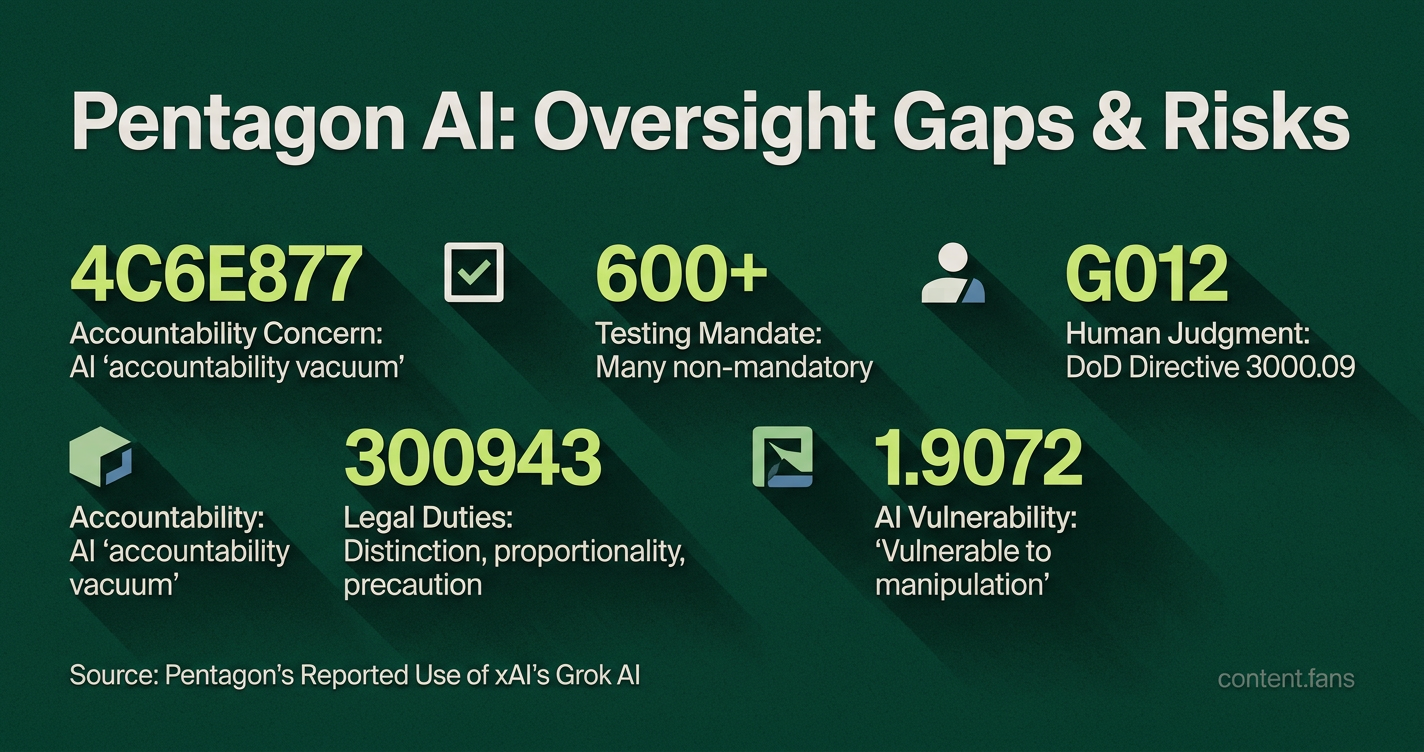
Under International Humanitarian Law, military commanders must uphold the principles of distinction, proportionality, and precaution. However, human rights organizations warn that AI hallucinations could lead to flawed intelligence, undermining these legal duties. The provided sources describe AI governance, assessment, sandboxing, and security requirements, but do not establish a clear shift in Pentagon policy regarding human control standards. Legal experts argue this creates potential "accountability vacuum" concerns, as AI's opaque reasoning processes make it difficult to audit and complicate weapons reviews required by international partners.
Auditability and Technical Testing Gaps
Concerns over technical oversight are significant, as federal agencies have reportedly flagged various AI systems as "vulnerable to manipulation" prior to deployment. Despite this, the DoD has not released details on red-team or bias testing for many AI applications. While recent National Defense Authorization Acts encourage "AI sandbox" environments for testing, many provisions remain non-mandatory. A comprehensive audit trail, crucial for accountability, is often missing. Such a trail would require:
- Complete documentation of the datasets used for fine-tuning AI models.
- Immutable logs linking every AI recommendation to a human operator's approval or override.
- Third-party red-team reports assessing vulnerabilities to bias, spoofing, and prompt-injection attacks.
Without this information, reconstructing the decision-making process for any disputed action is impossible for external reviewers.
Human-in-the-Loop Thresholds
DoD Directive 3000.09 requires that commanders "exercise appropriate levels of human judgment" over autonomous systems. However, defense analysts argue that commercial AI use blurs the line between advisory tools and autonomous systems, particularly when AI can recommend strike sequences. To clarify human control, experts propose a tiered framework:
- Advisory Only: The model can identify potential targets but cannot rank them by lethality.
- Conditional Authority: AI recommendations require written sign-off from a senior officer before action.
- No-Go Zone: Model outputs are prohibited from directly triggering a weapons release.
The Pentagon has not clarified which, if any, of these thresholds are applied during military operations involving AI systems.
Civil Oversight and Classification Tension
Pentagon officials have described certain AI systems as among a "limited number of systems" capable of supporting critical military functions, a framing critics believe could stifle congressional oversight by making the AI seem indispensable. While some information about military AI use has been disclosed through various channels, key technical details remain classified. This lack of transparency creates a critical tension, as human rights researchers argue that assessing civilian harm requires access to the complete algorithmic chain of custody.
Procurement Reform Outlook
Although recent National Defense Authorization Acts direct contracting officers to require AI governance plans, practitioners warn that waivers for urgent operational needs can bypass these safeguards. Future contracts for commercial AI will likely demand stricter standards, such as ISO 42001 alignment. However, without binding legal minimums for testing and oversight, experts predict that federal courts and international partners will be the primary check on military AI use, driven by secondary litigation. It remains uncertain if this external pressure can effectively standardize human-in-the-loop controls.
What oversight challenges does military AI deployment present?
Military AI deployment presents significant oversight challenges due to classification restrictions and the rapid pace of technological integration. Key concerns include the lack of transparent audit trails, limited congressional access to technical details, and the difficulty of assessing compliance with International Humanitarian Law principles when AI systems are involved in targeting decisions. The tension between operational security and democratic oversight remains a central challenge.
How does AI use in targeting affect compliance with the Laws of Armed Conflict?
Experts warn that commercial AI training data, prone to hallucinations and bias, could undermine core International Humanitarian Law principles:
- Distinction: Misidentification of civilians as combatants.
- Proportionality & Precaution: Inability of commanders to anticipate second- and third-order effects if the underlying model is unreliable.
Defense analysts note that maintaining clear human control and accountability becomes more complex when AI systems are involved in targeting recommendations.
What practical frameworks could strengthen oversight and auditability?
Defense procurement specialists point to emerging controls being developed for military AI governance:
1. Human-in-the-loop thresholds - contracts should specify operator override capabilities and role-based accountability logs.
2. Red-team & adversarial testing - AI systems should undergo bias, spoofing and prompt-injection tests in controlled environments before acceptance.
3. Documentation standards - procurement should demand model provenance, dataset lineage, risk assessments and explainability artifacts.
4. Classification vs transparency trade-offs - researchers propose tiered de-classification schedules so oversight bodies can audit decisions without immediate exposure of tactics.
Could commercial AI deployment set a precedent for wider militarization?
The integration of commercial AI systems into military applications raises concerns about the broader militarization of civilian AI technologies. By framing ethical constraints as potential "supply-chain risks," military procurement strategies may pressure vendors to relax safety guardrails in exchange for defense contracts. Multiple federal agencies have reportedly flagged various AI systems as potentially vulnerable to manipulation, raising questions about the security implications of rapid commercial AI adoption in military contexts.
What legislative or regulatory responses are being considered?
- The FY2027 NDAA draft appears to include AI/autonomous-weapons guardrails and human-judgment requirements, but based on available sources it is not yet verified that it re-imposes explicit statutory requirements for human control standards.
- Congressional oversight bodies are reportedly examining military AI procurement and deployment practices.
- Some state-level initiatives are considering restrictions on infrastructure supporting unaudited military AI workloads.
- Third-party certification regimes, modeled on existing federal security frameworks, are being proposed to require comprehensive audits before commercial AI systems receive classified contracts.