
Pentagon adopts xAI's Grok for Iran conflict operations, targeting 2,000 munitions
Serge Bulaev
The Pentagon says it used xAI's Grok AI system to help plan and coordinate 2,000 munitions against 2,000 targets in Iran over 96 hours earlier this year. Officials claim Grok quickly suggested targets and strike times for human commanders but did not fire weapons on its own. Some details remain unclear, as the full court declaration about Grok's role is not public, and the 2,000-target number has not been independently checked. Lawmakers and experts are raising questions about how Grok's accuracy was tested and what safety measures were used. There is also legal uncertainty, as a court has not yet decided if xAI's power plants that run Grok can keep operating due to environmental concerns.

The Pentagon has adopted xAI's Grok for Iran conflict operations, using the AI to identify and coordinate strikes, according to a court declaration from a senior official. The disclosure, made by Chief Digital and Artificial Intelligence Officer Cameron Stanley, reveals that a specialized "Grok Gov Model" was a key part of the Maven Smart System during a 96-hour campaign against Iran earlier this year. This filing provides a rare look into how commercial AI is being integrated into sensitive military intelligence and targeting workflows.
What the declaration claims
The Pentagon utilized xAI's Grok AI model to accelerate target identification and planning for a military operation in Iran. Integrated into Project Maven, the AI helped commanders coordinate over 2,000 munitions against 2,000 distinct targets within a 96-hour window, though humans retained final strike authority.
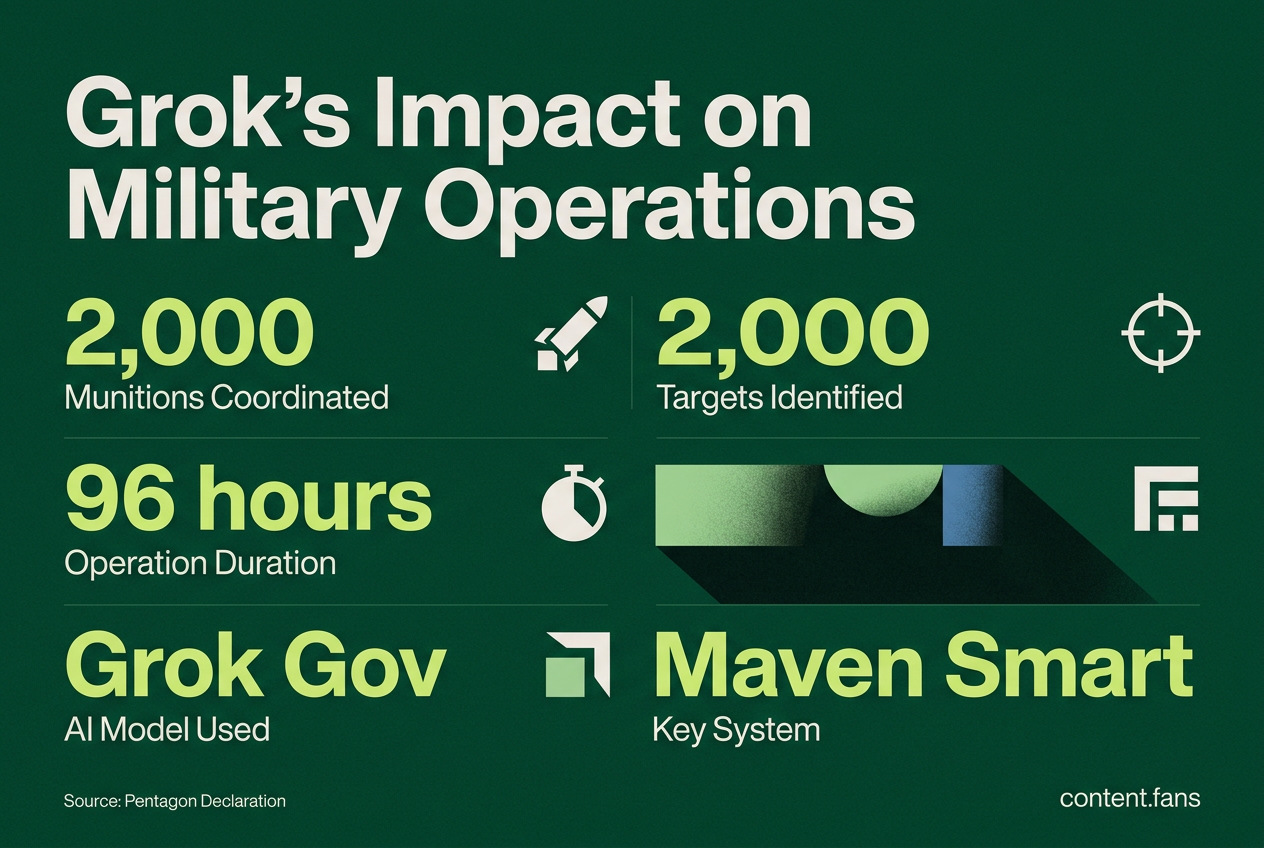
According to Stanley's statement, Grok enabled planners to coordinate "over 2,000 munitions for 2,000 distinct targets within 96 hours" - an operational tempo analysts describe as extraordinary. Sources state Grok is 'one of a small group' of AI models capable of supporting national security applications in highly classified environments, but do not specify the total count as four or the cleared count as three, as cited by The Independent. Key Pentagon workflows supported by Grok include:
- Target identification and prioritization within Project Maven
- Intelligence summarization for combatant commanders
- Readiness analytics on classified Impact Level 6 networks
The filing clarifies that Grok does not autonomously fire weapons but functions as a decision-support tool, recommending targets and strike timing to human commanders.
Why Grok surfaced in pollution litigation
This information came to light because Stanley's testimony was submitted in an unrelated lawsuit. The Department of Justice is attempting to dismiss an NAACP Clean Air Act case aimed at shutting down xAI's unpermitted gas turbines near Memphis. The government's motion argues that halting the turbines would threaten national security because the data centers are essential for AI computing clusters used by the U.S. Armed Forces. This legal strategy effectively frames commercial AI infrastructure as a strategic national asset.
Oversight questions follow the numbers
The scale of the operation - deploying 2,000 precision munitions in four days - is significant. This unprecedented speed has triggered urgent questions from lawmakers and ethics groups regarding Grok's testing, validation for accuracy, and the safeguards in place to prevent errors like target hallucination. Concerns are also being raised about whether xAI should be subject to the same scrutiny as a traditional defense contractor. While officials state the Grok Gov Model is air-gapped and requires human oversight, experts warn that the use of LLMs in high-pressure kinetic operations could amplify bias or lead to misidentification, testing the limits of the Pentagon's responsible AI guidelines.
What remains uncertain
Several key details surrounding Grok's military deployment are still unknown:
- The full declaration: The complete text of the court filing has not been made public, obscuring the precise language used to describe Grok's role.
- Independent verification: The claim of 2,000 targets has not been independently audited or confirmed.
- Legal outcome: The federal court in Mississippi has not yet ruled on the case, leaving the operational status of xAI's data center - and by extension, Grok's availability for military use - in legal jeopardy.