
Pentagon adds Alibaba, Baidu to China military list; stocks fall
Serge Bulaev
The U.S. Department of Defense added Alibaba, Baidu, and other Chinese firms to a list of 'Chinese Military Companies' on June 9, 2026. This move may impact their business with the U.S. government, as direct contracting bans will start on June 30, 2026, and broader rules on supply chains may follow a year later. Stock prices for these companies dropped after the news, but analysts suggest this is more of a warning than a sign of immediate financial loss. The companies deny any links to the Chinese military and may challenge the decision in court, though this process could take months. Experts note that these rules might make companies outside of defense think carefully about working with the listed firms.

The U.S. Department of Defense's move to add Alibaba, Baidu, and other prominent Chinese firms to its list of 'Chinese Military Companies' immediately sent their stock prices lower. The designation sets a timeline for strict U.S. government contracting bans and signals widening scrutiny of China's military-civil fusion strategy.
What Is the Pentagon's Section 1260H List?
The Section 1260H list identifies firms the Pentagon believes are linked to the Chinese military, either through ownership, control, or other affiliations. While not a trade sanction, the designation primarily functions to block these companies from participating in the U.S. Department of Defense's vast supply chain.
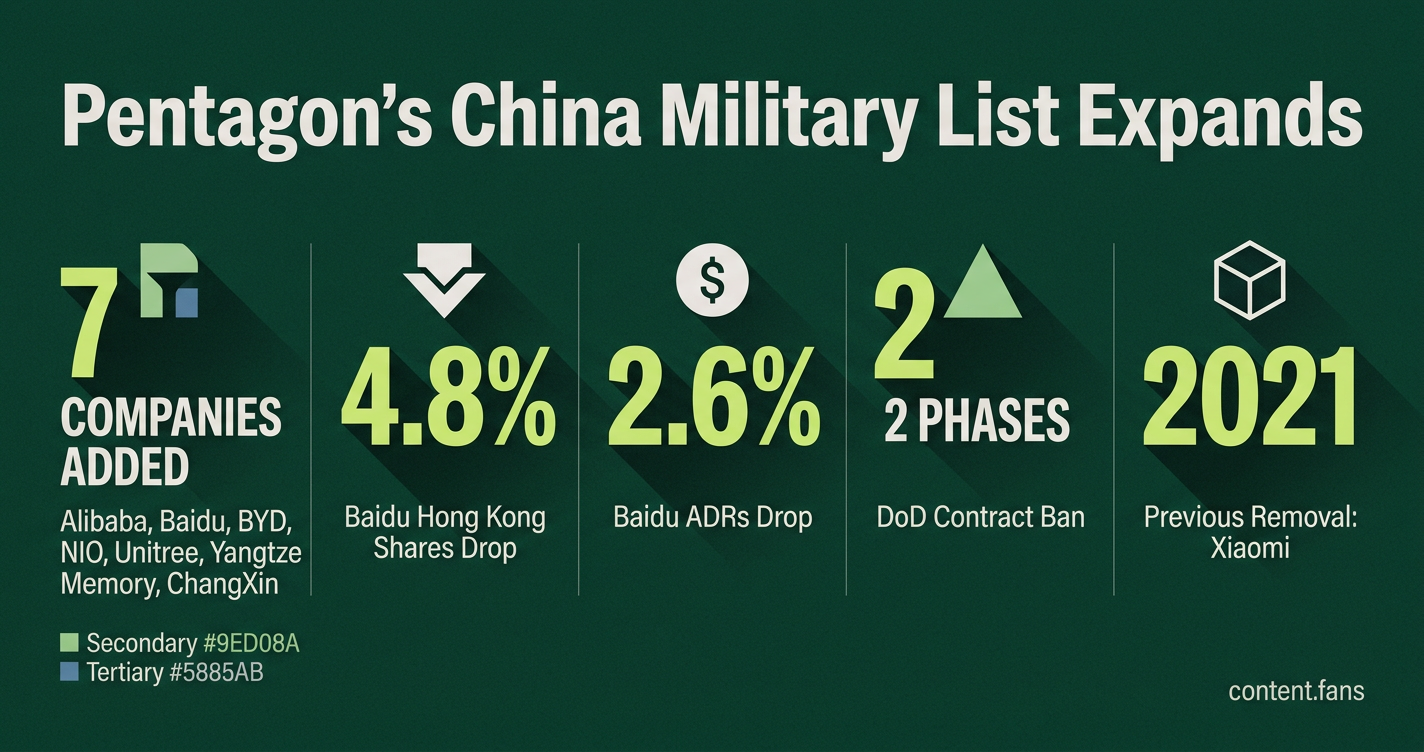
According to industry reports, the list flags companies that the Department of Defense determined qualify as 'Chinese military companies.' The recent update included tech giants Alibaba and Baidu, alongside automakers BYD and NIO, robotics firm Unitree, and chipmakers Yangtze Memory and ChangXin. According to industry reports, criteria can include direct or indirect ties to the Chinese military, holding military production licenses, or operating within state-run military-civil fusion zones.
How Did the Market React to the News?
The market reaction was swift, driven by investor sentiment rather than an immediate financial shock. Following the announcement, reports noted significant drops in U.S.-listed shares:
- Alibaba (ADR): According to industry reports, shares fell significantly in trading.
- Baidu (ADR): Baidu's Hong Kong shares fell by as much as 4.8%, and its ADRs fell 2.6% overnight.
- BYD: Showed a mixed reaction according to industry reports, with varying performance between U.S. and Hong Kong markets.
Analysts characterized the declines as a "warning signal" and a "risk-premium event," with share prices stabilizing as the market awaits further regulatory action.
What Are the Practical Consequences of the Listing?
The designation imposes a two-phase ban on U.S. defense procurement:
- Initial phase: The Department of Defense (DoD) is prohibited from awarding new contracts directly to any listed company or an entity it controls.
- Extended phase: The ban extends to indirect procurement, forcing DoD suppliers to ensure their products and services contain no components or inputs from the listed firms.
This second phase could trigger complex supply-chain audits and increase compliance costs for contractors using services like Alibaba's cloud platform, Baidu's AI tools, or parts from BYD. The move is expected to influence vendor decisions well beyond the defense industry.
Can Companies Challenge the Pentagon's Decision?
Yes, legal challenges are possible and have succeeded before. Xiaomi was removed from the Pentagon-related blacklist in 2021 after legal challenge, though the precedent value of this case remains limited. Both Alibaba and Baidu have publicly rejected any military affiliation and signaled their intent to seek legal remedies. However, litigation can take months, and the procurement blackouts remain in effect unless a court grants an injunction.
Will More Chinese Companies Be Added in the Future?
Analysts believe it is very likely the list will continue to grow. The Pentagon can add firms based on their presence in military-civil fusion zones or through "corporate-family reach," which includes parents or subsidiaries with significant ownership stakes. This suggests future additions may come from expanding the scope of already-listed corporate groups.