
Bunkerhill Health Raises $25M for AI-Powered Hospital Automation
Serge Bulaev
Bunkerhill Health, a San Francisco company, raised $25 million to expand its AI tools that help automate hospital work. Its platform, Carebricks, may help turn AI findings in medical scans and ECGs into tasks like booking referrals and sending provider messages. Since 2025, Bunkerhill has received seven FDA clearances for its clinical algorithms, which might catch silent diseases early. Investors seem to believe hospital automation is becoming important, but it is not certain how quickly hospitals will adopt these tools or if they will show clear benefits in patient care.

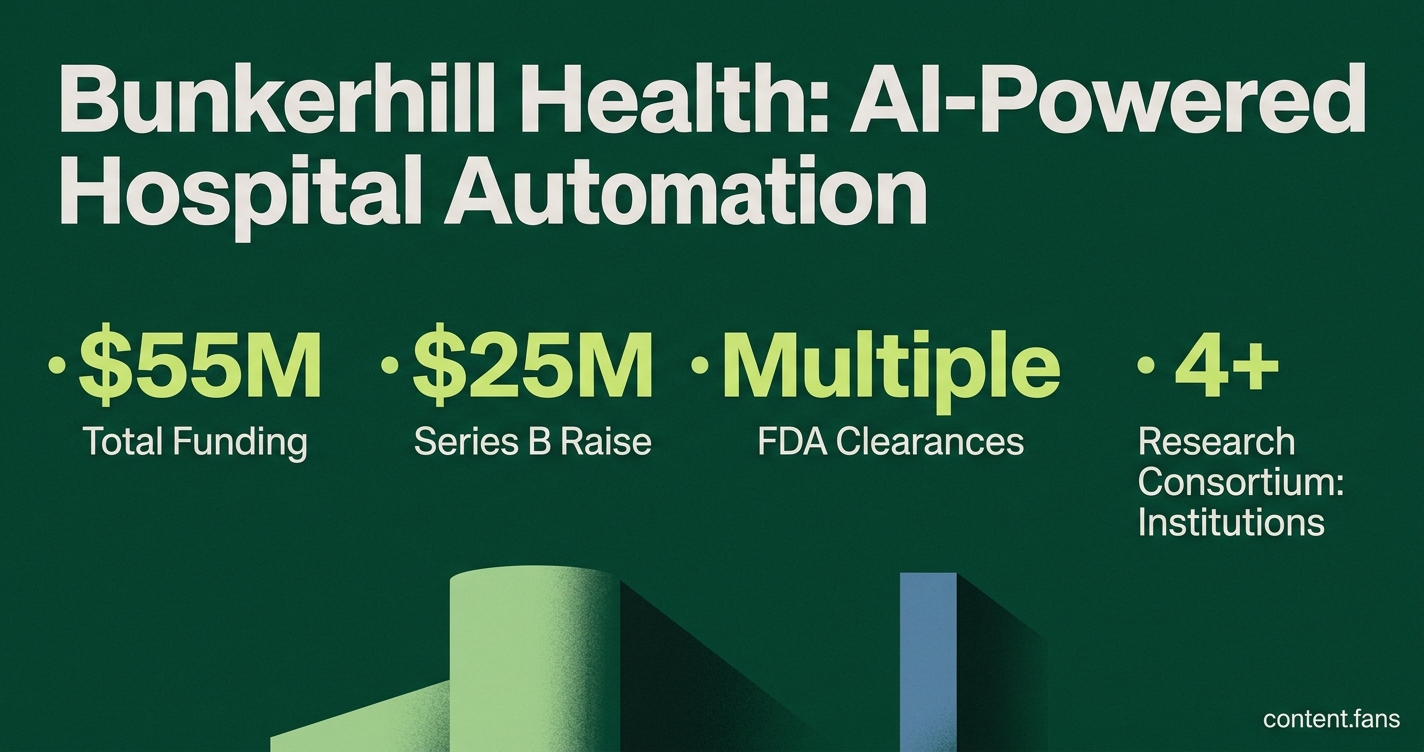
Bunkerhill Health raises $25M for AI-powered hospital automation, securing Series B funding to expand its platform of clinical algorithms and AI agents. The San Francisco startup's total financing now reaches $55 million, with backing from prominent investors including Khosla Ventures, Sequoia, Felicis, Optum Ventures, and Y Combinator.
The company's platform addresses the significant administrative burden on U.S. health systems. It uniquely combines FDA-cleared clinical algorithms with 'agentic AI' to automate both clinical and operational tasks. This system moves beyond simple documentation, enabling everything from early disease detection to immediate care interventions.
What specific FDA-cleared algorithms does Bunkerhill Health offer?
Bunkerhill Health provides a suite of FDA-cleared AI algorithms designed for opportunistic screening. These tools analyze existing medical imaging, like CT scans and ECGs, to detect signs of silent diseases such as cardiovascular conditions and osteoporosis that were not the original focus of the exam.
The company has developed multiple algorithms for various clinical applications, including tools for automated abdominal aortic quantification on both contrast and non-contrast CTs, opportunistic bone density assessment for osteoporosis risk from abdominal CTs, and AI for aortic valve calcification quantification on non-cardiac CTs. The company has also developed ECG-based AI for detecting reduced ejection fraction for heart failure screening.
All algorithms were developed using data from Bunkerhill's multi-institutional research consortium of academic medical centers, including UCSF, Emory, MedStar, and Stanford.
How does the Carebricks platform automate hospital workflows?
The Carebricks platform acts as a "system of action," converting passive AI detections into automated clinical tasks. When an algorithm flags a high-risk finding, Carebricks deploys AI agents to:
- Initiate referrals to cardiology, vascular, or other specialties
- Coordinate follow-up care with longitudinal tracking
- Send guideline-based messages to providers and patients
- Trigger prior authorization and registry submissions
- Place medical orders directly in third-party EHR systems
This agentic workflow approach eliminates manual intervention delays, ensuring critical findings (like elevated calcium scores or undiagnosed osteoporosis) translate into timely care rather than being lost in administrative gaps.
What makes Bunkerhill Health different from other healthcare AI startups?
While the healthcare AI landscape includes competitors in administrative automation, Bunkerhill targets a different problem. The company's strategy is built on three core differentiators:
| Dimension | Typical Competitors | Bunkerhill Health |
|---|---|---|
| Regulatory foundation | General-purpose AI tools | Multiple FDA-cleared clinical algorithms with specific diagnostic functions |
| Automation depth | Documentation, coding, scheduling | Clinical + operational - from detection through care delivery |
| Data source | Structured EHR data | Opportunistic screening from existing imaging and ECGs |
While most automation startups address administrative workflows, Bunkerhill's algorithms surface previously invisible disease burden from routine scans ordered for other reasons - detecting abdominal aortic aneurysms during GI workups or osteoporosis during trauma evaluations.
What reimbursement support exists for health systems adopting these tools?
The company is working to establish reimbursement pathways for AI-driven analysis on chest CTs. Such developments would provide reimbursement clarity, removing financial barriers for health systems and transforming the technology into a sustainable clinical service.
The contrast-enhanced CT clearances are particularly valuable clinically, as many routine chest CTs now use contrast - dramatically expanding the addressable patient population beyond traditional non-contrast screening protocols.
Why did Khosla Ventures and Sequoia Capital invest in this round?
The Series B round, jointly led by Khosla Ventures and Sequoia, signals strong investor conviction that agentic AI is foundational to the future of healthcare delivery. Khosla Ventures has a track record of backing key players in this space, including Rad AI and Vista AI.
Sequoia's investment highlights a strategic focus on AI that progresses from simple assistance to autonomous action. The addition of Optum Ventures, UnitedHealth Group's investment arm, provides crucial health system validation, while continued support from Y Combinator underscores Bunkerhill's proven product-market fit.
The total funding raised positions Bunkerhill to compete against better-funded documentation-focused rivals by leaning into its regulatory moat and clinical outcome differentiation - areas where FDA clearances create harder-to-replicate barriers than administrative automation alone.