
Google Ads mandates AI content disclosure by July 2026
Serge Bulaev
Google Ads will require all advertisers to clearly label any ads made using generative AI by July 2026. The rules say advertisers must declare if outside AI tools were used, or Google will disclose it automatically if its own AI created the ad. Some places, like the EU, India, and New York, will show a visible "AI Generated" label on the ad itself, while other areas will display the notice in an information panel. The policy covers all ad formats and includes extra rules for election ads and a ban on deepfake images of real people. Experts suggest these new labels may help build trust with users, but advertisers are ultimately responsible for following the rules.

By July 2026, Google Ads mandates AI content disclosure when generative AI substantially contributes to ad content on its platforms, including Search, YouTube, and Discover. This significant policy shift requires transparent labeling for generative AI in advertising, aligning creative development with new transparency standards and placing full compliance responsibility on advertisers.
Key AI Disclosure Rules for Advertisers
The new policy requires advertisers to disclose when generative AI substantially contributes to ad content. This declaration is manual for third-party tools but automatic when using Google's native AI. In specific regions, a visible label appears directly on the ad, enhancing transparency for all users.
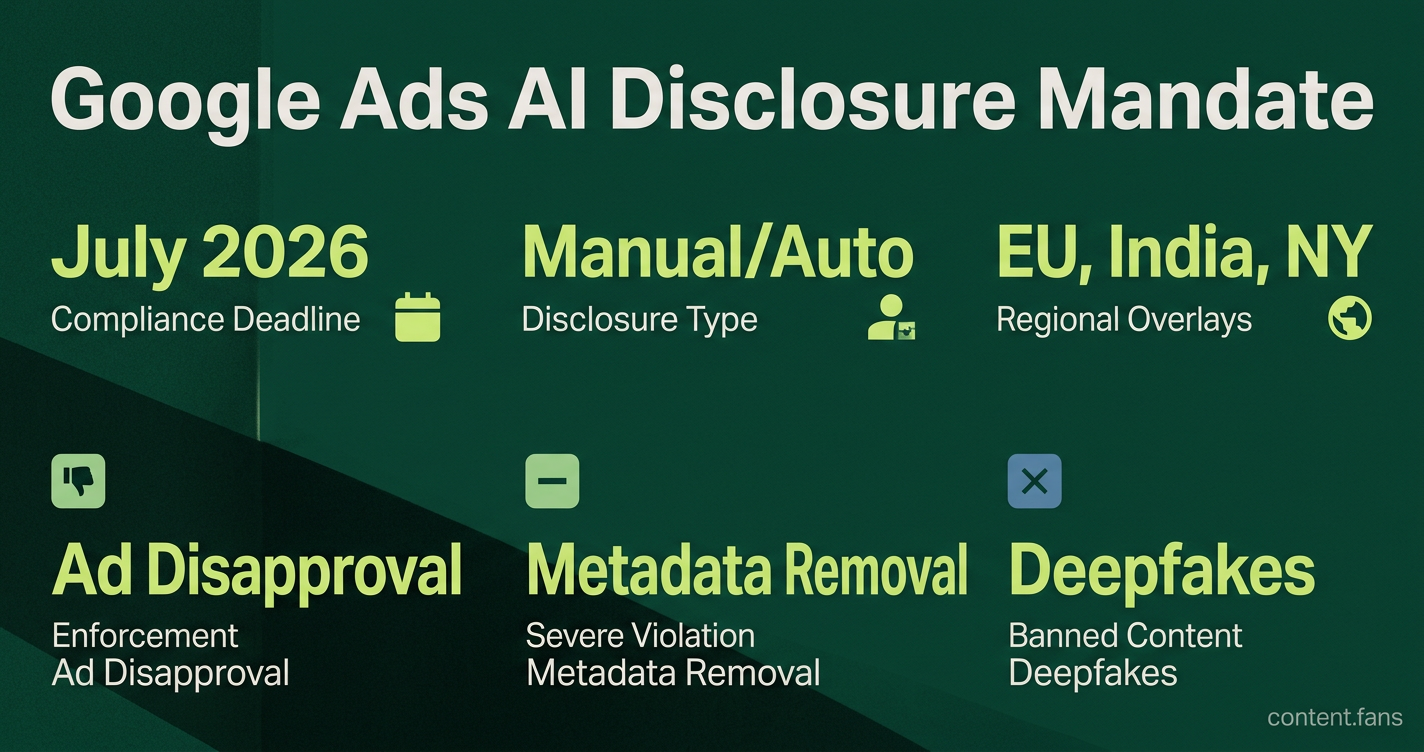
Google's updated policy outlines three primary compliance pillars for advertisers, as detailed on the Google blog:
1. Manual Declaration: Advertisers must self-disclose when third-party generative AI tools "substantially" contribute to ad visuals, audio, or copy.
2. Automatic Labeling: Ads created entirely with Google's native AI features will be disclosed automatically by the platform.
3. Regional Overlays: A 'How this ad was made' panel is accessible globally via My Ad Center; on-ad labels appear automatically or via advertiser control only in the EU, India, and New York where local regulations require them.
This policy applies to all ad formats, from Search text ads to Performance Max videos. Google rolled out the new AI disclosure requirement on July 9, 2026, with gradual rollout across the month of July.
Enforcement and Penalties for Non-Compliance
Google will enforce this policy using a combination of advertiser self-declarations and its own automated detection systems. Discrepancies will result in immediate ad disapproval. Repeated violations risk account suspension under Google's Misrepresentation policy. Furthermore, any attempt to remove AI-generated metadata is considered a severe "system circumvention" violation.
A strict, separate policy also bans deepfakes or synthetic media depicting real people, even with disclosure. Brands must audit all creative assets to ensure compliance.
Regional Requirements and Election Ad Safeguards
In the European Union, India, and New York State, regulations mandate a conspicuous on-ad overlay, not just a disclosure panel. This "AI Generated" label appears directly on video, image, and carousel ads. Advertisers in other regions can use the information panel, but should anticipate that more local laws may require overlays in the future.
For election ads, an additional declaration is required in campaign settings. If synthetic content is used, advertisers must confirm it and may need to add a prominent in-ad disclaimer like "This image was created with AI" to avoid automatic rejection.
How Brands Can Prepare for the July 2026 Deadline
Advertisers are solely responsible for determining if AI has "substantially" altered an ad creative. To ensure readiness, experts recommend documenting all AI tool usage, retaining original source files, and preserving provenance metadata. Key preparation steps include:
- Inventory all third-party generative AI tools used by creative and marketing teams.
- Activate the new AI content disclosure control within Google Ads account settings.
- Educate creative teams on specific regional overlay requirements.
- Audit all creative assets to ensure they comply with the deepfake prohibition.
- Schedule final compliance audits well before the July 2026 deadline.
Proactive disclosure may benefit brands by building consumer trust. Industry reports suggest that many consumers report that AI disclosure either enhances or has no negative impact on their purchase intent. This finding positions transparency not just as a regulatory requirement, but as a valuable trust signal in modern advertising.
What is the new Google Ads AI disclosure requirement?
Starting July 2026, every ad running on Search, YouTube, and Discover that contains AI-generated or AI-edited content must carry a visible disclosure. Google's own AI tools will trigger an automatic label inside the new "How this ad was made" panel, while advertisers using third-party AI must manually self-declare via a control in My Ad Center. In the EU, India, and New York, the disclosure appears directly on the ad as an "AI Generated" overlay; elsewhere it is one click away behind the three-dot menu.
Who has to do the work - Google or the advertiser?
It depends on whose brainpower created the asset:
- Google AI tools (Performance Max, Search generative assets, etc.) - disclosure is automatic.
- Third-party AI (Midjourney, ElevenLabs, ChatGPT, etc.) - the advertiser must tick the AI box; Google performs no independent verification of external tools.
- Human-made or AI-assisted (color correction, cropping, headline optimization) - no disclosure required.
Failing to label third-party AI is treated as Misrepresentation: the ad is disapproved at review and repeated misses can escalate to account suspension.
How are regulators enforcing the rule?
Google couples automated AI detection with advertiser self-declaration. Mismatches or stripped metadata are flagged as circumventing systems - the platform's harshest enforcement bucket. Civil penalties already hit $53,048 per violation in the U.S. and can reach 3% of global turnover in the EU. A categorical deepfake ban applies worldwide: AI may not depict real, identifiable people regardless of consent.
Will the label hurt campaign performance?
Early data says no. Industry reports suggest that many Gen Z and Millennials either trust or ignore AI labels when deciding to purchase, and a significant portion of U.S. consumers believe brands have a duty to disclose. Yahoo and Publicis measured an overall trust lift when ads carried a clear "Created with AI" badge, while silence is increasingly read as hiding something.
How does Google's policy compare with Meta, Amazon, and Microsoft?
- Meta already enforces a global "AI-generated" tag for photorealistic synthetic media; omission triggers policy strikes and can end in account restriction.
- Amazon currently requires disclosure only in Kindle Direct Publishing, not in its ad platform.
- Microsoft Advertising follows general FTC truth-in-advertising rules for AI disclosure requirements.
Bottom line: Mandatory AI disclosure is required by the EU AI Act starting August 2, 2026, and brands that build transparency into their creative workflows are turning compliance into a competitive trust signal.