
ParcelBio Unveils $13M Seed Round for Next-Gen mRNA Platform
Serge Bulaev
ParcelBio has raised $13 million to develop its new mRNA platform, which may help make protein treatments last longer in the body. Other companies also recently raised funds for similar next-generation mRNA and RNA therapies that might work better or reach more tissues. The science behind these therapies suggests they can be made stronger or last longer using special RNA designs. The US FDA recently introduced new ways that could help these products get approved faster, but experts say safety and manufacturing still need careful review. Analysts suggest that the first long-term mRNA treatments may be approved for use as early as 2028, though this depends on continued positive safety results.

Investment in next-gen mRNA platforms is surging, driven by the promise of more potent and durable therapies for chronic diseases. A wave of recent seed and series funding indicates capital is targeting platforms that combine novel molecular engineering with clear regulatory strategies. This analysis examines how that investment aligns with emerging science, the competitive landscape, and projected commercialization timelines.
ParcelBio Highlights the Durability Thesis
ParcelBio has secured $13 million in seed funding to advance its APEXm platform. This next-generation technology engineers linear mRNA to express therapeutic proteins for longer durations, aiming to improve treatments for chronic conditions by recruiting the body's own stabilizing mechanisms without complex manufacturing changes.
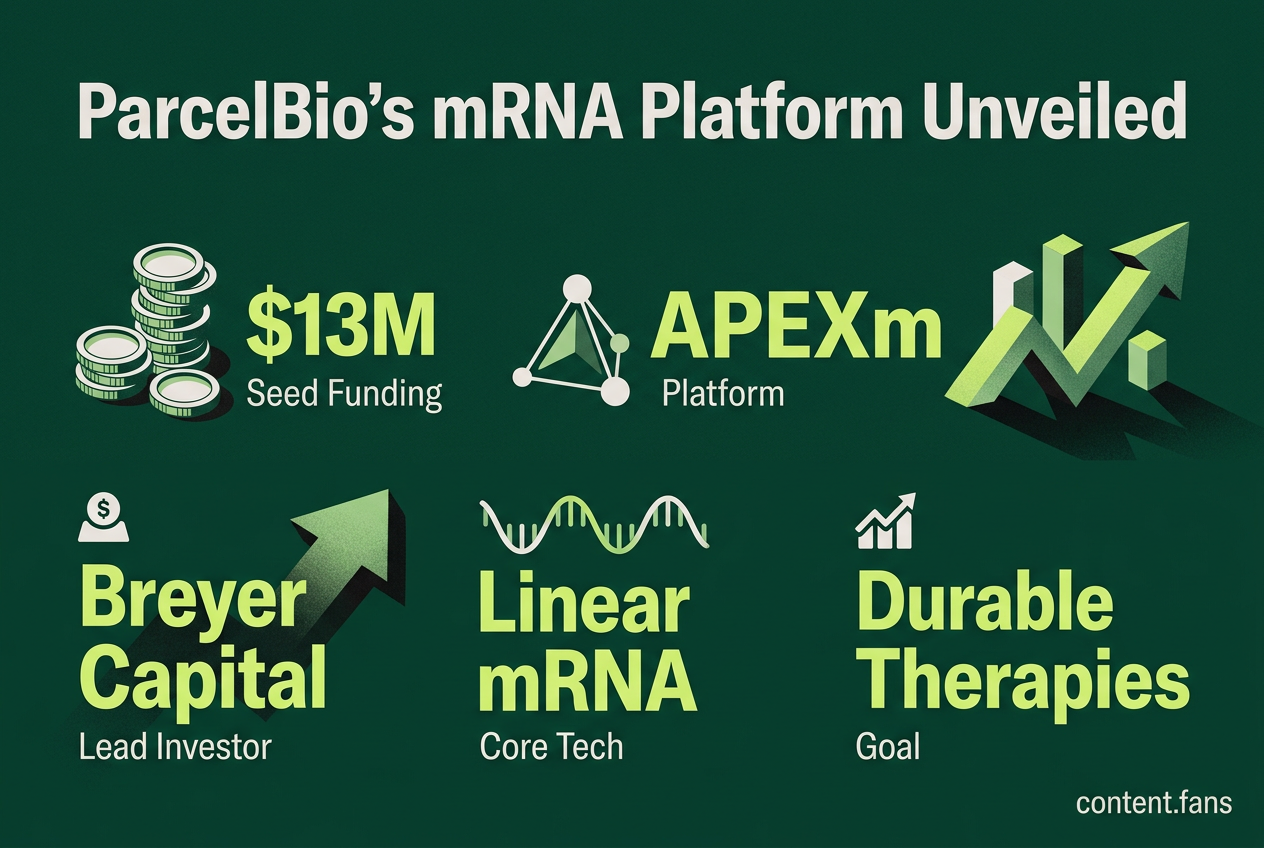
With founding year unconfirmed in sources, ParcelBio emerged from stealth on May 7, 2026, with its $13 million seed round led by Breyer Capital. As detailed in the BusinessWire release, other participants include General Catalyst, Y Combinator, and Metaplanet. The funding will advance the APEXm platform, which integrates novel RNA domains into linear mRNA to leverage the body's natural RNA-stabilizing machinery. Preclinical data suggests this method yields higher, more sustained protein expression than current clinical designs while maintaining standard manufacturing processes.
Competitive Landscape and Recent Capital Infusions
The focus on durability and potency is reflected in several major financing rounds across recent years:
- Strand Therapeutics: According to industry reports, raised significant Series B funding for STX-001, a programmable mRNA designed to express IL-12 within the tumor microenvironment, as reported by Diagnostics World News.
- Vivatides Therapeutics: Secured substantial Series A funding to develop an extrahepatic delivery platform for siRNA and antisense drug candidates.
- Orna Therapeutics: Closed $221M Series B in 2022 to advance its circular RNA platform, which is engineered to resist degradation. The technology attracted significant upfront payment from Merck in a strategic partnership.
This investment pattern suggests investor preference is shifting toward technologies that enhance protein expression duration and expand tissue targeting, moving beyond the models established by first-generation mRNA vaccines.
Scientific Mechanisms at Play
Several distinct scientific strategies are being employed to enhance the performance of RNA therapeutics:
- Linear mRNA Stabilization: ParcelBio's approach involves inserting specific RNA motifs into linear mRNA. These motifs recruit the body's own stabilizing proteins, aiming for multi-day protein expression without using self-replicating elements.
- Circular RNA (circRNA): Companies like Orna are developing circular RNA, where the molecule's ends are covalently bonded. This structure resists degradation by exonuclease enzymes, potentially increasing protein yield and duration.
- Programmable Logic: Strand Therapeutics embeds conditional elements into its mRNA. This allows therapies, such as cytokines, to activate only within a specific environment like a tumor, maximizing local potency while improving the safety profile.
- Advanced Delivery Systems: Vivatides is focused on creating lipid-free chemistries capable of delivering RNA therapies to extrahepatic tissues, a known limitation of standard lipid nanoparticle (LNP) delivery systems.
Regulatory Considerations
The regulatory environment is adapting to these innovations. According to industry reports, new accelerated pathways may provide faster routes for certain gene-editing and RNA-based products. Additionally, therapies for chronic conditions can utilize the existing Accelerated Approval pathway if they demonstrate a strong correlation with surrogate biomarkers, like sustained PCSK9 knockdown. However, experts emphasize that regulators will closely scrutinize data on cumulative dosing, immunogenicity, and manufacturing consistency, particularly for treatments designed for long-term or lifelong use.
Commercialization Timelines to 2030
Market analysts project key milestones for the broader RNA field, with pivotal data for several RNA therapeutics expected in coming years. In the mRNA space, according to industry reports, Moderna's mRNA-3927 for propionic acidemia may be ready for regulatory submission in the coming years. Should next-generation platforms demonstrate favorable durability and safety, analysts predict the first approvals for chronic-use mRNA therapies could occur by the end of the decade. This would pave the way for wider adoption in cardiometabolic and rare disease markets, assuming long-term safety is confirmed and quality assurance for novel constructs can be standardized.
What makes ParcelBio's seed round stand out in today's mRNA landscape?
ParcelBio's financing, led by Breyer Capital and joined by General Catalyst, Y Combinator, Metaplanet and others, represents a significant pure-durability seed round. It signals that investors are now willing to pay a premium for linear-mRNA solutions that extend expression without switching to circular or self-replicating formats. According to industry reports, the company has raised substantial funding, representing significant growth from its Y Combinator pre-seed.
How does the APEXm platform actually improve mRNA durability?
APEXm engineers novel RNA domains directly into the linear transcript to recruit endogenous stabilizing machinery. Pre-clinical data show higher peak protein and longer tail expression versus a leading clinical mRNA design, while keeping standard IVT and LNP manufacturability. The approach avoids the double-stranded RNA baggage of self-amplifying vectors and the complex circular-synthesis steps pursued by Orna or Laronde.
Which indications will ParcelBio chase first, and why do they need longer-lasting mRNA?
The lead program is an in vivo CAR-T for autoimmune disease, where durable CD19-targeted cell depletion could allow quarterly or bi-annual dosing instead of the current multi-week cycles. Oncology and encoded protein replacement are next; both reward sustained therapeutic levels and are poorly served by today's limited expression window.
How does the competitive field of "durability-first" mRNA look after this deal?
Recent years saw substantial funding flow to longevity-focused RNA start-ups: Strand (significant Series B for programmable tumor-localized mRNA), Orna (Series B for circular RNA) and Vivatides (Series A for extra-hepatic delivery). ParcelBio is among the seed-stage companies betting on linear-mRNA durability, carving out a niche with simpler CMC and easier regulatory comparability to approved covid-style templates.
What regulatory milestones and commercial inflection points should investors watch?
With evolving regulatory pathways and Moderna's chronic-dosing rare-disease data both validating repeat-administration safety, ParcelBio is positioned to advance its development timeline. If APEXm proves significantly longer expression in primates, partnership discussions with big-pharma autoimmune or oncology units are expected in the coming years, ahead of the projected durability-driven market inflection.