
OpenAI open sources Agentic Commerce Protocol for AI shopping
Serge Bulaev
The Agentic Commerce Protocol (ACP) is an open standard from OpenAI that lets AI handle online shopping tasks like searching products, building carts, and processing payments, while merchants keep control. ACP mainly covers the customer-facing parts of shopping, and leaves things like inventory management to other systems. As of early 2026, adoption appears limited, with only a small number of merchants using ACP checkouts, possibly due to lower conversion rates compared to traditional methods. New standards like Google's Universal Commerce Protocol may increase competition, and it seems likely that multiple protocols will be used instead of just one. Merchants are experimenting with ACP to learn how AI can recommend products, and ongoing changes may affect how AI shopping works in the future.

OpenAI's Agentic Commerce Protocol (ACP) is a standard enabling AI assistants to manage online shopping, from product search to payment processing, while keeping merchants in full control. The protocol defines how an AI requests catalog data, builds carts, and tracks fulfillment, with Stripe managing payments and tax logic. According to industry reports, the specification uses date-based versioning for stability and can be implemented as a REST endpoint or an MCP server.
What ACP Covers - and What It Leaves to Others
ACP is designed to manage the consumer-facing aspects of e-commerce. It enables AI agents to handle product discovery, build shopping carts with promotions, and manage buyer consent and identity verification. Core business operations like inventory management and warehouse routing are handled by separate back-office APIs.
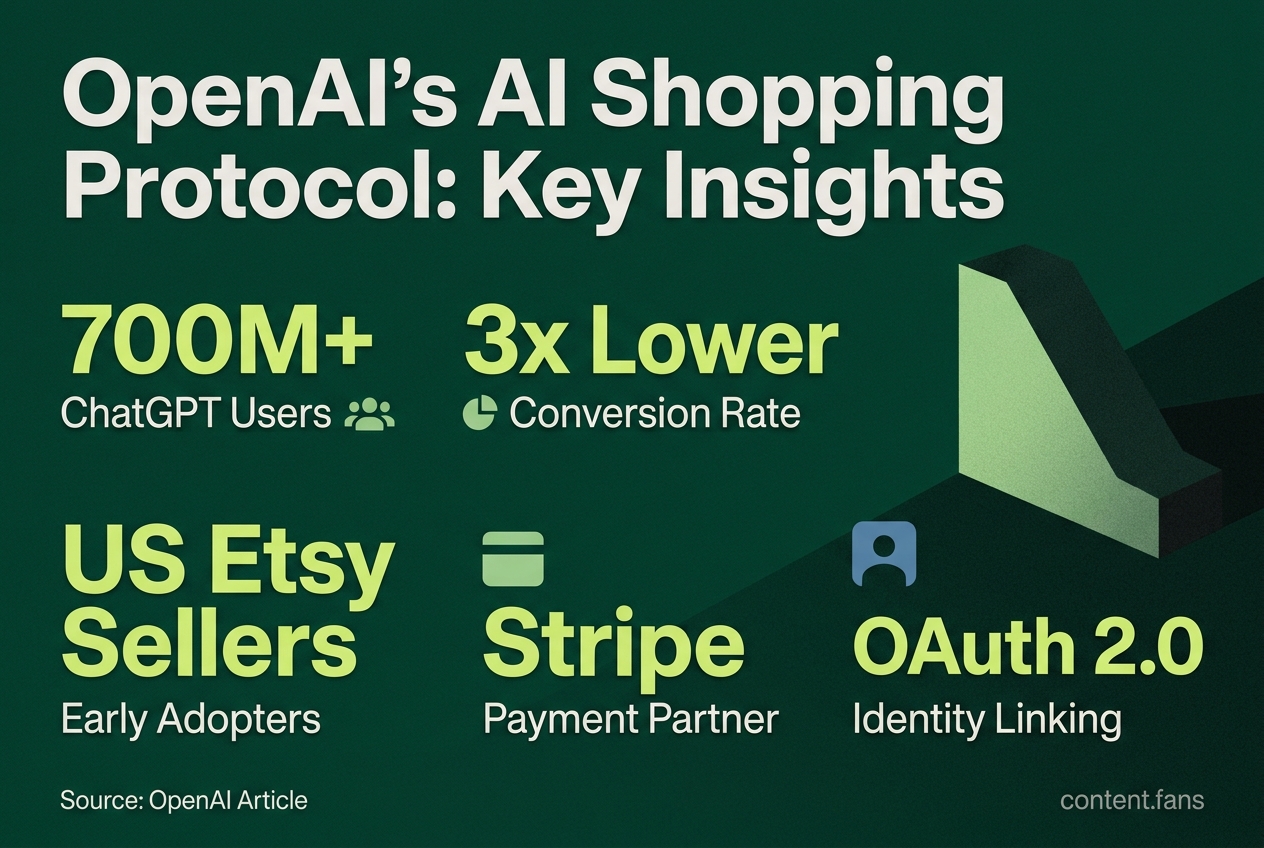
ACP's focus on the consumer-facing layer includes:
* Product discovery and side-by-side comparisons
* Cart construction, including promotions and buyer consent flows
* Identity linking via OAuth 2.0 for loyalty programs and returns
Business process orchestration, such as inventory synchronization or warehouse routing, remains the domain of the Model Context Protocol (MCP) and similar back-office APIs.
Adoption to Date
Despite ChatGPT's substantial user base of over 700 million weekly active users, ACP adoption has been cautious. Early implementations in 2025 were limited to US Etsy sellers, with expansion plans including PayPal adoption and multi-item/international capabilities by 2026. Analysts attribute this slow start to conversion rates that were roughly three times lower than traditional checkout methods, which prompted OpenAI to allow retailers to surface richer app-style experiences and optional redirects within the standard.
The competitive landscape is also expanding with reports of emerging alternative protocols. Industry observers suggest merchants are carefully comparing governance models, license terms, and buyer reach of different standards. This trend suggests an emerging multi-protocol ecosystem rather than a single universal standard.
Technical Entry Points
Developers can begin implementing ACP by consulting the official reference specification at agenticcommerce.dev and the associated guides on the OpenAI Developers portal. According to industry reports, the specification includes endpoints for key functions such as inventory search, cart pricing, payment processing, and order status tracking.
Future versions of the protocol are expected to include optional modules for subscriptions and bundled offers, though these features remain in development.
Why Merchants Experiment
Major US retailers such as Target, Best Buy, Lowe's, and Wayfair are piloting ACP to expose their full product catalogs to conversational search without major re-platforming. For mid-market sellers, Shopify's catalog connector makes ACP available to a significant portion of its storefronts, though only a small subset is currently active. Observers argue that early adopters gain invaluable insight into how AI proposes products and promotions - data that may influence paid acquisition budgets once agentic commerce scales.
As the Agentic Commerce Protocol evolves alongside competing standards, its future will be defined by ongoing experimentation. Merchants will likely continue to monitor conversion data, governance updates, and international expansion plans to determine how AI-driven shopping will ultimately function within ChatGPT and the broader e-commerce ecosystem.
What is the Agentic Commerce Protocol (ACP) and when did OpenAI release it?
OpenAI launched the Agentic Commerce Protocol in a closed launch on September 29, 2025. The specification lives at agenticcommerce.dev and lets AI agents talk to Shopify, Etsy, Instacart and other storefronts to discover, cart and buy products without leaving the chat window.
How does ACP differ from the Model Context Protocol (MCP)?
While MCP equips agents with back-office tools - inventory feeds, order-management APIs, shipping web-hooks - ACP handles the consumer face: search, compare, checkout and pay inside ChatGPT. Think of MCP as the ERP connector and ACP as the digital shop-front; together they let one agent move from "find me a red sofa" to "mark it shipped" without changing standards.
Which merchants and platforms already support ACP?
According to industry reports, the protocol is being piloted by U.S. ChatGPT users. Early adopters include Etsy U.S. sellers via Offsite Ads, Instacart for grocery baskets, Target, Sephora, Nordstrom, Lowe's, Best Buy, Home Depot and Wayfair. A significant number of Shopify merchants are in staged onboarding, although only a small number of stores have maintained the one-click "Instant Checkout" after OpenAI pivoted to merchant-hosted checkout for better conversion.
Why did OpenAI drop "Instant Checkout" and switch to merchant apps?
Internal data showed in-chat purchases converted significantly worse than sending shoppers to the retailer's own site. To protect merchant margins and customer trust, OpenAI reportedly moved away from universal one-click checkout and rebuilt the flow around rich product discovery that ends in a merchant app or web redirect, keeping the retailer of record intact while still using ACP messages behind the scenes.
What could ACP mean for shopper behavior and e-commerce revenue?
Industry analysts forecast that substantial retail revenue could flow through agentic channels by 2030, with AI-handled orders showing significant growth on major platforms. Market research suggests that a growing portion of commercial search traffic will move to AI answer engines; stores that expose an ACP endpoint today are effectively stocking the shelves where tomorrow's shoppers will ask, "Order everything I need for taco night."