
Palo Alto Networks Warns AI Cuts Cyberattack Timelines to 25 Minutes
Serge Bulaev
Palo Alto Networks warns that AI may let cyber attackers steal data much faster, even in as little as 25 minutes. Experts suggest attackers appear to be getting faster at finding and using system weaknesses, while most companies might not be ready to defend against these new threats. Some studies suggest that AI tools for defenders could help, but only a few companies use them widely. It is unclear how much faster attacks could get, but experts recommend improving identity protections, patching quickly, and practicing defenses soon. The reports also suggest that new AI systems could become insider risks because companies may not be able to spot when these agents are compromised.

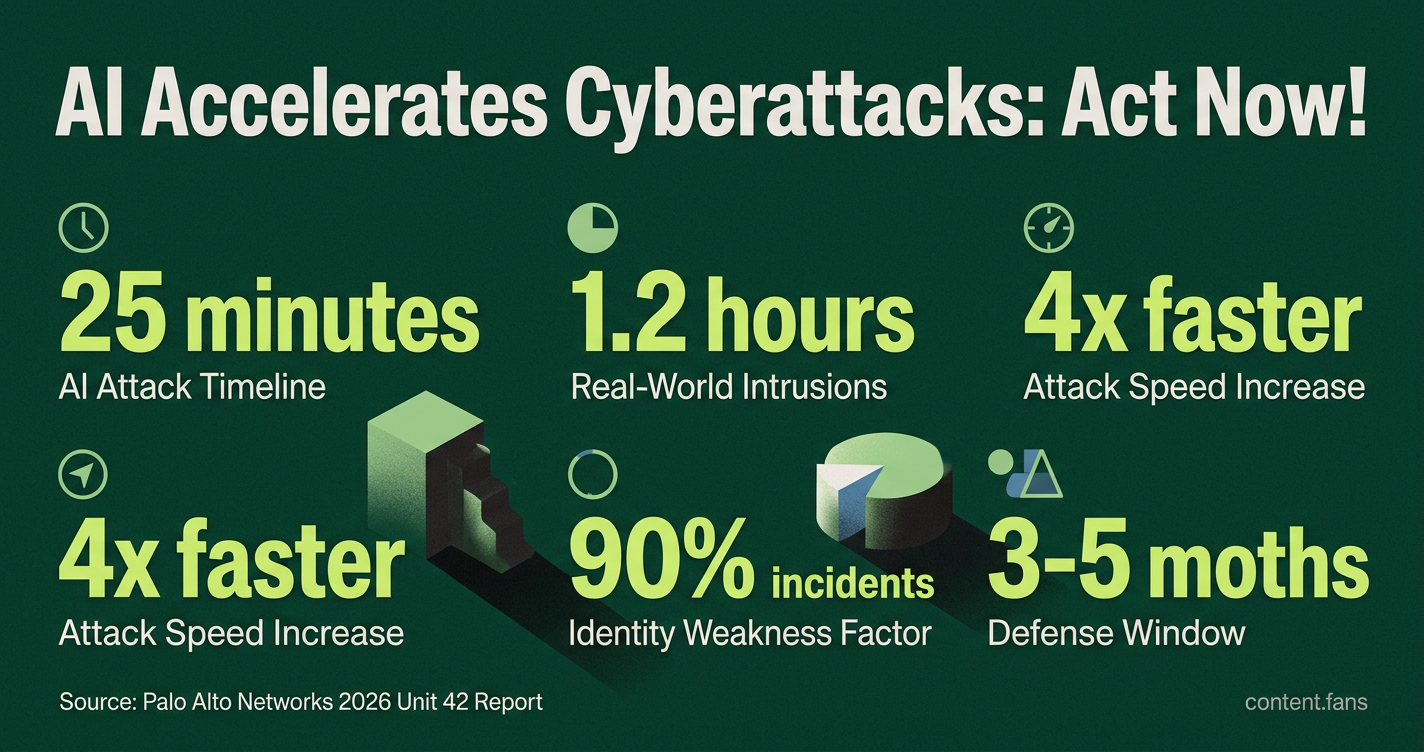
Recent findings from Palo Alto Networks confirm that AI cuts cyberattack timelines drastically, with simulated attacks achieving data theft in just 25 minutes. This acceleration is detailed in the 2026 Unit 42 Global Incident Response Report, which found the fastest real-world intrusions now take only 1.2 hours.
Security leaders are now in a race against time. According to Lee Klarich, Palo Alto Networks' CTO, defenders have a critical "three-to-five month window" before AI-driven attack methods become commonplace. This report examines the rapid evolution of AI threats and outlines the essential countermeasures security teams must implement now.
Compressed attack timelines
Artificial intelligence is dramatically increasing the speed and scale of cyberattacks. Malicious actors use AI to automate reconnaissance, discover vulnerabilities, and execute exploits faster than ever before. This reduces the time from initial breach to data theft, putting immense pressure on conventional corporate defense strategies and timelines.
Key data points illustrate this new reality: Palo Alto Networks reports attacks are 4x faster overall; specific exfiltration data shows 72-minute timelines but no quadrupling metric is provided in sources, and identity-based weaknesses were a factor in 90% of incidents. Industry reports suggest attackers can find and weaponize flaws faster than most organizations can apply patches.
Frontier models accelerate capability
The UK's AI Safety Institute (AISI) is tracking significant growth in AI's offensive capabilities. According to its capability analysis, the complexity of cyber tasks that AI can autonomously complete is advancing rapidly. Frontier models are already solving complex network challenges that previously required extensive human expert time, demonstrating clear and rapid advancement.
Operational strain inside SOCs
Security Operations Centers (SOCs) are already under significant pressure, with teams handling thousands of alerts daily and wasting substantial time on false positives. While defensive AI tools can significantly reduce detection time and manual work, their adoption remains limited, leaving many organizations at a disadvantage.
Immediate defensive priorities
With the disclosure-to-exploit window shrinking from years to hours, experts recommend focusing on four immediate priorities within the next three to five months:
- Harden Identity: Implement phishing-resistant authentication and actively monitor for credential and token misuse.
- Accelerate Patching: Reduce patch deployment times for internet-facing systems from weeks to days.
- Maintain Continuous Asset Mapping: Eliminate blind spots by continuously discovering and tracking all network assets.
- Conduct AI-Driven Drills: Rehearse incident response using realistic AI-assisted attack scenarios and measure performance with strict service-level objectives (SLOs).
AISI's findings reinforce this urgency, and the institute cautions that current tests may even understate real-world AI capabilities as the technology continues to mature.
Autonomous agents: new insider risk
Looking ahead, Palo Alto Networks identifies autonomous AI agents as a significant emerging insider threat. These agents, which can outnumber human employees and possess extensive system privileges, create a new attack surface. Industry reports suggest that many of today's security tools are incapable of detecting a compromised agent operating and moving laterally across a network autonomously.
While the ultimate trajectory of AI in cyber warfare is unknown, the trend is undeniable: attacker velocity is increasing while defender response times are shrinking. Organizations that delay their preparation risk confronting sophisticated, AI-powered attacks with outdated, ineffective defenses.
How fast are AI-driven attacks really moving?
According to industry reports, simulated AI-assisted intrusions can reach data exfiltration in remarkably short timeframes. The fastest real-world incidents tracked by security researchers show significant acceleration in attack speeds. The message is blunt: operator time is no longer the bottleneck; parallel AI reconnaissance lets criminals probe hundreds of targets at once and strike wherever they find a weak signal.
Which frontier models are showing up in incident data?
Security analysts report that advanced AI models are increasingly appearing in threat-intelligence discussions, with attackers benchmarking new language models as routinely as they once tested exploit kits.
What security incidents highlight AI threats?
Industry reports describe cases where threat actors have used AI to generate sophisticated exploits, including attempts at mass exploitation events. These incidents demonstrate how AI can accelerate the creation of attack tools and bypass traditional security measures.
Why do experts emphasize urgency?
Security researchers indicate that the capabilities of AI models in cyber tasks are advancing rapidly. Capabilities that previously required extensive human expertise are now within reach of AI systems operating on corporate networks. If current trends continue, fully autonomous end-to-end attacks could emerge in the coming years, compressing defender reaction windows significantly.
What should security teams do right now?
Palo Alto Networks puts the actionable horizon at three to five months. Priority moves that show measurable impact in customer environments:
1. Harden identity - identity-based weaknesses are involved in the vast majority of breaches
2. Patch inside days, not months - disclosure-to-exploit times have fallen dramatically
3. Deploy AI-augmented SOC tooling - early adopters report significant improvements in detection speed and reduced manual work
4. Write and rehearse playbooks against AI-agent insider scenarios; current security stacks struggle to detect compromised autonomous agents
5. Track readiness with SLOs so progress is visible to boards and partners
The race is no longer human vs. human - it is human + AI vs. AI. Defenders who integrate their own machine teammates today are the ones still standing tomorrow.