
NAD bans Ingenuity's 'brain health' claims on kids' snacks
Serge Bulaev
The National Advertising Division (NAD) found that some of Ingenuity Brands' brain health claims on kids' snacks were not supported by strong enough evidence. NAD allowed some statements like "supports immunity" but rejected claims such as "promotes brain health," saying the products did not have enough DHA to back up those claims. Regulators outside the U.S. have set clear DHA levels needed for brain health claims, but many U.S. snacks have lower amounts. This situation suggests companies may need more scientific proof before making similar health claims in the future. The Ingenuity case may also point to more focus on claims about cognitive or mood benefits in foods and drinks going forward.

Following the NAD's ban on Ingenuity's 'brain health' claims for kids' snacks, the food industry faces stricter rules for substantiating cognitive benefits. This ruling by the National Advertising Division (NAD) signals a new era of enforcement, demanding robust scientific evidence for any claim related to focus, memory, or brain development. This report provides an authoritative look at the case, its benchmarks, and the future of functional food marketing.
NAD case spotlights evidentiary demands
NAD found some nutrition-gap and immunity claims supported, but recommended discontinuing claims like 'promotes brain health' because the applesauce contained less DHA than the level in the cited studies. While some general health statements were allowed, specific 'brain health' promises were deemed unsupported by the low dosage levels compared to amounts used in clinical research studies.
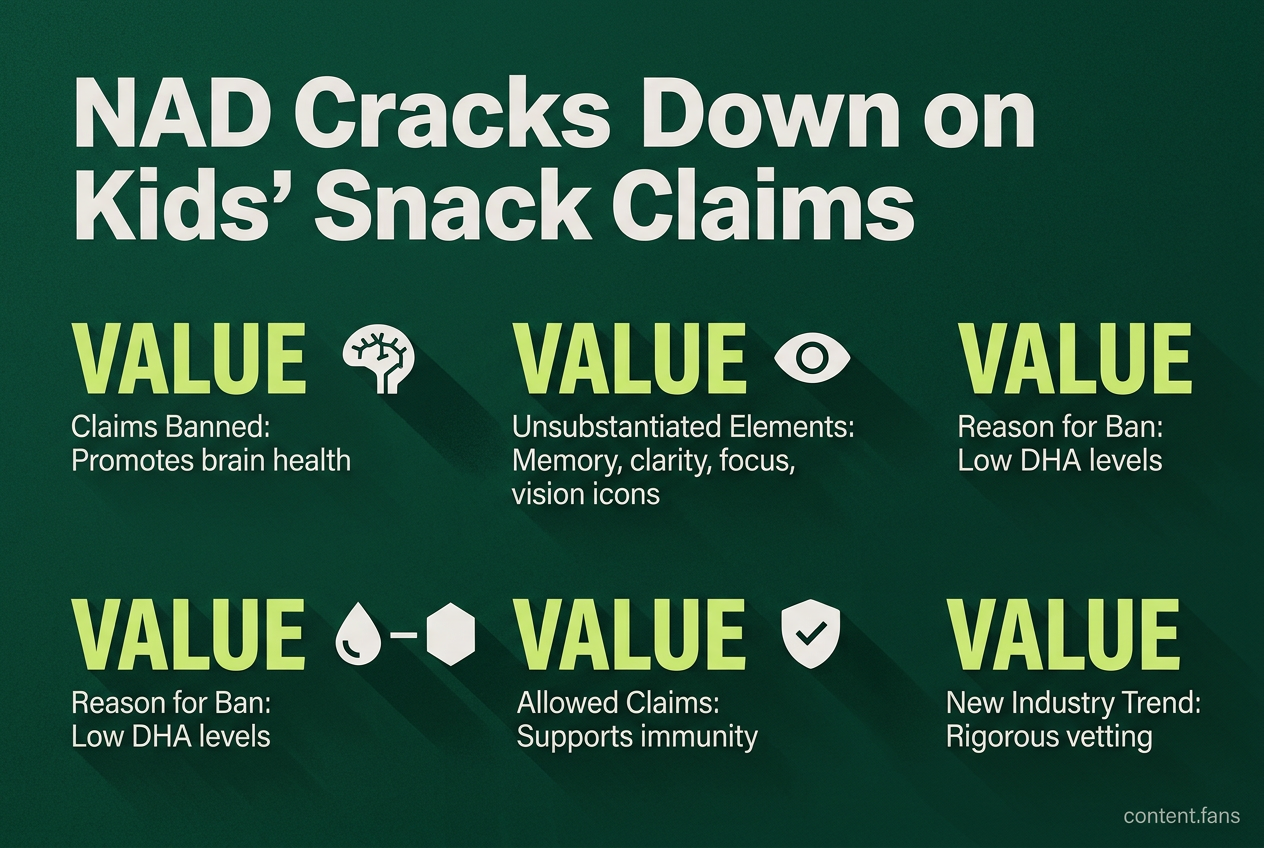
In its decision, NAD reviewed the complete marketing presentation for Ingenuity Brands' Brainiac line. NAD found reasonable basis for some claims like 'supports immunity' but determined other cognitive performance claims were unsupported and required modification. However, it rejected specific front-of-pack claims, including:
- "Promotes brain health" on applesauce pouches
- Icons representing "memory," "clarity," "focus," and "vision" on gummies
The NAD determined these phrases implied measurable cognitive benefits that were not substantiated by the product's low DHA levels. The ruling emphasized that all marketing elements - design, visuals, and text - contribute to an overall impression that requires competent and reliable scientific evidence.
Benchmarks for DHA levels
International regulators provide clear benchmarks for DHA dosage, which NAD often references. According to industry reports, regulatory authorities have established specific daily intake recommendations for brain health claims, with varying amounts for different age groups, as detailed in an assessment summarized by Omegor. Many U.S. snacks, including Ingenuity's, offer significantly less DHA per serving. This dosage gap is central to why the NAD is rejecting broad 'brain health' claims that lack substantiation at clinically recognized levels.
Claims audits become routine
The Ingenuity case is part of a broader trend of increased claims enforcement. Inquiries can be initiated by competitors, consumers, or NAD's own monitoring team. In response, brands are increasingly adopting new protocols to mitigate risk, including:
- Rigorous Vetting: Implementing pre-launch legal and R&D reviews of all claims.
- Strategic Reformulation: Adjusting products to meet nutrient levels established in scientific literature.
- Precise Language: Replacing ambiguous terms like "clean ingredients" with specific, verifiable descriptions.
NAD decisions consistently stress that claims must be supported by high-quality clinical data on the finished product. This ruling suggests future scrutiny will extend to other functional categories, such as mood and energy benefits in adaptogenic drinks, forcing brands to proactively align their evidence with regulatory precedent.
Which claims did NAD accept from Ingenuity Brands?
NAD agreed that Ingenuity could keep two statements:
- "Supports immunity" on the Brainiac Brain Squeezers Applesauce
- "Helps close the brain nutrition gap" on the broader Brainiac snack line
Both claims were backed by World Health Organization guidance on children's omega-3 shortfalls and supported by the product's vitamin and mineral profile.
Why did NAD reject the applesauce "promotes brain health" claim?
The core issue was DHA quantity. According to industry reports, regulatory guidelines recommend significant daily DHA intake for children to back a brain-development claim. Ingenuity's applesauce did not meet or come close to that clinically relevant dose, so NAD concluded the claim was unsubstantiated.
How does NAD decide what counts as a claim?
NAD reviews advertising "holistically", meaning it looks at:
- Front-of-pack buzzwords ("memory", "focus", "clarity")
- Visual cues (brain graphics, scientific icons)
- Category shorthand (anything a reasonable shopper would infer as a benefit)
If even the overall impression suggests a measurable cognitive benefit, the marketer must supply robust clinical evidence, not just general nutrition data.
What dosage of DHA is actually needed for a child brain-health claim?
According to industry reports, regulatory authorities have established minimum thresholds for DHA intake to support brain health claims in children, with different amounts recommended for various age groups. By comparison, international intakes vary widely, but regulators consistently point to established regulatory thresholds when reviewing cognitive claims.
What should food brands do next?
Following recent enforcement trends, companies should:
1. Audit every claim against NAD precedent and regulatory dosage levels
2. Reformulate or re-label if DHA or other actives fall short of clinically relevant amounts
3. Stop using vague terms like "clean ingredients" unless they are explicitly defined and proven
4. Create a disciplined substantiation workflow covering packaging, web copy, and social posts
Failure to comply not only invites NAD challenges but also ramps up class-action and state AG scrutiny across the US market.