
OpenClaw unveils persistent AI agent framework with MiniMax M3 support
Serge Bulaev
OpenClaw is a new open-source framework that lets AI agents remember past actions, plan, and use real computer tools with less human help. It can connect language models to apps like WhatsApp and Slack, and save memory so the agent recalls context between sessions. AI agent use in businesses may be growing, but most companies are still testing them instead of using them fully. Experts warn that always-on agents need strong safety controls, like limiting access and tracking actions. Reports suggest companies are interested but are cautious as they move from experiments to real deployments.

The concept of persistent AI agents is rapidly evolving from theory to reality. The new OpenClaw persistent AI agent framework exemplifies this shift, enabling agents that remember, plan, and execute tasks on real systems without constant human guidance. This report examines OpenClaw's architecture, current enterprise adoption trends, and the critical safety measures required for deploying these "always-on" systems.
OpenClaw: a living testbed for persistence
OpenClaw is a self-hosted, open-source framework connecting large language models (LLMs) to shell commands, browsers, and messaging platforms. Recent releases have introduced key governance features, MiniMax M3 model support, and primitives for multi-agent planning like Workboard orchestration. By storing persistent memory in local files or a plugin state layer, agents can maintain context across multiple sessions.
OpenClaw is an open-source framework for building persistent AI agents that remember past interactions, plan complex tasks, and use real computer tools. It connects large language models to everyday applications and system commands, enabling them to operate autonomously and bridge the gap between conversation and execution.
The framework's core capabilities include:
- Scheduled or heartbeat execution for continuous operation.
- Sandboxed file system access (read, write, delete).
- Connectors for Slack, WhatsApp, Discord, Telegram, and more.
- Agnostic support for models like GPT, Gemini, Claude, and MiniMax M3.
These features realize the vision of an autonomous agent that remains active, manages long-term tasks, and interacts with real-world tools beyond simple conversation.
Enterprise appetite and the adoption gap
Industry reports indicate significant growth projected for the AI agent market over the coming years. Analysts suggest that a substantial portion of enterprise applications could embed agents in the near future, representing a massive leap from current adoption levels.
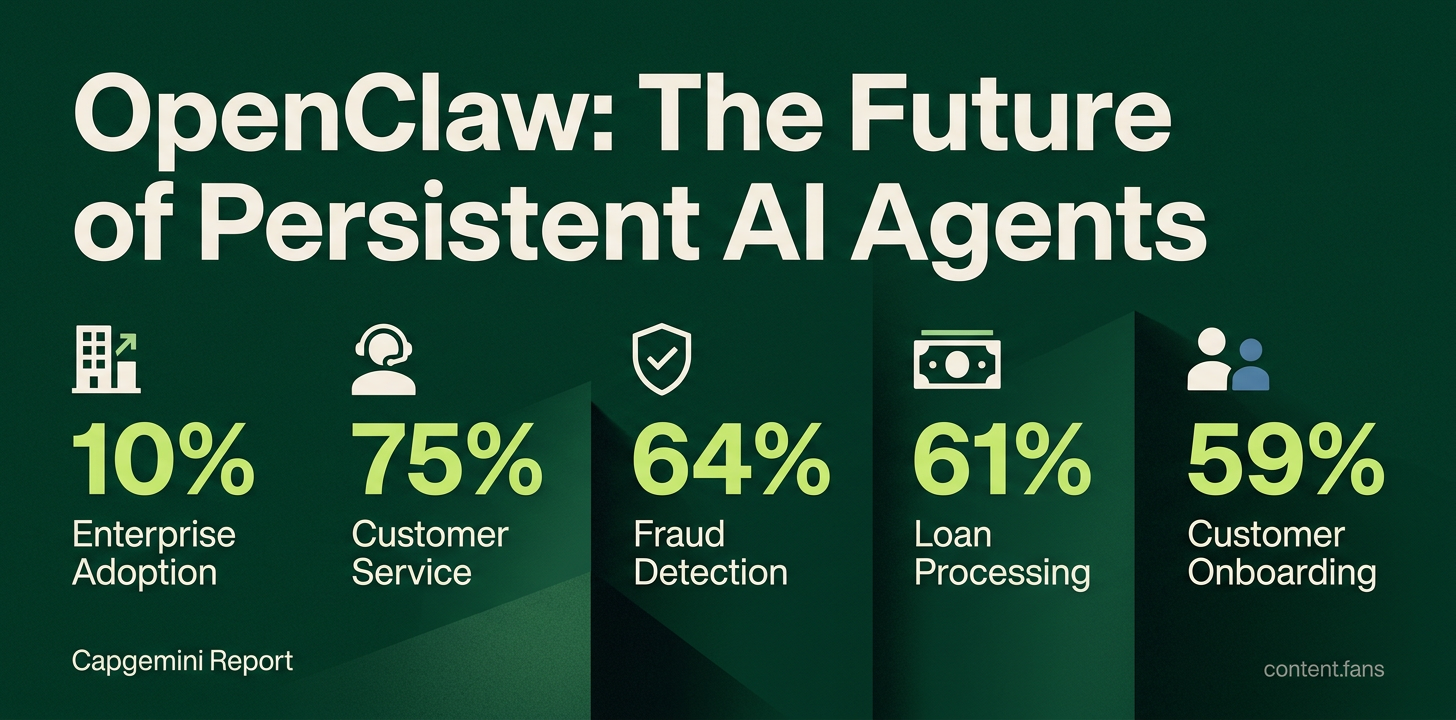
However, adoption remains uneven. While many companies are experimenting with agents, only a small fraction have deployed them in production. Capgemini reports customer service (75%), fraud detection (64%), loan processing (61%), and customer onboarding (59%) as the top processes, and says only 10% of surveyed firms have implemented AI agents at scale. This data reveals a market characterized by high enthusiasm but cautious implementation, especially for agents with autonomous system access.
Safety and governance for always-on agents
As persistent agents evolve, security experts caution they blur the line between automated software and a digital employee, demanding robust governance. Recommended controls focus on seven key areas:
- Unique agent identities with short-lived, scoped credentials.
- Least-privilege access to tools, directories, and APIs.
- Sandboxed execution environments that isolate network and file operations.
- Segmented memory stores with provenance tags, expiration policies, and periodic purges.
- Runtime policy enforcement to block prompt injection, data exfiltration, and unsafe chaining.
- Immutable audit logs covering every prompt, tool call, memory write, and file action.
- Continuous red-teaming and automated test suites wired into CI pipelines.
Experts emphasize that these guardrails must be built into the agent platform, not added as optional plugins. To ensure accountability, every agent action should be mapped to a human sponsor.
Persistent Agents - Always-On Agent Architectures: where work begins today
Current trends indicate a measured but decisive rollout of persistent agents. While frameworks like OpenClaw prove the technology is ready, market data reveals a significant gap between experimentation and production. The consensus from security experts is clear: robust sandboxing, least-privilege access, and comprehensive auditing are non-negotiable foundations for any agent that maintains state and interacts with live systems.
What exactly is a "persistent" AI agent, and how does OpenClaw embody that idea?
A persistent agent is stateful: it remembers context across days, keeps long-running plans in memory, and can resume work after you close the chat window.
OpenClaw demonstrates this concept through:
- Running on a continuous heartbeat instead of waiting for a prompt
- Storing user preferences and intermediate results in plugin state management
- Using orchestration capabilities to coordinate multi-step, multi-day workflows without human prompting each morning
Recent builds allow the agent to pick up where it left off after a container restart, turning ephemeral tasks into reliable background jobs.
How does OpenClaw let the agent access real tools and files safely?
OpenClaw was designed to bridge the gap between LLM capabilities and real-world action while maintaining safety:
- Filesystem sandboxing - agents can read/write only inside a user-defined workspace
- Scoped API credentials - each plugin receives short-lived tokens that expire after the task
- Approval gates for destructive commands such as
rm -rfor mass email sends - Immutable audit logs that record every file touch, shell command, and network request
Production deployments emphasize logging every interaction in append-only storage to meet compliance requirements - a practical example of the strong permissioning approach recommended by security experts.
Which kinds of enterprises are moving persistent agents into production right now?
According to industry reports, a small but growing number of organizations have scaled AI agents to full production, with early movers concentrated in:
- Banking & insurance - Capgemini reports that 75% of banks and 70% of insurers have deployed AI agents in customer service, using agents for overnight compliance checks and end-of-day reconciliation
- Customer-support centers - A significant portion of large enterprises now rely on agents for first-line ticket triage, with many inquiries resolved without human hand-off
- Software-engineering teams - OpenClaw is being tested at several Fortune 500 companies as a nightly CI/CD helper that reads logs, patches minor bugs, and opens pull requests before engineers arrive
Industry forecasts suggest that a substantial portion of enterprise applications will embed task-specific agents in the coming years, representing a significant jump that underscores the experimentation-to-production gap closing.
What new capabilities are available in recent OpenClaw releases?
Recent releases have made OpenClaw more like a structured agent platform than a script runner:
| Feature | Benefit |
|---|---|
| Skill Workshop (governed UI) | Lets non-engineers install or tweak skills without touching YAML |
| Workboard orchestration | Enables multi-agent planning so one agent can hand off sub-tasks to others |
| Native tablet support | Turns tablets into portable agent dashboards for field service teams |
| MiniMax M3 provider | Adds a cost-efficient Chinese-language model already tuned for function-calling |
| Enhanced plugin state | Improves memory persistence across container restarts or crashes |
Early adopters report that orchestration capabilities have significantly reduced their multi-day onboarding workflows to autonomous operations, illustrating how persistent planning loops reduce manual effort.
How should companies govern persistent agents that hold long-term memory and file access?
Security teams treat persistent agents as high-risk software actors:
- Identity & permissions - give each agent its own identity and use least-privilege scopes
- Memory governance - store memories in an access-controlled table, expire sensitive entries daily, and log provenance
- Runtime oversight - require human approval for bulk file deletes, external uploads, or API modifications above a risk score
- Continuous red-teaming - schedule automated attack simulations whenever the model weights or prompt templates change
- Immutable audit trail - append-only logs of every prompt, tool call, and memory read/write for post-incident forensics
Security experts emphasize that baseline guardrails must be built into the platforms themselves, not bolted on later. Following that principle helps bridge the experimentation-to-production gap without jeopardizing customer trust.