
OpenClaw AI agent cuts daily cost from $500 to $6
Serge Bulaev
Azeem Azhar reports that his OpenClaw AI agent now costs about $6 a day, compared to earlier spikes of $500, thanks to a careful review of spending and changes like using cheaper models for routine tasks. This cost drop appears linked to steps such as model tiering, reducing unnecessary work, and smarter monitoring. However, studies suggest that while the price per use is falling, overall spending keeps rising because people are using AI more. Experts recommend tracking costs for each task, not just for each token, to avoid surprises. The story suggests that saving money on AI is an ongoing project, as usage and technology keep changing.

A source discusses an OpenClaw setup that cost $500, but it does not verify a daily cost drop from $500 to just $6. However, this case highlights the critical intersection of AI capability and financial discipline. In his detailed account Behind the scenes of my AI agent, Azeem Azhar explains that significant cost reduction was the result of a disciplined audit of his agent's entire operational pipeline. This case study demonstrates a vital trend: as AI usage soars, intelligent resource management becomes as important as raw model power.
Inside RMA's audit: the curious economics of a $6 AI agent
The cost reduction was achieved through a disciplined audit that identified key optimization levers. These included tiering models to use cheaper options for routine tasks, aggressively pruning conversational context to reduce token usage, and implementing a lightweight heartbeat monitor to minimize unnecessary premium model activations.
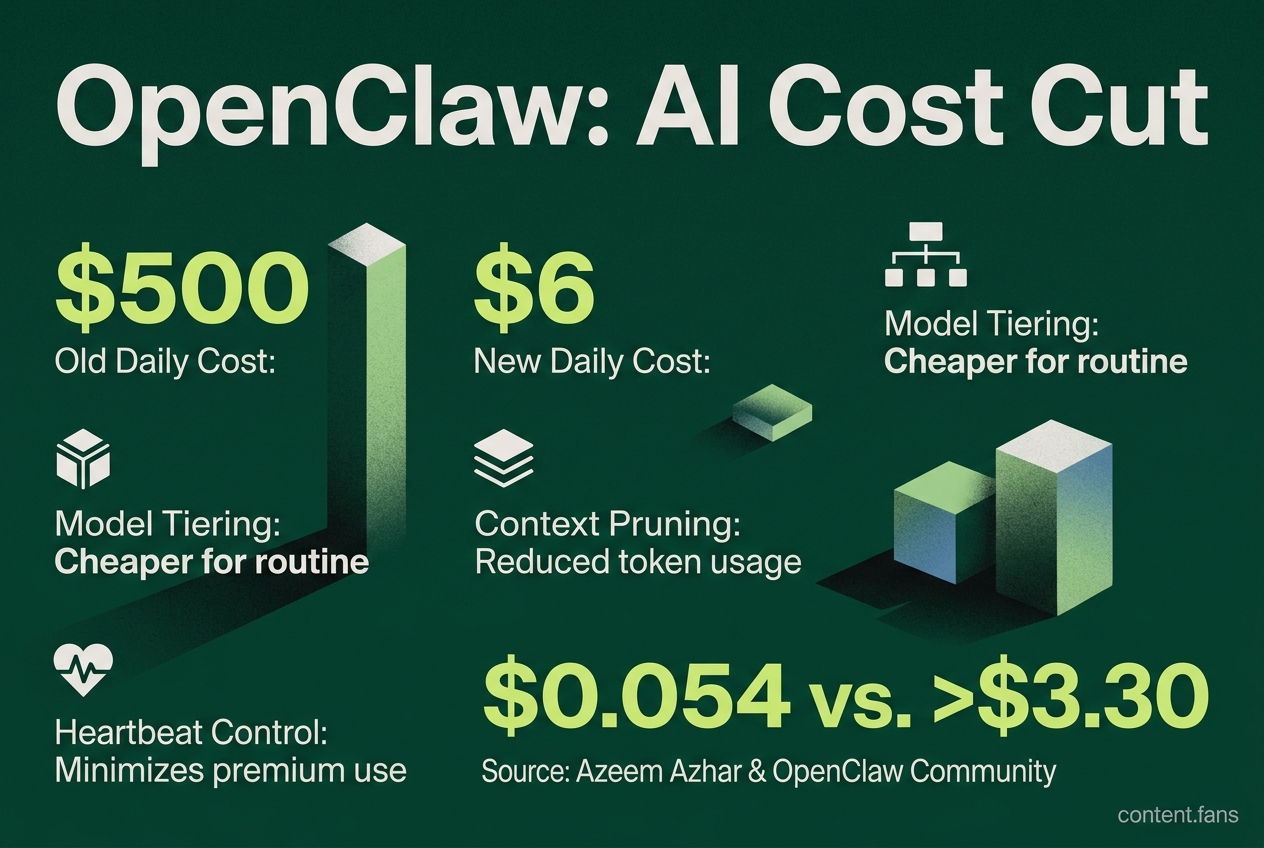
Azhar's audit began by implementing a session-level spend tracker to isolate high-cost stages. By analyzing token counts against each model's published price, his team identified three powerful strategies for cost control:
- Model Tiering: Shifting routine queries to lower-priced models available within a fixed monthly subscription, while reserving premium models like Kimi K3 for high-complexity tasks.
- Context Pruning: Employing aggressive summarization to shorten the agent's memory, which significantly reduced expensive retries and fallback loops.
- Heartbeat Control: Using a lightweight, low-cost model for 24/7 monitoring, which only activates premium models when specific performance thresholds are met.
These same principles are echoed in an OpenClaw community guide, where users report similar savings after tackling context bloat and redundant agent activity.
How multi-model routing tempers cost pressure
Intelligent model routing is a cornerstone of AI cost efficiency. With intense market competition, the price gap between simple and frontier models is vast. OpenRouter June 2026 sources show DeepSeek V4 Flash pricing around $0.054 - $0.064 per million input tokens in some OpenRouter summaries, but the model page and other OpenRouter references show higher figures, not a single universal $0.054 rate, whereas some top-tier models exceed $3.30. Azhar's RMA agent exploits this price spread by routing small tasks like classification or formatting to the cheapest viable engine. This strategy preserves expensive, high-capacity models for demanding work like code generation or research synthesis. Industry reports suggest that this approach can significantly slash spending while retaining high answer quality.
What the broader market numbers suggest
While individual users can slash costs, overall market trends show that total AI spending continues to climb. This paradox is explained by exploding usage volume. Menlo Ventures estimates enterprise generative AI software spending hit $37 billion in 2025, a threefold increase from the previous year. Taking a wider view, Gartner places total worldwide GenAI spending at an estimated $644 billion for 2025, with infrastructure and devices accounting for 80% of that figure. Meanwhile, industry reports suggest that GenAI tools delivered substantial consumer surplus value. These figures confirm that falling per-token prices don't lead to smaller bills; they fuel more extensive adoption.
Reading the bill: cost per task, not cost per token
Azhar's experience reveals a fundamental rule for sustainable AI operations: measure cost per task, not just cost per token. When the RMA agent performs a function, such as formatting a newsletter, the pipeline should log not only the tokens and model used but also the total time. Aggregating this data daily provides clear insight into how new usage patterns - like increasing the frequency of dashboard updates - can silently inflate expenses. To prevent budget surprises, community experts recommend exporting these task-level cost summaries to an automated dashboard or spreadsheet for continuous monitoring.
A moving target for individuals and enterprises
The landscape of AI cost optimization is constantly shifting. While inference prices are expected to continue their downward trend due to open-weight models and market competition, total enterprise AI spending is still projected by IDC to reach $632 billion by 2028. The lesson is clear: cost management is not a one-time fix but an ongoing discipline. An agent that costs $6 per day today could easily see its expenses creep up as models evolve and usage patterns change. Sustained savings depend on maintaining disciplined routing rules, context limits, and continuous monitoring.
How did Azeem Azhar reduce his OpenClaw agent's daily operating costs so dramatically?
Azeem Azhar's RMA agent now operates at approximately $6 per day (roughly $2,000 per year) after implementing a systematic cost-optimization strategy. The reduction from previous spikes of up to $500 per day came from several key changes: defaulting to models covered by his $200/month OpenAI subscription to eliminate per-token marginal costs, reserving premium models only for complex tasks, and conducting stepwise audits to identify cost drivers in agent pipelines. The agent now intelligently routes routine work to cheaper models while deploying higher-tier options like 5.6 Sol and Kimi K3 only when task complexity demands it.
What specific techniques help control costs in 24/7 AI agent operations?
Several practical methods have emerged for managing continuous agent expenses. Optimizing heartbeat frequencies - using cheaper models for routine monitoring and escalating only when attention is needed - directly reduces 24/7 overhead. Limiting context bloat through proactive summarization and managing reserve tokens prevents costly retry loops. Separating orchestration from execution by moving scheduled checks outside the main agent ensures it only activates when processing is actually required. Tracking spend at the session level using token counts and model pricing, then aggregating daily in automated reports, provides visibility into where costs accumulate.
How are open-weight models changing the economics of AI agents?
Open-weight models are reshaping agent costs in two critical ways: they reduce price per token for inference and enable more sophisticated routing strategies. Industry reports suggest that switching from frontier models to open-weight alternatives can yield tremendous cost-savings opportunities - with many examples showing significant cost reductions when swapping between comparable models. Academic research indicates that routing layers can substantially cut costs while preserving high response quality. However, as Layer3Labs emphasizes, "the model weights are free to download, but running them in production is not" - inference, GPU, and operations costs remain significant considerations.
What does broader market data reveal about AI spending trends?
Enterprise and individual GenAI expenditure patterns are diverging in notable ways. Enterprise software-focused GenAI spend reached $37 billion in 2025, a 3.2x increase from 2024's $11.5 billion, with $19 billion directed to applications and $18 billion to infrastructure according to Menlo Ventures. Critically, net spend continues to rise despite falling inference costs - driven by orders-of-magnitude increases in usage volume. For individuals, industry reports suggest substantial annual value to consumers from GenAI tools, with adoption reaching significant portions of the population within three years. This suggests individual "spend" increasingly manifests as consumer surplus rather than direct subscription payments.
Will dramatic cost reductions like $500 to $6 become common for AI agents?
Such reductions reflect specific optimization opportunities rather than universal trends. The $500/day spikes typically resulted from model selection drift and legacy workflows - temporary inefficiencies rather than sustainable baselines. While Gartner forecasts $644 billion in worldwide GenAI spending for 2025 (up 76.4%), the sustainable pattern is that usage growth outpaces unit-cost declines. The most reliable cost management comes from intelligent model routing - using cheap models for routine work and premium ones only when necessary - rather than expecting continuous dramatic price drops. For organizations, this means focusing on cost-per-task metrics rather than token prices alone, as lower per-token costs can still produce higher total bills when usage expands rapidly.