
OpenAI's Sora shutdown reveals $1 million daily GPU burn
Serge Bulaev
OpenAI shut down its Sora project, which may have been using about $1 million in GPU costs per day. This move suggests that investors want companies to focus expensive computing resources on projects with clearer ways to make money. Experts now recommend that AI costs be managed throughout the model's life, from picking the right use case to watching spending after launch. Suggestions include using smaller models, optimizing training, and strict governance to link spending to business value. Companies may also save money by using a mix of different cloud computing options and closely monitoring which projects to invest in.

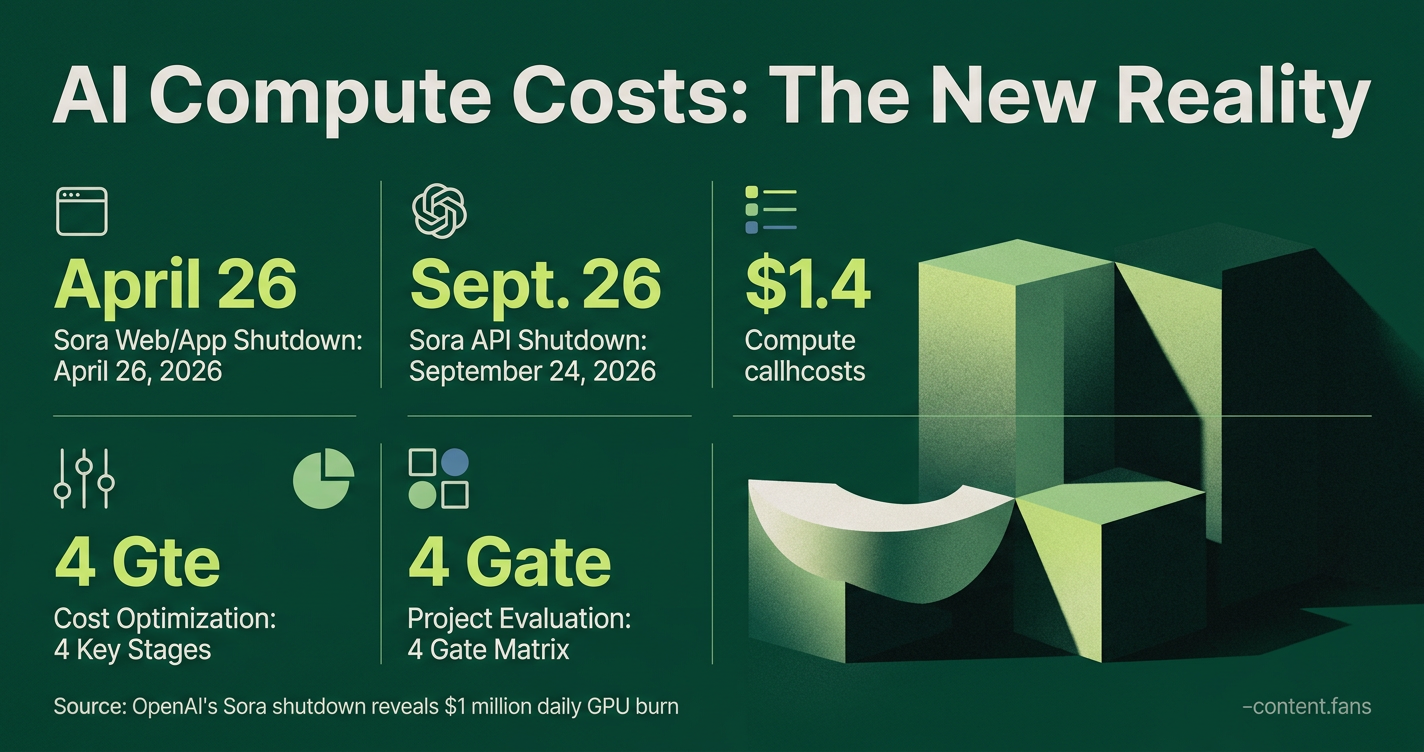
OpenAI's Sora web and app experiences were discontinued on April 26, 2026, and the API is scheduled for discontinuation on September 24, 2026; OpenAI says it needed to make trade-offs on products with high compute costs. This decision highlights a critical shift in the AI industry. As GPU costs skyrocket, engineering leaders are urgently seeking strategies to manage server expenses and align model roadmaps with clear business value. This brief outlines key tactics enterprises are adopting to control AI spending without sacrificing innovation.
Compute spending signals
The discontinuation of OpenAI's Sora on April 26, 2026, was a strategic move to reallocate GPU capacity due to high compute costs. This decision signals a growing investor preference for directing expensive, scarce accelerators toward projects with clear monetization strategies. While hyperscaler capital expenditures continue to grow significantly, this portfolio shift indicates a greater focus on unit economics and financial discipline.
Enterprises are managing staggering AI compute costs by adopting a lifecycle approach. This involves right-sizing models for specific use cases, implementing efficient training techniques, and establishing strict FinOps governance to ensure that all spending is directly tied to measurable business value and return on investment.
Cost-aware model lifecycle
Treating AI cost as a full lifecycle challenge, not just a procurement issue, is critical for sustainable scaling. Following guidance for Generative AI cost optimization, leading practitioners break down cost-saving actions into four key stages of model development and deployment:
- Use case definition and model right-sizing
- Data cleansing and deduplication before training
- Training efficiency techniques such as mixed precision and checkpointing
- FinOps governance for deployment and monitoring
Prioritization checklist for model work
To effectively triage AI initiatives and allocate resources wisely, CTOs can use the following stage-gate matrix to evaluate project viability.
| Gate | Approve when | Decline when |
|---|---|---|
| Intake | Objective aligns with a revenue or risk KPI | Use case lacks named owner |
| Design | Smaller pretrained model plus PEFT meets KPI | Only full pretraining is requested |
| Pre-prod | Pilot shows cost per inference on track | Latency or accuracy gaps require 10x larger model |
| Post-launch | Unit cost falls or stays flat at scale | Spend grows faster than usage |
Hybrid cloud procurement
Strategic cloud procurement offers immediate savings. Utilizing spot instances and reserved blocks can significantly reduce costs, while fine-tuning techniques like LoRA or QLoRA can substantially cut training expenses compared to pretraining from scratch. A common best practice is a hybrid cloud strategy: running intermittent research workloads on low-cost spot instances while dedicating reserved GPU clusters for consistent, production-level inference.
Governance that links risk and spend
A robust governance framework is essential for linking AI risk management with financial oversight. Many enterprises are adopting a stage-gated, risk-tiered model aligned with the NIST AI RMF. Key controls include maintaining a complete model inventory, classifying models by risk, requiring budget approvals at each stage gate, and continuously monitoring for performance drift and cost anomalies in production. Crucially, every AI project must be tied to a specific business KPI and have a pre-defined exit strategy if it fails to deliver value.
Managing Server Costs and Prioritizing Model Roadmaps
To prioritize which projects receive funding, establish a cross-functional review board to score proposals based on expected business impact, payback period, unit economics, and opportunity cost. Projects that don't meet the criteria should be declined, with resources redirected toward retraining proven models or exploring parameter-efficient tuning. Implementing practical controls like daily token limits, automated early stopping, and detailed experiment tracking maintains research velocity while preventing budget overruns. When engineering teams assign a dollar cost to each training step, it becomes easier to justify budgets and eliminate non-essential work.