
OpenAI's IPO Faces Delays Amid Governance and Microsoft Contract Debates
Serge Bulaev
OpenAI's initial public offering may be delayed because of complex business relationships and governance questions.

The anticipated OpenAI IPO faces significant delays due to its complex governance structure and deep contractual ties with Microsoft. Analysts warn that this nonprofit-for-profit hybrid model, combined with an intricate cap table, presents major hurdles for a public listing.
Hybrid governance tensions
OpenAI operates as a public-benefit corporation, but its nonprofit foundation retains veto power over major strategic decisions. According to industry reports, this hybrid model has drawn criticism for potentially creating conflicts between mission-driven goals and shareholder interests post-IPO.
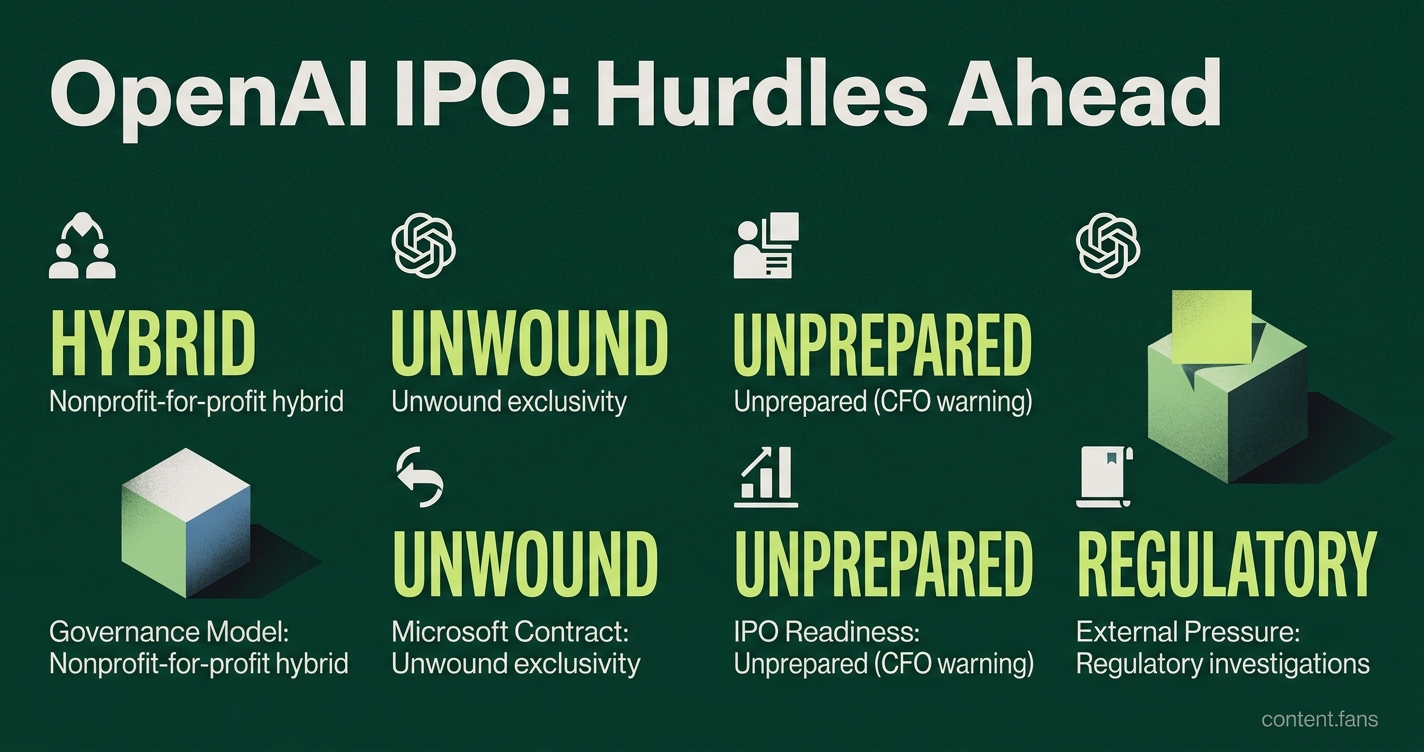
OpenAI's IPO is delayed by its unique nonprofit-for-profit structure, which gives a foundation veto power, and its deep financial reliance on Microsoft. These factors, alongside a complex cap table with multiple investor classes, create significant regulatory and disclosure challenges that must be resolved before a public offering.
Microsoft's deep involvement further complicates matters. According to industry reports, the tech giant holds a significant stake in OpenAI's for-profit arm, maintains a non-voting board observer seat, and serves as the primary cloud provider. Standardizing terms for multiple distinct investor classes - including Microsoft, employees, and various funds - is a critical prerequisite for any SEC filing.
Contractual knots with Microsoft
Historically, OpenAI's reliance on Microsoft Azure was governed by exclusive revenue-sharing agreements. The two firms unwound key exclusivity clauses in an amended agreement finalized in late April 2026 to reduce concentration risk, though this move has created uncertainty around future cost structures. Consequently, any S-1 filing will need to detail these updated terms, as investors will closely scrutinize profit margins against cloud expenditures.
Internal readiness debates
According to industry reports, internal disagreements signal a lack of IPO readiness. CFO Sarah Friar has reportedly warned that OpenAI is unprepared for a public offering due to slowing revenue and massive planned data-center expenses. This reportedly clashes with leadership's push for an earlier listing timeline, exposing strategic differences over the company's financial stability and internal controls. Industry sources suggest the need for audited financials to meet public-company standards remains a priority.
External legal and regulatory pressure
According to industry reports, legal challenges regarding OpenAI's governance have brought the company's transparency under public scrutiny. The company also faces mounting external pressures, including ongoing regulatory investigations and copyright lawsuits, which significantly increase compliance costs and will heavily influence the risk disclosures in any future prospectus.
• Key external risks that industry observers monitor:
- Ongoing regulatory investigations into market practices
- US litigation on training-data copyright
- Potential AI-safety regulations that could raise operating costs
Timing window and valuation debate
Given the unresolved complexities in its cap table, pending cloud contract revisions, and the need for sustainable revenue to justify massive infrastructure spending, many market watchers believe an IPO in the near term faces significant challenges.
Reporting from Cory Weinberg and Erin Woo highlights that while OpenAI has a lean balance sheet, its intertwined corporate relationships make its financials highly unusual (The Information). They suggest investors will likely demand a valuation discount until greater clarity on its corporate structure is provided.
Ultimately, OpenAI's public-benefit status, while protecting its mission, creates uncertainty for investors about cash-flow allocation. Without simplified governance and reduced dependence on Microsoft, Wall Street may view the company less as a high-growth AI leader and more as a complex regulatory puzzle.
What makes OpenAI's governance structure a roadblock to going public?
OpenAI still operates under a hybrid nonprofit-for-profit model: the original nonprofit foundation retains a significant stake and veto power over strategic decisions, while the capped-profit public-benefit corporation houses the commercial business. Analysts warn this creates a "delicate balance between innovation and sustainability" that clashes with public-market expectations. The complex cap table further includes multiple distinct share classes (from Microsoft, various funds, and employee equity), making the standardization required for an SEC filing a multi-year exercise.
How does Microsoft's stake and cloud contract limit independence?
According to industry reports, Microsoft owns a substantial portion of OpenAI's for-profit arm, sits on its board (albeit as a non-voting observer) and serves as the exclusive cloud-compute provider under a multibillion-dollar revenue-share agreement. In April 2026 the two companies ended key exclusivity clauses, but OpenAI still relies heavily on Azure credits and substantial annual GPU spending. Regulators worry this interdependency will force complex disclosure on pricing, data sharing and future commitments in any S-1 filing.
Why did CFO Sarah Friar reportedly push back on an accelerated IPO timeline?
According to industry reports, CFO Sarah Friar has warned that internal controls, revenue transparency and cap-table clarity may still be below public-company standards, potentially conflicting with leadership's goals for an earlier listing. Industry sources suggest that concerns about revenue growth and substantial infrastructure commitments could impact investor reception, leading to challenging IPO conditions or forced postponement.
What regulatory and litigation risks have emerged?
According to industry reports, legal challenges over governance, IP and the shift from nonprofit to for-profit have brought scrutiny to OpenAI's corporate structure. Meanwhile, regulatory investigations into the Microsoft partnership and copyright suits from publishers remain active. Industry observers suggest legal reserves and compliance costs represent a significant expense consideration for potential IPO investors.
When do industry experts expect OpenAI to actually go public?
After considering governance fixes, cap-table standardization and legal cleanup, many industry observers suggest the timeline may extend well into the future. According to industry reports, the path to a public offering may require substantial additional preparation time to address these complex structural challenges.